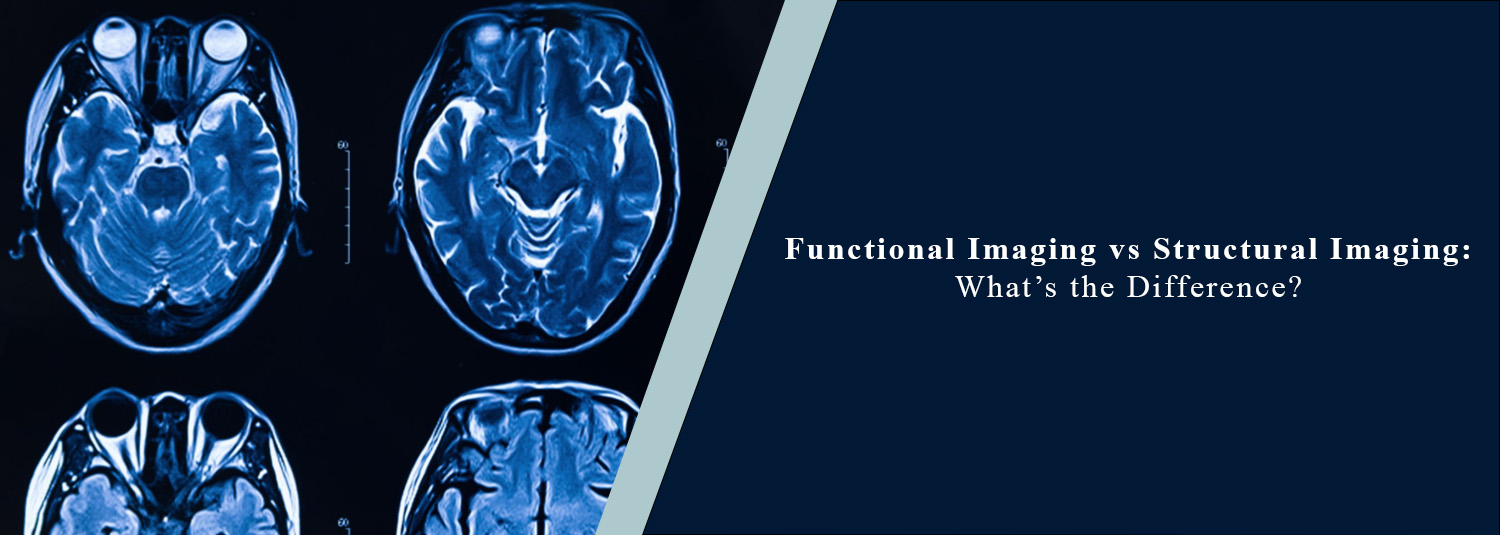
Functional Imaging vs Structural Imaging: What’s the Difference?
Talk to Health Expert

Dr. Nikunj Jain
Co-Founder and HOD - Nuclear Medicine ,MBBS, DRM, DNB, FEBNM, FANMB, Dip. CBNC
The pathway to diagnosis and knowledge about disease has been revolutionized by medical imaging. Imaging tests may be used to help doctors see what's happening in the body and pinpoint the cause of the symptoms without requiring surgery. Not all imaging tests provide the same type of information, though.
Some imaging tests provide only information concerning the configuration of an organ or tissue, and others provide information on the function of an organ or tissue. Now that's where functional imaging gets important, different from structural imaging.
A simple explanation is that structural imaging provides information to the doctor about the structure of the body, whereas functional imaging gives information regarding the function going on in the body. For better diagnosis, both kinds of imaging can be used consecutively sometimes.
Today, with the development of molecular imaging and hybrid imaging, many types of information are being integrated during the same test procedure. At Molecular Diagnostics and Therapy, state-of-the-art diagnostic imaging medicine allows physicians to obtain useful information regarding the structure and function of the various organs.
What Is Structural Imaging? Structural imaging assists with examining how the organs, tissues, or parts of the body look. It can reveal the dimensions, configuration, location, and attributes of a specific region. Routine structural imaging is done using computed tomography (CT), magnetic resonance imaging (MRI), ultrasound, or X-rays.
A CT scan can, for instance, tell if there's a swelling, mass, stone, or physical irregularity present in the abdomen if the patient is experiencing abdominal discomfort. In the same way, the MRI can give a detailed image of the brain, spine, joints, and soft tissue. Doctors use structural imaging particularly to find changes in the body that can not be seen.
What Is Functional Imaging? Functional imaging methods emphasize the activity of a particular organ or tissues, not only its appearance. Structural scans do not necessarily show all body parts as normal, but they may be functioning abnormally. Additional information about these changes can be garnered from functional imaging.
A functional imaging test, for instance, can help to show blood flow in an organ, the effectiveness of kidney function, the flow of blood to the heart muscle, or the uptake of particular substances in any given tissue. Functional imaging is an integral part of nuclear medicine. Tracer measured in a tiny amount to indicate activity within the body.
How Is Functional Imaging Different From Structural Imaging? The key distinction between them is that each test offers a different sort of information. Structural imaging is used to find the answers to the questions of "What does this organ look like?" and "Is there some visible abnormality?
Answers questions that include, “How does this organ function?” or “Is there abnormal activity in this region?” A functional or molecular image scan, for instance, might give information regarding the activity of a tumour, or a CT scan about its size and shape. Hence, doctors resort to using both kinds of imaging tests in some instances.
What Is Molecular Imaging? Molecular imaging is an advanced diagnostic imaging technology that targets processes within cells and tissues. May provide insight into changes earlier than some structural changes can be seen. The body is treated with special substances that illuminate specific activity, called tracers.
One well-known example of molecular imaging is a PET scan. A radioactive substance is added to the body, and the location where the tracer deposits is picked up by a special scanner. This information can be important to understanding increased or unusual activity, and may be used to help in the diagnosis, treatment plan, and follow-up of cancer.
What Is Hybrid Imaging?
Hybrid imaging is the combination of two imaging modalities in one examination. For example, PET-CT is a common method used. PET can give information about the function or about the molecular nature, whereas CT gives detailed structural information. These images can then provide doctors with information on both the location of an abnormal area and any possible activity.
SPECT is another instance of a hybrid imaging modality. Integrates working data obtained from another imaging modality (SPECT) with structural data obtained from another imaging modality (CT). Hybrid imaging can consequently offer a more comprehensive picture than either imaging type.
Why Is Functional Imaging Important?
Structural imaging alone may not yield enough information; functional imaging could provide that information. For instance, one kidney may be a normal size and shape, but stop working. Doctors can use a functional scan to learn a bit more about how well the kidney is functioning.
In the same way, the heart can look all right on physical examination but lack blood supply to a portion of the heart muscle. A cardiac nuclear scan may give additional information on blood flow that can't be obtained from a cardiac structural test. This extra information may assist doctors to decide more effectively whether tests and treatment are needed.
Why Is Structural Imaging Important? Structural imaging is always a vital component of contemporary healthcare. It can easily detect physical changes like fractures, tumors, swelling, bleeding, stones, and organ/tissue changes. CT scans and MRIs can create very detailed images to assist your doctor in finding abnormalities and their size and shape. Many symptoms and conditions are the first line of investigation with structural imaging.
Can Both Types of Imaging Be Used Together? Yes. In many situations, using both functional and structural information can give doctors a better understanding of a patient's condition. For example, a PET-CT combines molecular information with detailed anatomical images. The PET part can show an area of increased activity, while the CT part can help identify its exact location and physical appearance. This combination can be particularly helpful in cancer care, where doctors may need to know both where a tumour is and how active it is.
Which Imaging Test Is Right for You? There is no single imaging test that is best for every patient. The right test depends on the symptoms, suspected condition, medical history, and information the doctor needs. For some problems, an X-ray or ultrasound may be enough. Other conditions may require CT or MRI. In certain cases, doctors may recommend functional imaging, molecular imaging, or hybrid imaging for additional information. Patients should not choose an imaging test based only on cost or convenience. The test should be selected according to the medical question that needs to be answered.
The Role of Diagnostic Imaging Modern diagnostic imaging provides doctors with several ways to examine the body. Structural imaging, functional imaging, molecular imaging, and hybrid imaging each have their own role. The goal is not simply to produce pictures but to provide useful information that can help doctors understand a patient's condition and plan appropriate care. At Molecular Diagnostics and Therapy, advanced imaging and nuclear medicine services are available to support accurate diagnosis and treatment planning. The appropriate imaging method is selected based on the patient's medical needs and the doctor's recommendation.
Conclusion There is one basic, fundamental distinction between functional imaging and structural imaging. Functional imaging gives information on the activity of the body's organs and tissues, while structural imaging gives information about the structure of the body. There is no right or wrong answer to either type. They can be complementary to each other, and they give information in various ways. Molecular imaging can yield information about activity at the cellular level, and hybrid imaging can integrate functional and structural information in one examination.
These various types of technology are in use today and are vital to helping physicians improve their understanding of disease and to identify changes, as well as helping them to plan treatment and monitor a patient over time. Advanced imaging technologies enable Molecular Diagnostics and Therapy to deliver precise and meaningful information that assists doctors in their decision-making process.
Frequently Asked Questions
In News
Get Our Mobile App
for Easy Access
Book tests, view reports, and manage your health records on the go. Experience convenient healthcare with Molecular Diagnostics and Therapy.
- ✔ Book tests & home collection
- ✔ View reports instantly
- ✔ Track health history
- ✔ Get notifications & reminders
- ✔ Easy appointment management