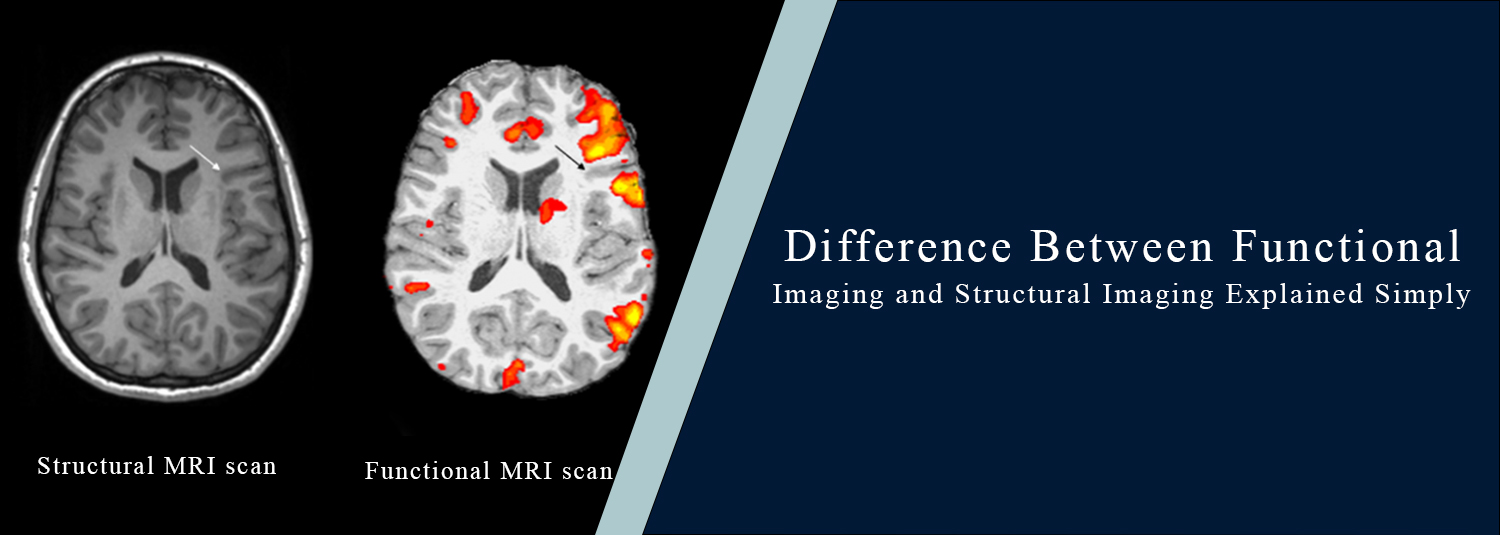
Difference Between Functional Imaging and Structural Imaging Explained Simply
Talk to Health Expert

Dr. Nikunj Jain
Co-Founder and HOD - Nuclear Medicine ,MBBS, DRM, DNB, FEBNM, FANMB, Dip. CBNC
Modern medicine relies on the use of imaging to identify and intervene in a diseased condition. Various scans are done to enable doctors to scan internally without surgery. There are two broad techniques, which include functional imaging and structural imaging.
Although they may sound technical, the difference between them is actually quite simple. Understanding this distinction can help you better appreciate how modern diagnosis works, and why some diseases are detected earlier than ever before.
What Is Structural Imaging?
Structural imaging examines the form and shape of the body. It provides clear images of organs, bones, and tissues, indicating their size and location. Think of it like a photo, as it captures a motionless photo of the body at any given time.
Common Types of Structural Imaging:
X-rays- applied to bones and fractures.
CT (Computed Tomography) scan- detailed cross-sectional X-rays.
MRI (Magnetic Resonance Imaging)- very detailed images of soft tissues.
What Does It Help Detect?
Structural imaging is best in the detection of:
Broken or fractured bones
Abnormalities of the tumor or growth (when noticeable).
Exceptional or interior trauma.
Alterations in organ sizes or shapes.
But it normally reveals ills when the body is already transformed. The disease should be so developed that it is noticed.
What Is Functional Imaging?
Functional imaging examines the body's dynamics. It not only reveals biological and chemical activity, but also what is occurring within the body. It is more like a video where one can see what the body does as it takes place.
Common Types of Functional Imaging:
PET (Positron Emission Tomography) scans.
SPECT (Single Photon Emission Computed Tomography)
They employ minute traces of radioactive tracers that circulate to their distinct organs and reflect their activity.
What Does It Help Detect?
Functional imaging can be of great use in particular:
Detecting cancer early
Determining cardiac blood flow.
The research on brain functioning and nervous disorders.
Observing cell metabolic alterations.
Being able to view the smallest level, the functional imaging detects issues before even large changes are manifested.
Key Differences Between Functional and Structural Imaging
Let’s simply compare them:
Why Doctors Use Both Together?
There is no best type of imaging over the other; on the contrary, the two are complementary to each other.
Structural imaging informs the physicians of the location of the issue.
Functional imaging is a description of what the problem is doing.
For example:
A CT scan may demonstrate that the body has a small lump.
The PET scan would help tell whether the lump is a cancerous (active) lump or not.
This blend provides the physicians with a whole picture, which results in a more precise diagnosis and treatment plan.
Importance of Early Disease Detection
Functional imaging is able to detect disease early, before the manifestation. The onset of cancer, heart disease, and brain disorders is often marked by small alterations in cell activity.
By detecting those changes at a young age, doctors can:
Start treatment sooner
Stringent disease prevention.
Increase survival and recovery rates.
In the meantime, structural imaging also assists in verifying results and locating the problem precisely and in its size.
The Future of Medical Imaging
As technology continues to get advanced, the functional and structural understanding of the image is becoming a blur. There are hybrid machines that carry both of them in a single scan, such as PET-CT and PET-MRI.
Combining these allows physicians to view structure and function simultaneously and identify the diagnosis more precisely and personally.
Conclusion
Simply put, the distinction between functional and structural imaging can be reduced to: form vs. function:
Structural imaging, the process, reveals the appearance of the body.
Functional imaging is a way of demonstrating the functionality of the body.
The two are vital in contemporary medicine, and they are vital in offering one effective way of diagnosing diseases at an early stage and curing them. Not only does knowing this difference make medical imaging less confusing, but it also illustrates how much medical care has achieved in terms of saving lives by diagnosing the condition early.
Frequently Asked Questions
In News
Get Our Mobile App
for Easy Access
Book tests, view reports, and manage your health records on the go. Experience convenient healthcare with Molecular Diagnostics and Therapy.
- ✔ Book tests & home collection
- ✔ View reports instantly
- ✔ Track health history
- ✔ Get notifications & reminders
- ✔ Easy appointment management