CT Angiography: How It Helps Diagnose Blood Vessel Diseases?
Talk to Health Expert

Dr. Nikunj Jain
Co-Founder and HOD - Nuclear Medicine ,MBBS, DRM, DNB, FEBNM, FANMB, Dip. CBNC
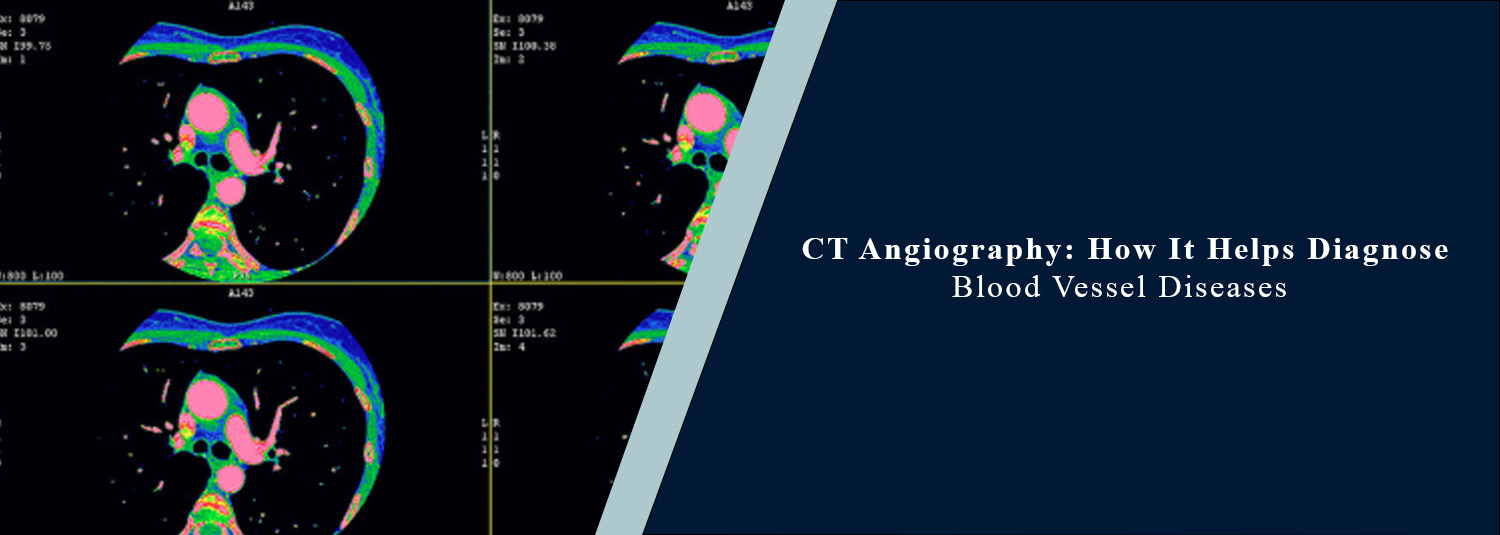
Blood vessels are crucial for delivering oxygen and nutrients to the body's cells. Poor circulation is associated with many health issues, such as heart attack, stroke, aneurysm, and peripheral artery disease, when the arteries and veins become narrowed, blocked, or damaged. Early detection is key for early intervention and improved health care outcomes. It is one of the most advanced imaging technologies available today, in which the doctor can watch blood vessels without going into the body, and it is not an invasive procedure; the doctor is not performing an invasive scan known as a CT angiography.
A computed tomography (CT) angiography to make high-resolution images of arteries and veins is performed while using contrast material. It helps doctors measure blood flow, identify problems, and determine the right way to treat them. A CT angiogram yields fast, reliable, and accurate EI in cases of the heart, brain, lung, kidney, or legs.
By combining with their highly trained radiology team and advanced CT imaging technology, Molecular Diagnostics and Therapy provides a precise and accurate CT angiography service that equips physicians with the information they need to make swift and accurate diagnoses and treatment plans.
What Is CT Angiography?
An advanced version of X-ray testing that uses a special dye injected into one of the veins and combines computer processing and X-ray technology to produce images of blood vessels in other parts of the body.
CT angiography has been useful because it is the only type of angiography that does not require inserting a catheter into an artery, but only into a vein in the arm. The contrast is injected into the blood as it circulates through the body; the CT scan obtains several detailed cross-sectional images that are then "reconstructed" to produce 3-D pictures of the blood vessels. These images help doctors determine if blood vessels are narrowed or blocked, if an aneurysm is present, if there is a blood clot, and if there are other abnormalities, with great ease and certainty.
Why Is a CT Angiography Test Recommended?
A CT angiography test is recommended when a doctor suspects diseases of the arteries or veins. This examination may be done for patients who suffer from chest pain, shortness of breath, severe headaches, dizziness, or leg pain as they walk, or from decreased blood circulation.
Most often, the test is ordered when doctors suspect pre-op blood supply or peripheral artery disease, to diagnose an aortic aneurysm, to detect narrowing of the blood vessels, to investigate a pulmonary embolism, or to evaluate the blood supply before surgery. The method is non-invasive, allows detailed images to be obtained quickly, and has become an important diagnostic tool in modern medicine.
What Is Coronary CT Angiography?
A common vascular imaging technique is called coronary CT angiography. This test is a specific test of the coronary arteries that feed blood into the heart muscle. When these arteries become narrow because of plaque, blood flow to the heart is reduced, which increases the risk of heart attack and angina.
CCTA can give doctors valuable information about whether there is coronary artery disease or not, whether heart-related symptoms are present, and whether the atherosclerosis requires other layers or further treatment. It is particularly valuable for people at moderate risk of heart disease, and can sometimes avoid the need for unnecessary invasive angiography.
Conditions Diagnosed with CT Angiography
A computed tomography angiogram can aid in the diagnosis of numerous vascular problems of the various parts of the body. These involve diseases of the coronary arteries, narrowing of the carotid arteries, brain aneurysms, abdominal aortic aneurysms, pulmonary embolism, peripheral artery disease, renal artery stenosis, vascular malformations, arterial blocks, and some congenital blood vessel abnormalities. The test also aids surgeons' planning for vascular surgery patients, as well as following patient progress in the time after surgery.
How Is the Procedure Performed?
An IV (intravenous) line is inserted into a vein in the arm before the procedure. During the test, this line is fed with a contrast dye. The patient is lying comfortably on the scanning table of the CT scan machine, which moves into the machine and takes multiple images in seconds.
While the contrast is being injected, patients might feel a bit of heat or taste a “metal” flavor. These feelings last only a short time and typically diminish rapidly. The total length of CT angiography takes about 15 to 30 minutes, though the time spent on CT scanning only takes a few seconds.
How Should You Prepare?
Preparation depends on the type of CT angiography that is being performed. There may be a period of hours when the patient is asked not to eat before the scan. Generally, people are advised to drink their water unless otherwise directed.
Individuals should notify the doctor of pregnancies, kidney disease, diabetes, allergies to any contrast dye, asthma, and/or medications being taken. Before taking contrast dyes, some blood and urine tests may be ordered to check the way the kidneys are working. High-quality images and minimised risk of complications can be obtained if all preparation instructions are followed.
Benefits of CT Angiography
A CT angiogram provides several benefits over many other previous imaging methods. The procedure is easily performed; it generates very detailed 3D images, scanning takes just a few minutes, and it enables doctors to assess blood vessels all over the body.
CT angiography offers very good visualization of the vascular anatomy, and therefore, this procedure can often detect the disease earlier, before it reaches the critical stage. Early diagnosis means treatment can commence sooner, thus improving the long-term outcomes, and the risk of life-threatening complications is minimal.
Are There Any Risks?
A CT scan is a medical imaging technique that, as with other X-ray techniques, exposes the body to a certain amount of radiation. In modern CT, however, advanced technology is employed to reduce radiation while still getting a very good image.
Rarely, there may be an allergic reaction to the dye given to the patient. Contrast is excreted by the kidneys, and patients with kidney disease need to be evaluated carefully before they can be given contrast. Your doctor decides if the advantages of the exam outweigh any risks involved.
Understanding the Results
After the scan, a radiologist carefully reviews the images for any abnormalities involving the blood vessels. Normal findings indicate healthy blood flow without significant narrowing or blockage. Abnormal findings may reveal plaque buildup, aneurysms, blood clots, arterial narrowing, vascular malformations, or other circulatory problems.
The results are shared with your treating physician, who explains the findings and recommends further treatment or additional investigations if required. At Molecular Diagnostics and Therapy, experienced radiologists provide accurate reporting to support confident clinical decision-making.
Conclusion
Enlightened by various advances, CT angiography has emerged as one of the most valuable imaging approaches in the diagnosis of blood vessel diseases, rapidly and accurately. This new-generation CT angiography test offers in-depth information, which can help doctors identify disease, even in the heart, in arteries to the brain and lungs, and in arteries of the kidneys or legs.
CT angiogram is a crucial tool for the diagnosis of vascular diseases, planning treatment, and monitoring vascular disease after treatment, without many of the risks involved with the traditional, invasive angiogram. The use of cutting-edge imaging technology can mean the difference between life and death for patients and help prevent future cardiovascular complications.
Molecular Diagnostics and Therapy takes pride in upholding these objectives with cutting-edge CT imaging systems; they have precise and accessible diagnostic and therapeutic support by experienced radiologists, and excellent healthcare quality.
Frequently Asked Questions
In News
Get Our Mobile App
for Easy Access
Book tests, view reports, and manage your health records on the go. Experience convenient healthcare with Molecular Diagnostics and Therapy.
- ✔ Book tests & home collection
- ✔ View reports instantly
- ✔ Track health history
- ✔ Get notifications & reminders
- ✔ Easy appointment management