When Is It Better Than an X-Ray?
Talk to Health Expert

Dr. Nikunj Jain
Co-Founder and HOD - Nuclear Medicine ,MBBS, DRM, DNB, FEBNM, FANMB, Dip. CBNC
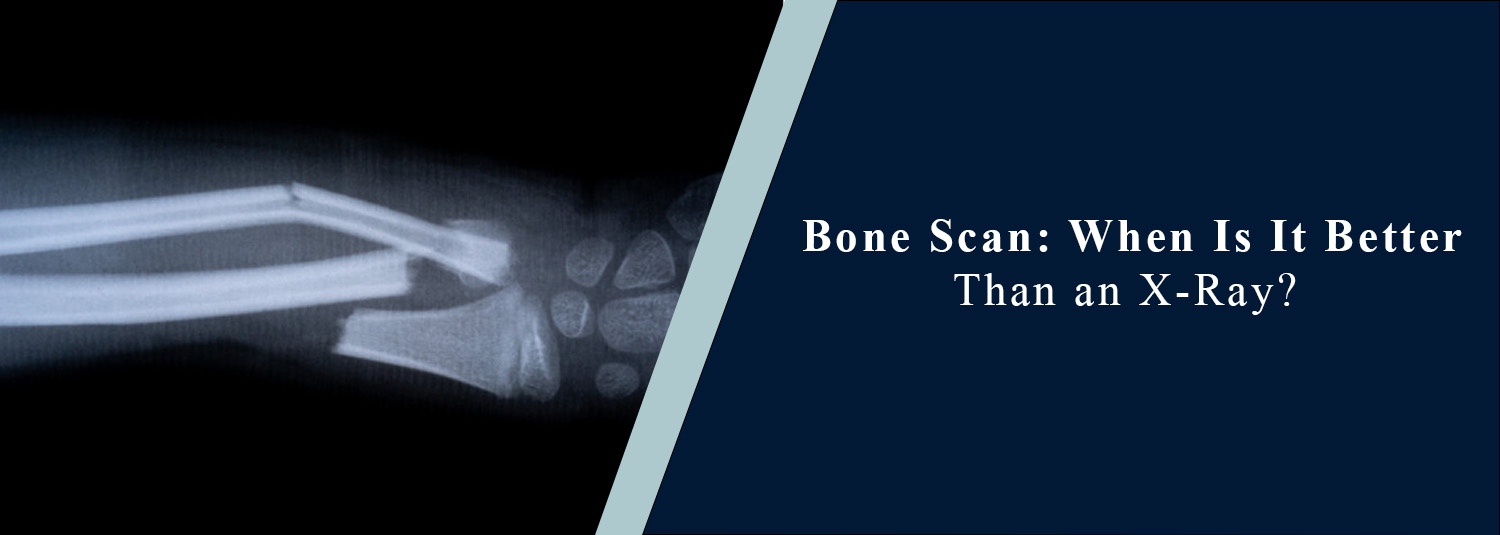
The health of bones is critical for mobility and health. Imaging tests are an essential part of diagnosis for doctors who suspect a bone injury, infection, arthritis, or cancer. The most popular imaging techniques are X-ray and bone scan. Each is useful for diagnosis, but with different uses and offers different kinds of information.
Many people think that an X-ray will uncover all the bone issues. But not always. A bone scan test may be better, as the following conditions may not show up on an X-ray in the early stages. Patients should be informed of the advantages of bone scans over X-rays and understand when a bone scan is beneficial.
With cutting-edge imaging and diagnostic procedures as part of their services, Molecular Diagnostics and Therapy offers accurate bone scan exams for the early detection and diagnosis of multiple bone conditions.
What Is a Bone Scan?
A bone scan is a nuclear medicine imaging procedure that examines bone metabolism and identifies bone changes that can be felt, but not seen on regular X-rays. As part of the procedure, a small amount of radioactive tracer is injected into the bloodstream. This tracer will localize in the bones and concentrate in areas of higher bone activity.
A special gamma camera then takes pictures of the skeleton to see where infection, bone breaks, tumors, arthritis, and other bone problems may be. Unlike an X-ray, which reflects on the structure of the bones, a bone scan gives information that reflects on the functioning of the bones.
What Is an X-Ray?
A bone scan is a nuclear medicine imaging procedure that examines bone metabolism and identifies bone changes that can be felt, but not seen on regular X-rays. As part of the procedure, a small amount of radioactive tracer is injected into the bloodstream. This tracer will localize in the bones and concentrate in areas of higher bone activity. A special gamma camera then takes pictures of the skeleton to see where infection, bone breaks, tumors, arthritis, and other bone problems may be.
Bone fractures
Joint dislocations
Bone deformities
Severe arthritis
Certain bone infections
In early stages of bone diseases, though, an X-ray may NOT always show the disease, particularly if there is no structural damage to the bone.
How Does a Bone Scan Differ from an X-Ray?
This is because an X-ray will give information about the structure of the bone, and a bone scan test will give information about what is happening within the bone.
Bone scans can give details of abnormal bone metabolism before these changes can become apparent on X-ray. This is particularly important for identifying diseases early. Both tests may be given together since they give complementary information to the physician.
When Is a Bone Scan Better Than an X-Ray?
A bone scan is recommended if the X-rays show that everything is fine, but the pain persists. It comes into special service for the diagnosis of a small stress fracture which does not show up on a routine X-ray.
Bone scans are also preferred when doctors suspect that cancer has spread to the bones. The scan can help identify the entire skeleton in one procedure and multiple problems. A bone scan might also be useful in diagnosing bone pain for people who still have soreness that has no known cause. Bone scans are usually used to find out the presence of:
Stress fractures
Bone infections
Bone tumors
Bone metastasis
Osteomyelitis
Unexplained bone pain
Early arthritis changes
Loosening of joint replacements
Molecular Diagnostics and Therapy uses cutting-edge imaging technology to deliver correct bone scan test results for early diagnosis and treatment planning.
Can a Bone Scan Detect Bone Cancer?
Yes. A bone scan is commonly administered to look for the spread of cancer from other organs of the body (metastases) in the bones.
The scan will not identify all types of cancer but will show if there is any abnormal bone activity, in which case a further investigation will be required using further imaging or biopsy. Early Identification allows the doctor to start palliative treatment at an earlier stage.
Is a Bone Scan Useful After an Injury?
However, in some patients, with no apparent abnormality on X-ray, symptoms persist. Under such conditions, tests such as a bone scan may be indicated to better identify unsuspected bone damage or very small "stress" fractures. Athletes and physically active people have a bone scan if they have a suspected overuse injury.
Is a Bone Scan Safe?
The actual procedure of a bone scan is usually safe for patients. The radioactive tracer is very radioactive, but only a little bit, and is generally excreted in the urine within 1-2 days. Patients are advised to drink lots of water following the scan to help ensure that the tracer is removed from the patient's system. All pregnant women should notify their physicians before having any nuclear medicine test.
What Happens During the Test?
The process starts with the radioactive tracer being injected into a vein. The patient rests on a beta scanning table, and after about two to four hours, when there is enough tracer in the bones, the images are captured in a gamma camera to get detailed images. Generally takes about 30-60 minutes and is not painful.
Bone Scan Test in Delhi, Ghaziabad, and Noida
Patients who are seeking the most reliable bone scan test in Delhi, bone scan test in Ghaziabad, or bone scan test in Noida should opt for a diagnostic center that has top-notch technology in Nuclear Medicine and has experienced professionals to research the bones.
They provide due diligence in bone scan services with modern imaging equipment to make assistance with accurate diagnosis of fractures, infections, arthritis, and bone cancers.
Conclusion
X-rays and bone scans have different uses and are different types of valuable tools to help diagnose. X-rays can be used to excellent advantage to reveal fractures and problems with the structure of bone, and a bone scan can give better detail of problems with bones in early stages of bone diseases, stress fractures, infections, arthritis, and cancer spread before the structure of bones shows signs of problems.
A bone scan is ordered when a patient continues to experience pain despite normal X-ray results or when information on the activity of the bone is needed. A patient needs to be diagnosed as early as possible for diagnosis, so that the treatment can be administered in time.
High-quality bone scan and bone scan test services in Delhi, Ghaziabad, and Noida are available at Molecular Diagnostic and Therapy, wherein their expert radiologists, along with advanced nuclear medicine imaging and reliable diagnostic services, assist them in diagnosing bone ailments with precision and maintaining good bone health.
Frequently Asked Questions
In News
Get Our Mobile App
for Easy Access
Book tests, view reports, and manage your health records on the go. Experience convenient healthcare with Molecular Diagnostics and Therapy.
- ✔ Book tests & home collection
- ✔ View reports instantly
- ✔ Track health history
- ✔ Get notifications & reminders
- ✔ Easy appointment management