What Happens Inside Your Body During a PET Scan?
Talk to Health Expert

Dr. Nikunj Jain
Co-Founder and HOD - Nuclear Medicine ,MBBS, DRM, DNB, FEBNM, FANMB, Dip. CBNC
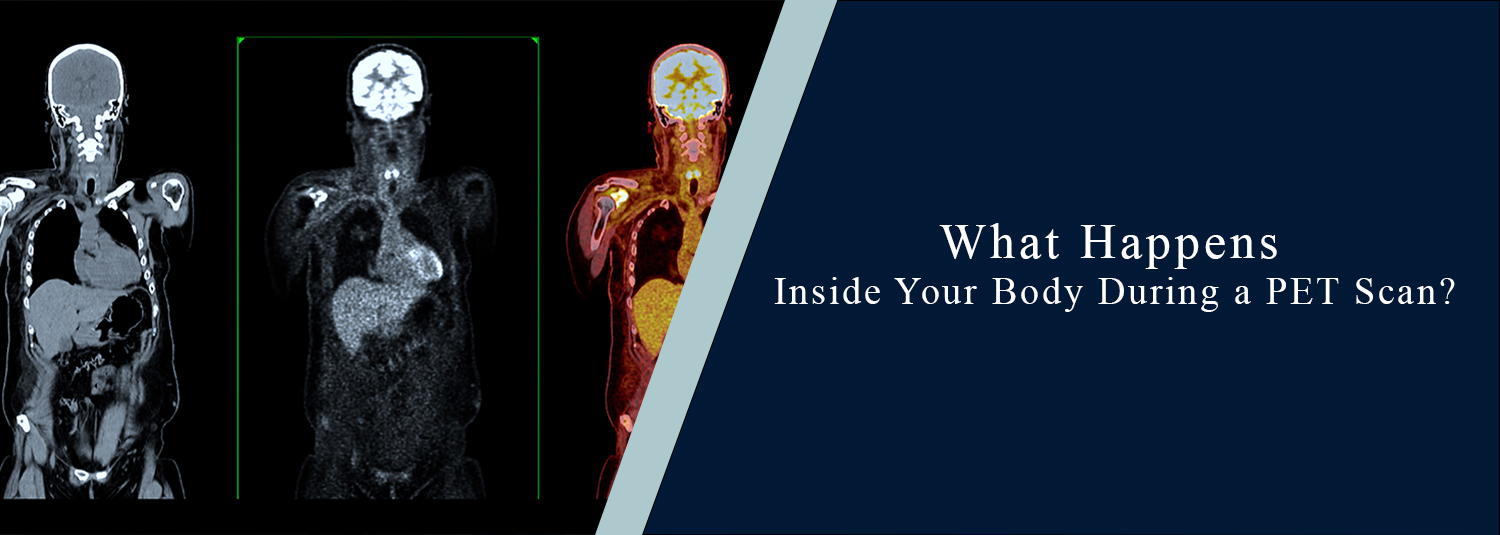
One of the most sophisticated methods through which doctors can capture images within the body includes a Positron Emission Tomography (PET) scan. All scans depict organs and bones, but a PET scan is a scan that indicates the manner in which the body is functioning at the cellular level. It assists physicians in the identification of disease early, monitoring the effectiveness of treatments, and understanding organ and tissue behavior.
But what actually happens inside your body during a PET scan? Let’s break it down in a simple and clear way.
Understanding the Basics of a PET Scan
A PET scan incorporates a very small amount of radioactive material referred to as a radiotracer. This is normally combined with glucose, a kind of sugar used by your body to provide energy, and is referred to as FDG (fluorodeoxyglucose).
Why glucose? Glucose is required in your cells to generate energy. Working cells- such as brain cells, cancer cells, or inflamed tissue- consume extra glucose. This fact is the key principle in PET scans.
Step 1: Injection of the Radiotracer
To start with, a fast injection of a radiotracer is administered to you via the vein. The tracer is transferred into your blood like any other nutrient.
The tracer acts like glucose and enters the cells in the body. It also emits small particles known as positrons, which are required in the image.
In this step, you will not have anything out of the ordinary. The level of radioactive substance is quite minimal and harmless.
Step 2: Distribution and Uptake by Cells
Radiotracer disperses in the body following injection into the body and many tissues absorb it. The key ideas are:
Very active Cells, such as brain or cancer cell take up more tracer.
Less active cells will take up less tracer.
As an example, cancer cells multiply rapidly and require much energy. They take up too much glucose (and hence tracer) compared to normal cells. This contrast allows medics to identify the abnormal.
Step 3: Positron Emission and Detection
When tracer is introduced into cells, it decays and emits positrons. In the body, they emit high-energy gamma rays when they interact with electrons.
These gamma rays are detected by the PET scanner, which is a ring of sensors around your body. The signals are sent to a computer to be processed.
Step 4: Image Formation
The computer scans through the signals and forms elaborate images of your body. The images are color‑coded:
Brightness is an indication of high activity (such as tumours or inflammation).
The darker it is, the less active it is.
These images demonstrate the way your body functions rather than its appearance.
Step 5: Combining PET with CT (PET-CT)
A CT scan is often combined with a PET scan. PET displays works; CT displays form. They are jointly used to allow doctors to identify the point of abnormal activity. An example would be that the precise position and activity of a tumor may be visualised, enhancing diagnosis and treatment planning.
What Does Your Body Experience During the Scan?
From your perspective, the experience is quite simple:
You lie still on a scanning table
The machine moves slowly around your body
The process is painless and non-invasive
Inside your body, however, complex processes are taking place—cells absorbing tracer, particles being emitted, and signals being captured to create detailed images.
Is It Safe?
Yes. PET scans are safe. The level of radiation is much low and it has been strictly regulated. The radioactive tracer is disintegrated quickly and exits the body, and is commonly passed in urine within 24 hours. The PET scan is an operation that is only undertaken by the doctors when the advantages outweigh the minute risks of the operation.
Why PET Scans Are So Important?
PET scans are used in many conditions to diagnose and monitor them, including:
Staging of cancer and its diagnosis.
Brain disorders (e.g., Alzheimer's disease)
Heart problems
Exhibiting the effectiveness of treatments.
Since the scans examined in the PET are innovations that examine the alterations at a cellular level, they have the potential to identify issues way before most of the other imaging tests.
Conclusion
On the outside, a PET scan might seem very basic, but a scan represents a very interesting combination of technology and biology within your body. Since the moment when the radiotracer gets into your bloodstream up to the very production of clear images, it travels within your body to each step, which demonstrates its most fundamental functioning.
Understanding the outcome, this will help to stop worrying and have confidence in the process. PET scans enable your physician to see behind the appearance and see what is actually going on in your body, resulting in a superior diagnosis and treatment.
In News
Get Our Mobile App
for Easy Access
Book tests, view reports, and manage your health records on the go. Experience convenient healthcare with Molecular Diagnostics and Therapy.
- ✔ Book tests & home collection
- ✔ View reports instantly
- ✔ Track health history
- ✔ Get notifications & reminders
- ✔ Easy appointment management