What Happens If Your Scan Shows an Abnormality?
Talk to Health Expert

Dr. Nikunj Jain
Co-Founder and HOD - Nuclear Medicine ,MBBS, DRM, DNB, FEBNM, FANMB, Dip. CBNC
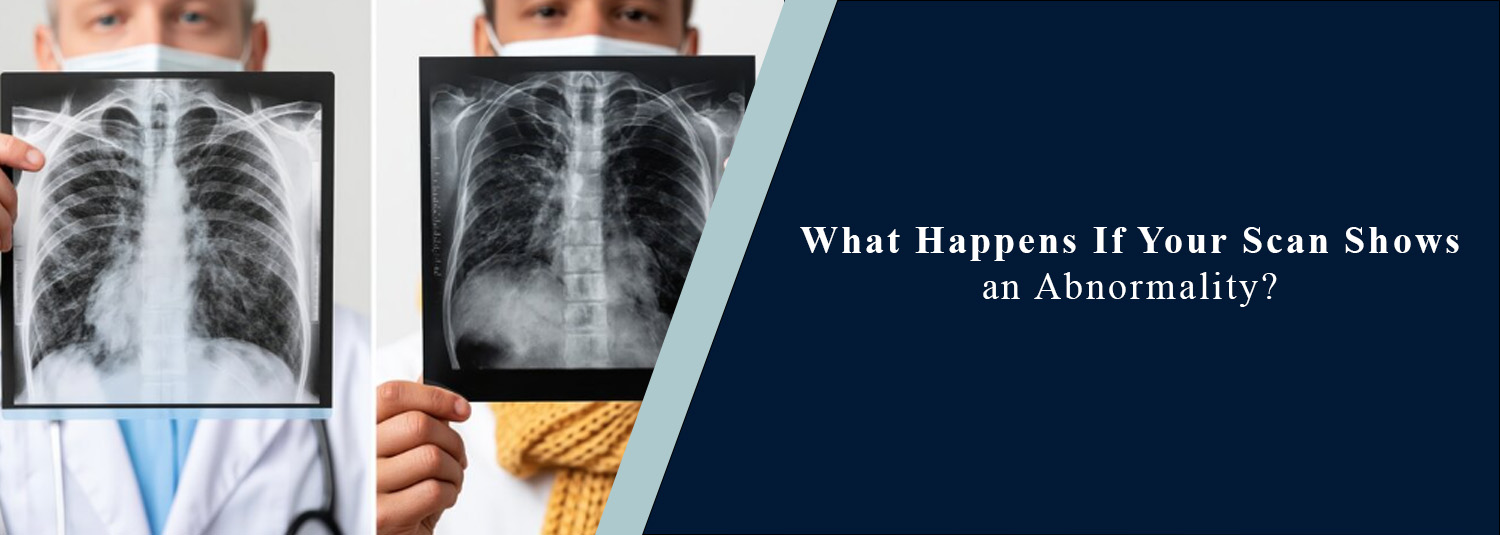
A report from the scan that highlights the abnormalities could be
distressing to receive. However, if you've had an MRI scan, CT scan, PET CT, or
other scan, you might hear the terms "abnormal" or "lesion"
or "mass" or "nodule" or "further evaluation recommended"
and become confused or frightened. But a diagnosis of something abnormal
doesn't always indicate a serious disease. Scan results must be interpreted
carefully with respect to your clinical condition, past medical history,
physical examination, and other tests performed.
A PET CT scan report, CT scan report, or MRI scan report provides
information for doctors from the procedure. The report is an important aspect
of diagnosis, but is rarely the ultimate answer. Molecular Diagnostics andTherapy is equipped with state-of-the-art imaging equipment, allowing the
medical staff to access comprehensive data on possible abnormalities and
determine the appropriate course of treatment for the patient.
What Does an Abnormal Scan Result Mean?
If the scan shows something that is abnormal, or the
radiologist/specialist has noticed an abnormality from what is normally
expected to see. This may involve an alteration of the organ shape, structure,
size, or appearance of the organ or tissue. Alternatively, it can be a region
of interest on a PET scan or another functional imaging examination that is
presenting unusual activity.
There are many possible causes of an abnormality. Certain
discoveries might be innocuous or associated with typical adjustments in the
body. Some others may be due to an infection, an inflammatory process, physical
damage, or a health problem that requires additional screening. For this
reason, the term “abnormal” does not automatically imply a diagnosis.
The First Step: Understanding Your Scan Report
Once you've had a scan, the radiologist or specialist looks at the
results. They construct a report describing what they observe. Information in a
CT scan report can include a description of the size and appearance of organs,
bones, lungs, or other body parts. A report from an MRI scan might detail
information about soft tissues, the brain, spinal cord, joints, or other parts.
PET-CT scan reports can contain details of where an abnormality is
found, and the amount of tracer activity seen in that region. The report also
helps to make a comparison of this scan to earlier scans. This comparison is
used to determine if the result is new, the same, going up, or going down.
Does an Abnormality Always Mean Cancer?
No, an abnormal scan doesn't necessarily mean cancer. Abnormal
imaging can be caused by many non-cancerous findings. A PET scan may appear as
a mass (more activity) when there is infection or inflammation. Scans may also
show injuries, scars, cysts, and changes related to age.
Likewise, there can be some abnormalities that sometimes do not
cause any symptoms and may not even need treatment. A location, appearance,
size, and/or activity of a scan combined with other medical information
determine the meaning of the finding. Before reaching a diagnosis, your doctor
may require further tests.
What Happens After an Abnormal Finding?
The next step is based on your findings. Occasionally, no action
is necessary. A doctor could just prescribe another scan after a period of time
to see if the result has elapsed. For others, further imaging tests might be
requested. In some cases, for instance, an abnormality found on one kind of
scan might be studied by another, such as MRI, CT, ultrasound, or another type
of scan.
Other laboratory tests, such as a blood test, may also be ordered.
Sometimes a biopsy might be required, where tissue is taken for examination.
Further testing is done to learn more about the finding and to find out if
treatment is necessary.
Why Might a Doctor Recommend Another Scan?
It is important to understand that repeat scans usually aren't a
sign of serious issues. Follow-up imaging might be recommended to determine if
the abnormality is stable or if it is changing. For instance, a small nodule or
lesion could be followed as it develops.
Backward or forward time shifting potentially offers valuable
information. If the abnormality doesn't change in any way, this can assist
doctors in determining what the abnormality is. If it does change, additional
evaluations may be warranted. The follow-up scan is either a different type of
scan or time-varying depending on the type of finding and medical history.
What Happens If Further Testing Is Recommended?
Further testing is recommended if your doctor feels there is more
he needs to learn before making a diagnosis. For instance, an abnormal area may
be found by the CT scan, which might not be detected in the MRI, but an MRI may
be able to give more information about the soft tissue properties of the
abnormal area.
Increased tracer uptake seen on PET-CT may be due to inflammatory
or infective processes and other reasons. Further tests may be useful to
determine its cause. If a biopsy is suggested, a relatively small specimen is
obtained and analyzed in a lab. This can help obtain more specific information
regarding some particular abnormalities. Your doctor will let you know why you
are having a specific test ordered, and what it may be able to help with.
Understanding PET CT Scan Reports
A PET CT scan report
combines information from PET and CT imaging. The CT portion shows the
structure and location of organs and tissues. The PET portion provides
information about tracer activity. An area of increased tracer uptake may
require further evaluation, but it does not automatically mean cancer.
Inflammation, infection, and other biological processes can also cause
increased uptake. For this reason, PET CT findings are always interpreted along
with the CT images, previous scans, medical history, and other test results.
Understanding CT Scan Reports
A CT scan report
describes the structures examined during the scan. It may mention findings such
as swelling, fluid, nodules, masses, enlarged lymph nodes, or other changes.
The report may also mention whether a finding appears stable compared with a
previous examination. Some CT findings are common and harmless, while others
need further investigation. Your doctor will decide what the finding means in
your specific case.
Understanding MRI Scan Reports
An MRI scan report can
contain detailed descriptions of the body's soft tissues. Depending on the area
scanned, it may describe changes in the brain, spinal discs, nerves, joints,
muscles, or other tissues. Terms in an MRI report can sound technical and
concerning. However, many findings, such as age-related degenerative changes,
are common and do not always require treatment. Your doctor will consider the
MRI findings together with your symptoms and physical examination.
Why You Should Not Diagnose Yourself From a Scan
Report
Online searches can make
medical terms sound more frightening than they actually are. A scan report is
written for medical professionals and may include technical descriptions that
require clinical interpretation. Reading a single word or phrase without
understanding the complete report can lead to unnecessary anxiety. It is best
to discuss your abnormal scan results with the doctor who requested the
examination. They can explain what the finding means in relation to your
overall health.
The Importance of Previous Scan Comparisons
Previous imaging can be
very valuable when an abnormality is found. A finding that looks concerning
today may have been present and unchanged for several years. In this case, the
older images can help doctors understand whether it is stable. On the other
hand, a new or changing abnormality may require further investigation. Whenever
possible, share your previous PET CT scan report, CT scan report, MRI scan
report, and images with your doctor or imaging centre.
When Is a Biopsy Needed?
Not every abnormal scan
finding requires a biopsy. A biopsy may be recommended when imaging alone
cannot determine the exact cause of an abnormality and a tissue diagnosis is
needed. The type of biopsy depends on the location of the abnormal area. Your
doctor will explain the procedure, possible benefits, and risks if it is
necessary. Imaging may also be used to guide certain biopsy procedures by
helping doctors identify the appropriate area for sampling.
The Role of Molecular Diagnostics and Therapy
At Molecular Diagnosticsand Therapy, advanced diagnostic imaging helps doctors identify and evaluate
different abnormalities. PET CT, CT, MRI, and other imaging services provide
valuable information that can support further medical decisions. Experienced
specialists review the scan images and prepare detailed reports for the
referring doctor. When an abnormal finding is present, the report can help
guide the doctor in deciding whether observation, follow-up imaging, additional
tests, or further evaluation may be needed.
Conclusion
Being informed that something is abnormal in a PET-CT scan report,
CT scan report, or MRI scan report could be stressful, but an abnormal finding
does not necessarily indicate a serious disease. One component in the
diagnostic process is a scan. The imaging results are taken into account with
symptoms, medical history, exam, and other tests and studies performed.
Next, this may be as simple as observing the findings; further imaging may be required, further tests may be necessary, or in some cases even a biopsy is performed. The primary emphasis isn't on reading the report. Talk with your health care provider about your test results, and know if more tests should be done or not; and take the medical advice you receive.
Frequently Asked Questions
In News
Get Our Mobile App
for Easy Access
Book tests, view reports, and manage your health records on the go. Experience convenient healthcare with Molecular Diagnostics and Therapy.
- ✔ Book tests & home collection
- ✔ View reports instantly
- ✔ Track health history
- ✔ Get notifications & reminders
- ✔ Easy appointment management