Can MRI Detect Nerve Damage?
Talk to Health Expert

Dr. Nikunj Jain
Co-Founder and HOD - Nuclear Medicine ,MBBS, DRM, DNB, FEBNM, FANMB, Dip. CBNC
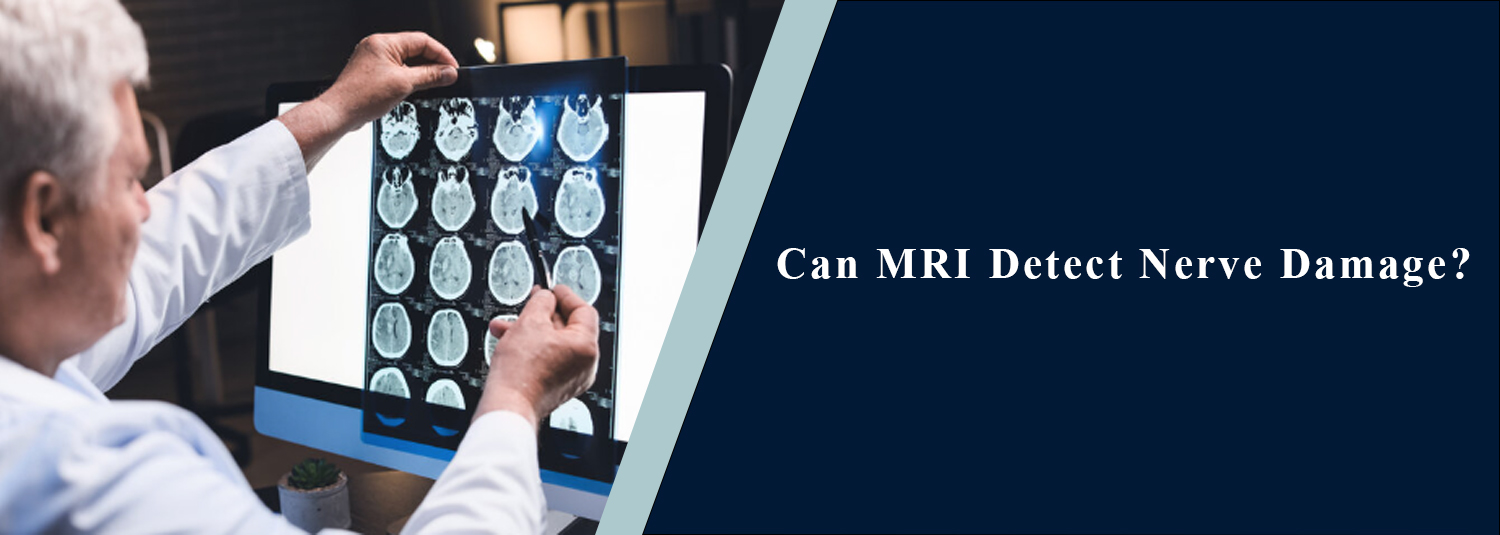
People who have often complained of pain and neurological problems do not know if an MRI can accurately determine the damage to the nerves. The answer is yes. MRI is considered one of the most advanced forms of
imaging and would be utilized for examination of the nerves, brain, spinal cord, and/or surrounding soft tissues.
It helps the doctor diagnose conditions that might be compressing, causing pressure, or injuring the nerves. At Molecular Diagnostics and Therapy, a variety of MRI capabilities and skilled radiology care help provide an accurate assessment of nerve-related problems and neurological diseases.
Understanding Nerve Damage
A nerve conducts information between various parts of the body to and from the brain and spinal cord. Nerves can become compressed, inflamed, injured, or damaged, thereby severing the brain/body connection. This can present a variety of symptoms, depending on the area of damage and the severity of the damage.
Others may experience numbness, tingling, or pain in their hands or feet, but some patients may experience severe pain, weakness, or difficulty with coordination. Nerve damage can occur due to injuries, back disc, diabetes, infections, autoimmune conditions, tumors, and poor circulation. Early diagnosis is essential because it is very likely that with the passage of time, the nerve damage would be progressive and that there would be a loss of functionality, mobility, and overall quality of life.
What is MRI?
MRI (Magnetic Resonance Imaging) is a sophisticated type of imaging that employs powerful magnetic fields and radio waves to produce extremely detailed images of the internal structures of the body. MRIs offer very bright images of soft tissues like nerves, muscles, ligaments, the spinal cord, and the brain that don't work with X-rays or CT.
Because MRI doesn't involve radiation, the technique is safer and is a better imaging choice for many who need repeat scans. MRI is common in the fields of neurology, spine imaging, orthopedics, and brain imaging due to its ability to create detailed images. MRI scans also allow doctors to spot problems that can't be easily seen by other scans. This is one of the most powerful diagnostic aids for disorders affecting the nerves.
Can MRI Detect Nerve Damage?
Many conditions that can be associated with nerve damage are detected by MRI. MRI does not always reveal any micro injury to the nerves, but it does allow the underlying etiology (reason) for nerve compression, inflammation, or dysfunction to be identified.
If a slipped disc in the back is actually squeezing the nerve root, for instance, an MRI can clearly show which part and how severe the compression is. This helps doctors decide if symptoms (they are something that you experience), like pain, numbness, or weakness, are due to nerve involvement.
MRI is very useful at detecting spinal disc problems, compression of the spine, pinched nerves, tumours disturbing nerves, brain abnormalities, inflammation of the nerves, and some neurological disorders. It may also be useful to detect swelling and structural alterations of nerves.
Advanced MRI imaging helps to enable the accurate identification of nerve compression and neurologic disorders, with the use of high-quality imaging technology and expert radiology services at Molecular Diagnostics and Therapy.
MRI for Spine and Back-Related Nerve Problems
Doctors suggest MRI tests to check for the nerve issues associated with the spine. The back, neck, arm, or leg pain may be due to conditions like slipped discs, spinal stenosis, degenerative spine disease, and nerve root compression.
MRI scans of the spine are ordered for patients who are suffering from lower back pain, neck pain, sciatica, numbness, or muscle weakness. MRI can, in great detail, let doctors see and read the vertebrae, spinal discs, spinal cord, and surrounding nerves.
Three-dimensional pictures produced by MRI give doctors more information about what's happening if a nerve is compressed, inflamed, or damaged. This information will be very useful, particularly in the planning of any treatment and before more advanced procedures or surgery.
MRI for Brain and Neurological Disorders
MRI is employed for the diagnosis of neurological diseases that could lead to impaired neural functioning. Any kind of disruption in the connection between the brain and the body, like stroke, multiple sclerosis, tumors, infections, or inflammatory diseases, can disrupt nerve communication.
MRI brain scans are extremely detailed images that can detect even minor brain tissue abnormalities. For patients who have headaches, seizures, weakness, dizziness, balance dysfunction, and/or puzzling neurological problems, an MRI is frequently a very useful test to perform. Doctors use advanced MRI technology to assess structural and some functional alterations to the nervous system to increase the accuracy of their diagnosis.
Advanced MRI Techniques for Nerve Imaging
In certain instances, specialized procedures of the MRI may be suggested, called MRI Neurography. This advanced imaging technique specifically targets nerves to enhance imaging of peripheral nerve abnormalities.
MRI Neurography may be useful for assessing: nerve entrapment; nerve injuries; nerve inflammation; and some chronic nerve disorders. Useful for use when there are specific symptoms that suggest nerve damage, but the routine imaging appears normal. These cutting-edge technologies enhance the doctors' ability to make more precise diagnosis of complicated neuro and nerve-related disorders.
Limitations of MRI
While very sophisticated, MRI has some drawbacks. A standard MRI scan sometimes does not clearly reflect a very small injury or a microscopic injury to the nerves. Other tests, such as nerve conduction studies, electromyography, blood tests, or neurological examinations, may also be necessary in some instances.
The interpretation of the MRI scan must always be supplemented by the patient's symptoms, their history, and physical examination. While a normal MRI often fully excludes nerve-related problems, sometimes an abnormal result does not necessarily mean that there is an actual problem.
Conclusion
MRI is important in identifying certain disorders that are linked with nerve damage. MRI creates images of the brain, spine, nerves, and other soft tissues that give doctors a clearer view of nerve compression or inflammation, a tumor, and any neurological abnormality.
MRI is an excellent way to assess nerve-related symptoms, though it will not always be able to directly detect micro-level damage to the nerves. It is important to be diagnosed early and treated in a timely fashion to prevent any long-term complications or effects. With advanced imaging technology and expert radiology support, Molecular Diagnostics and Therapy continues to provide reliable MRI services focused on accurate diagnosis, patient care, and high-quality neurological imaging.
Frequently Asked Questions
In News
Get Our Mobile App
for Easy Access
Book tests, view reports, and manage your health records on the go. Experience convenient healthcare with Molecular Diagnostics and Therapy.
- ✔ Book tests & home collection
- ✔ View reports instantly
- ✔ Track health history
- ✔ Get notifications & reminders
- ✔ Easy appointment management