HRCT Chest Scan for Lung Infection: When Is It Needed?
Talk to Health Expert

Dr. Nikunj Jain
Co-Founder and HOD - Nuclear Medicine ,MBBS, DRM, DNB, FEBNM, FANMB, Dip. CBNC
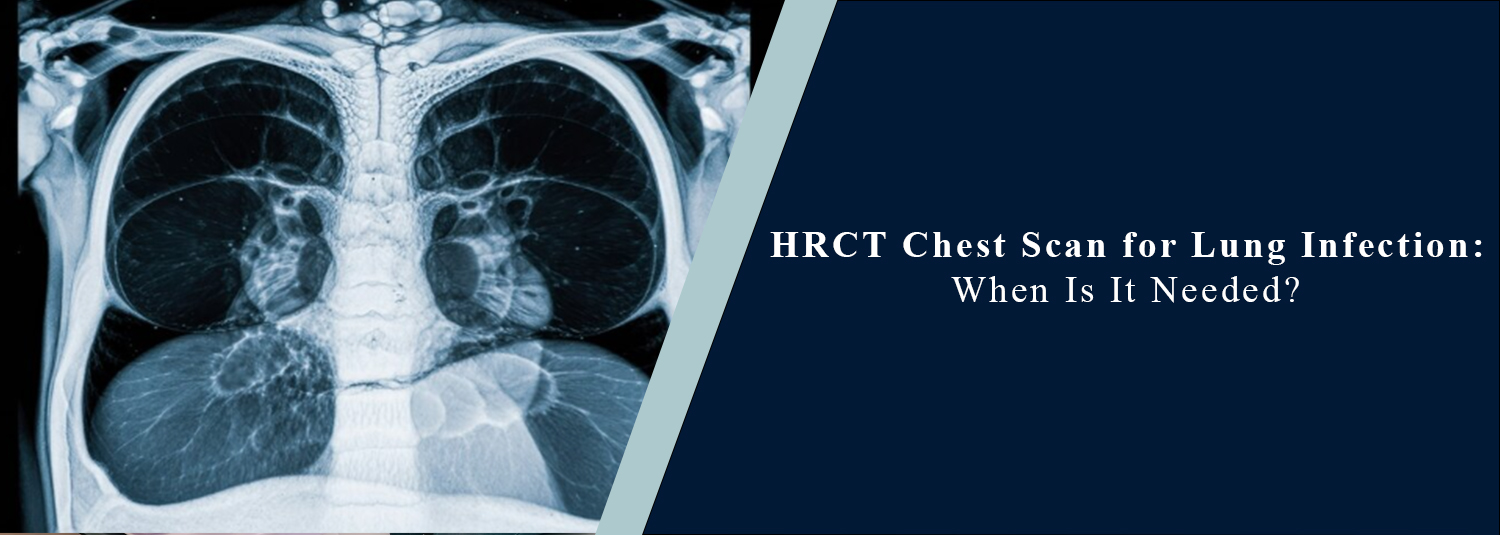
Lung infections can cause breathing problems, reduce oxygen in the body, and greatly affect health. Some minor infections can resolve with treatment and antiviral drugs; for some others, careful imaging is necessary in order to determine the extent of lung involvement. A very useful imaging technique for these purposes is the HRCT chest scan.
A highly detailed picture of the lungs and airways is taken using a machine called HRCT or High-Resolution Computed Tomography. It assists doctors when they need to detect abnormalities in the lungs, such as infections, inflammation, and scarring, that may not be apparent on a regular chest X-ray. HRCT imaging is an important tool in modern respiratory care that can be used to accurately diagnose and plan for the care of the patient. In Molecular Diagnostics and Therapy, doctors benefit from the use of highly technologically advanced HRCT imaging.
What is an HRCT Chest Scan?
HRCT chest scan is a non-invasive computed tomography (CT) scan of the chest, which is performed to obtain detailed cross-sectional images of the lungs. HRCT creates detailed images of the specimens, revealing the structures of the lungs, airways, and blood vessels, whereas traditional X-rays do not.
This test does not require an invasive procedure, and it only takes a couple of minutes. The patient is placed on a table, and a CT scanner takes detailed images of the chest during the scan. HRCT chest scans are useful for making a diagnosis of:
Lung infections.
Pneumonia.
Tuberculosis.
Interstitial lung disease.
Lung fibrosis.
Chronic breathing problems.
HRCT is also one of the best diagnostic tools for respiratory diseases, due to its detailed imaging.
Why is HRCT Important for Lung Infections?
Sometimes, a simple imaging test is not able to tell you the severity of a lung infection or assess it. Depending on the circumstances, they continue even after the X-ray of the chest is normal. HRCT helps doctors:
Determine the severity of the disease.
Detect underlying conditions of the lungs that may not be readily apparent.
Evaluate inflammation and tissue damage.
Monitor disease progression.
Evaluate response to therapy.
More accurate diagnosis and improved treatment planning are achieved thanks to the detailed imaging that is provided by HRCT.
Symptoms That May Require an HRCT Chest Scan
An HRCT chest scan may be recommended if there are extreme or persistent respiratory symptoms or if the symptoms are not explained. Common symptoms include:
Persistent cough.
A fever and difficulty breathing will occur.
Chest pain.
Shortness of breath.
Low oxygen levels.
Chest X-ray abnormalities.
For a patient who has progressive respiratory disease, HRCT can be used to identify any complications or spread from the infection.
HRCT Chest Scan in Pneumonia
One of the most frequently used and useful imaging tests in HRCT is to diagnose pneumonia. The scan is used to see how severe the infection is and to make sure there are no complications like fluid build-up or damage to the lungs. HRCT can detect:
Ground-glass opacities.
Lung consolidation.
Airway inflammation.
Spread of infection within the lungs.
This detailed evaluation helps in the timely identification of the problem and prompt management of it.
HRCT in Viral and Post-Infection Lung Damage
Others still have respiratory issues after an acute bout of viral illness. An HRCT scan is ordered to help determine whether there is ongoing inflammation, fibrosis, or scarring in the lungs. The scan enables doctors to assess if symptoms are caused by:
Residual infection.
Lung fibrosis.
Inflammatory changes.
Airway damage.
Recognition of the complications early ensures suitable surveillance and management. In Molecular Diagnostics and Therapy, high-resolution computed tomography (HRCT), a type of imaging that captures extremely detailed images of the lungs, is used to help correctly diagnose any existing lung infections and post-infection lung issues.
HRCT for Tuberculosis and Chronic Lung Disease
Detailed imaging might be needed for accurate diagnosis and follow-up for patients with TB or chronic respiratory infection. HRCT is useful in identifying lung cavities, nodules, fibrosis, and bronchial abnormalities in chronic lung disease. An HRCT may be ordered if:
Symptoms don't go away with treatment.
Chest X-rays are not helpful.
Complications are suspected.
A long-term monitoring program is required.
The effects of detailed imaging are helping doctors determine disease progression more effectively.
Benefits of HRCT Chest Scan
HRCT has many values when it comes to diagnosing lung diseases. Key benefits include:
Imaging of the lungs with great detail.
Early detection of abnormalities:
More accurate assessment of lung injury;
Improved and more rapid diagnosis
Improved treatment planning
Due to its accuracy, HRCT has become a favourite in the field of respiratory care for both emergency and long-term treatment.
Is HRCT Chest Scan Safe?
HRCT is an imaging technique that involves exposing the body to a controlled amount of radiation to form detailed images. The radiation exposure is greater than the amount of radiation you would receive during a standard chest X-ray, but overall, the radiation dose is considered safe if you need this scan.
HRCT should only be ordered when the diagnostic benefits of the procedure exceed the risks. Before the scan, the patient should let his/her physician know if they are pregnant or if his/her physician considers the patient to have previously undergone imaging procedures. Recent advances in imaging technology have also reduced the amount of radiation required and maintained high image quality.
How to Prepare for an HRCT Scan?
Very little preparation is necessary for most HRCT chest scans. Typically, the patient is advised to:
Wear comfortable clothing
Remove metallic objects
Let the doctor know of any medical history or implants.
It is a painless procedure; patients can attend to their normal work after the scan, depending on their condition. Depending on the condition being studied, some scans may use a contrast dye, although many HRCT scans do not use the dye.
Choosing the Right Diagnostic Centre
The scan is not the only factor for accurate imaging; the quality of equipment and radiology expertise contribute as well. It is crucial to get a dependable diagnostic centre where the results will be more reliable and the interpretation is correct. The advanced HRCT systems and qualified radiologists help to provide accurate imaging of the lungs with patient-centric diagnostic skills and care at Molecular Diagnostics and Therapy.
Conclusion
HRCT chest scan is an integral part of the diagnosis and follow-up of lung infections. HRCT imaging offers a wealth of detail, enabling accurate diagnoses and effective treatment planning, ranging from pneumonia and tuberculosis to post-viral lung complications and chronic respiratory disease.
Those with persistent respiratory symptoms should go to a doctor and have their symptoms evaluated early to minimise the potential for complications during the recovery process. Advanced imaging capabilities and skilled diagnostics continue to deliver dependable HRCT chest imaging for lung management at Molecular Diagnostics and Therapy.
Frequently Asked Questions
In News
Get Our Mobile App
for Easy Access
Book tests, view reports, and manage your health records on the go. Experience convenient healthcare with Molecular Diagnostics and Therapy.
- ✔ Book tests & home collection
- ✔ View reports instantly
- ✔ Track health history
- ✔ Get notifications & reminders
- ✔ Easy appointment management