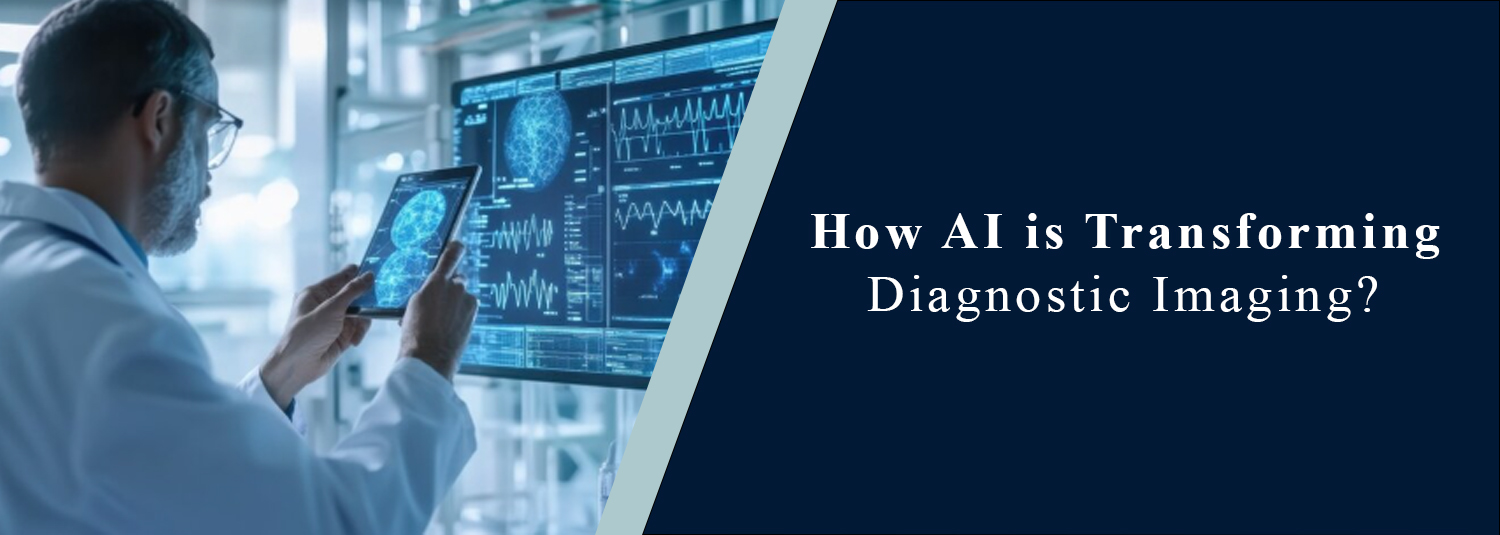
How AI is Transforming Diagnostic Imaging?
Talk to Health Expert

Dr. Nikunj Jain
Co-Founder and HOD - Nuclear Medicine ,MBBS, DRM, DNB, FEBNM, FANMB, Dip. CBNC
The healthcare sector is rapidly changing with Artificial Intelligence (AI), and one of the most significant developments is in diagnostic imaging. The MRI, CT scans, PET-CT, X-rays, and Ultrasound are some of the technologies that are becoming smarter and more efficient with the assistance of AI-powered systems. No matter the field, from the creation of faster scan analysis models to the creation of models that detect a disease at its initial stages, AI is assisting doctors and radiologists to work towards success by making sure that a patient receives the care they deserve. Molecular Diagnostics and Therapy is embracing advanced imaging technologies to support accurate and efficient patient diagnosis.
Diagnostic imaging is a key factor in disease detection, its treatment follow-ups, and the medical decision processes. But the translation of medical images is not an easy and time-consuming task that should be carried out by professionals with accuracy. This is the area where AI is impressive in making a change.
What is AI in Diagnostic Imaging?
AI in diagnostic imaging is the utilization of advanced computer algorithms and machine learning systems, which can process medical images and highlight abnormalities. Thousands of medical scans are used to train these systems, which are able to identify patterns that are connected with diseases and health conditions.
AI does not take the place of radiologists but cooperates with them by serving as an intelligent support system. It allows specialists to view the images more effectively and enhances diagnostic confidence. Currently, several imaging technologies are being powered by AI, including:
Neurological imaging
Faster and More Efficient Image Analysis
Speed is one of the most significant benefits of AI. The imaging scans of modern times are able to generate hundreds or even thousands of images of a single patient. Manually reviewing these images can be time-consuming and requires a lot of concentration.
AI-based image processing software can then identify suspicious objects automatically and detect a large amount of imaging data within seconds. This saves on the time of reporting and enables radiologists to pay attention to important discoveries. The advantages of quicker analysis for both doctors and patients include:
Minimising waiting time to report.
Improving emergency diagnosis.
Improvement of the workflow in diagnostic centers.
Helping in faster decision-making on treatment.
Quick diagnosis can help save a patient, such as in the case of stroke or internal bleeding, and in emergency cases.
Early Disease Detection
The use of AI is particularly useful in the diagnosis of diseases in their early stages. Various health disorders progress slowly and can present with very minimal changes in the imaging scans in their initial stage. In other instances, these tiny defects are not easily seen with the naked eye. With high sensitivity, AI systems are trained to observe these subtle patterns. This is beneficial in the early identification of:
Cancer tumors
Lung nodules
Brain abnormalities
Heart disease
Bone fractures
Neurological disorders
Treatment outcomes, complications, and survival might be better with early diagnosis. Indicatively, AI-assisted mammography can help detect early signs of breast cancer in a more precise manner, whereas AI in lung imaging technology can help identify tiny nodules that might have otherwise not been detected.
Improving Accuracy and Reducing Human Error
Radiologists may feel under pressure and have to study vast quantities of scans in a day. Excess and work overload can sometimes add the risk of missed findings. AI serves as a second review step, allowing radiologists to check suspicious results and enhance the overall accuracy. It has the ability to flag abnormal regions to be studied further and help to minimize false negatives.
Such a constellation of human skill and AI assistance results in a more dependable diagnostic procedure. Instead of doing away with radiologists, AI enhances their capability to make correct decisions.
AI in Cancer Imaging and PET-CT
Some of the most significant medical imaging uses of AI are the diagnosis and monitoring of cancer. Oncology largely applies PET-CT scans to detect cancer, assess tumor activity, and monitor response to treatment. AI can be used to enhance PET-CT imaging, which:
Detecting tumors earlier.
Excising tumor size.
Comparison of scans over time.
Tracking treatment effectiveness.
Identifying possible recurrence.
This enables the oncologists to develop more individualized treatment plans for the patients. Unnecessary delays in cancer diagnosis can also be minimized with the help of AI, since the latter is essential to successfully treating cancer. Advanced imaging centers such as Molecular Diagnostics and Therapy are adopting modern AI-assisted technologies to improve diagnostic precision and patient care.
Smarter MRI and CT Scans
Image quality and scan efficiency in MRI and CT imaging are also being enhanced by AI. State-of-the-art AI reconstruction is able to produce more clearly defined images at the same time, reducing scan time. This has several advantages:
Faster MRI procedures
Less radiation during CT scans.
Better patient comfort
Improved imaging quality
Reduced scan times are especially beneficial when it comes to children, the elderly, and those who have problems remaining stationary during scanning sessions.
Workflow Automation in Diagnostic Centers
AI is assisting the diagnostic centers automate and streamline their operations. Monotonous work like sorting out images, allocating time to urgent cases, and being able to help in the process of creating reports can now be handled in a better-organized way. This further enhances productivity and enables health care workers to concentrate more on patient treatment and intricate health-related choices.
Even the prioritization of emergency cases of an emergency can be supported by AI-powered workflow automation, where the cases of emergency are prioritized automatically, and PICC patients receive priority in the AI-based workflow automation.
Challenges and Limitations of AI
Although artificial intelligence has numerous advantages, it has its limitations. It does not substitute for the experience, judgment, and clinical insight of well-trained radiologists and doctors. Some challenges include:
Data privacy concerns
Required constant training of the systems.
Reliance on good-quality image data.
Possibility of erroneous translation unless monitored by humans.
Thus, AI is thought of as a facilitating tool and not a substitute for medical staff.
The Future of AI in Diagnostic Imaging
In the future, it is likely that the field of diagnostic imaging will become even more AI-powered. Researchers are also working on more developed systems that can forecast, provide real time images interpretation, and come up with personalized healthcare advice.
In the near future, AI can also contribute to making access to healthcare in remote areas faster and more precise, since diagnostic assistance is generally limited to specialist radiologists in remote areas. With the further advancement of technology, AI is bound to make its way into the sphere of modern radiology and precision medicine as one of its key elements.
Conclusion
Diagnostic imaging is changing with AI and the ability to increase the speed, accuracy, efficiency, and early disease detection. Starting with MRI, CT scans, and more advanced PET-CT systems, AI-powered systems are assisting healthcare professionals in making faster and more informed decisions.
Although human knowledge is still needed, AI is becoming an influential collaborator in healthcare today. As further developments occur, imaging technologies that are driven by AI will likely be significantly improved at supporting patient care, as well as defining the future of diagnostics on a global level.
Frequently Asked Questions
In News
Get Our Mobile App
for Easy Access
Book tests, view reports, and manage your health records on the go. Experience convenient healthcare with Molecular Diagnostics and Therapy.
- ✔ Book tests & home collection
- ✔ View reports instantly
- ✔ Track health history
- ✔ Get notifications & reminders
- ✔ Easy appointment management