
When Do Doctors Recommend a PET Scan Instead of CT or MRI?
Talk to Health Expert

Dr. Nikunj Jain
Co-Founder and HOD - Nuclear Medicine ,MBBS, DRM, DNB, FEBNM, FANMB, Dip. CBNC
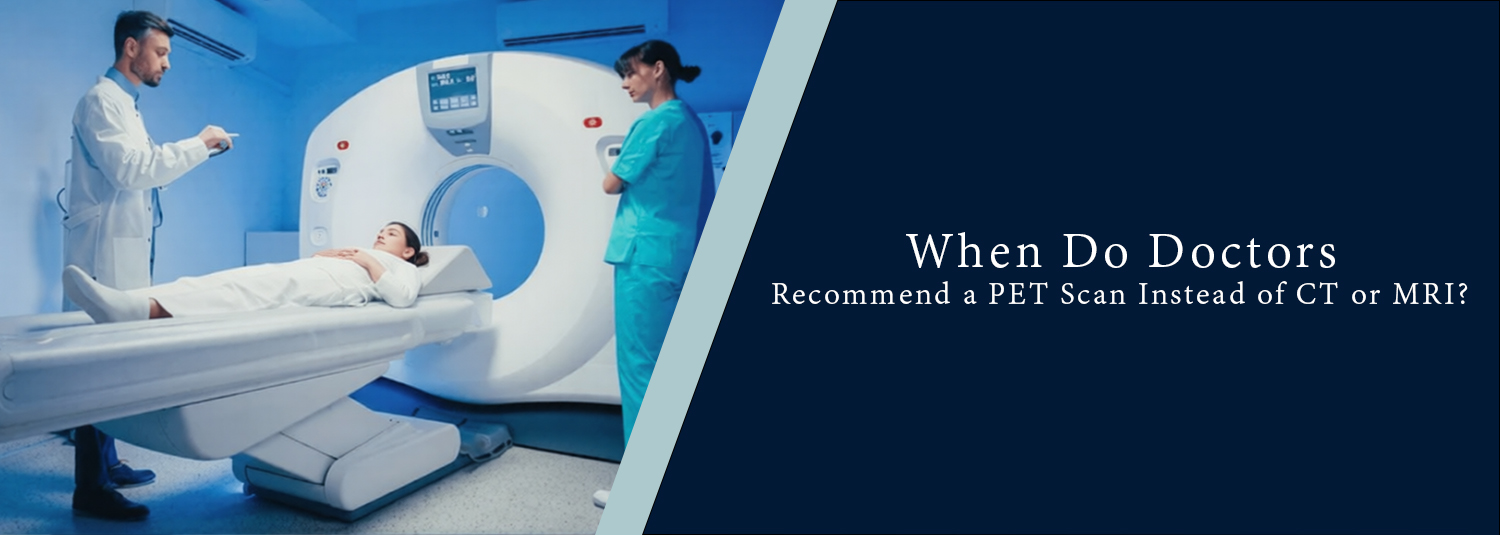
Diagnosis and treatment of diseases have undergone a revolution through medical imaging. The most popular imaging methods include CT (Computed Tomography), MRI (Magnetic Resonance Imaging) scan, and PET scan. Although all three are essential in the field of medicine, they have different functions. The most popular questions by patients are: When do doctors suggest a PET scan rather than a CT or MRI?
The differences between these imaging methods can be understood to make patients feel confident and informed about the choices in their healthcare choices.
What is a PET Scan?
A PET scan is a form of nuclear medicine whereby the camera assists the physician in monitoring the functioning of the tissues and organs. It consists of the injection of a limited amount of radioactive tracer (FDG - fluorodeoxyglucose). This tracer can be used to show the locations of high metabolic activity that may signify disease.
As opposed to CT and MRI that mainly render the structure of the organs, PET scans render functional imaging- they demonstrate how the body is functioning at the cellular level.
CT vs MRI vs PET: What’s the Difference?
CT Scan: This is via X-rays to form detailed images of the body in sectional form. It is good at identifying fractures, tumors, and internal bleeding.
MRI: It is a technique that generates very detailed images through the use of strong magnetic fields and radio waves, which are very convenient in soft tissues such as the brain, muscle, and ligaments.
PET Scan: It is used in determining metabolic activity, and it assists in determining abnormal cell functioning even before the structural changes are experienced.
PET is often used together with CT (PET-CT) in order to obtain both functional and anatomical data.
When Do Doctors Prefer a PET Scan?
Physicians also prescribe a PET scan as opposed to a CT or MRI under special circumstances that emphasize functions more than structure as a requirement.
1. Cancer Detection and Staging
Oncology is one of the most typical areas of use of PET scans. A PET scan is very sensitive in identifying cancer cells, as the cancer cells are generally highly metabolic compared to the normal cells.
A PET scan may be recommended by the doctor to:
Early detection of cancer.
Identify the precise dissemination (staging).
Determine metastasis (to other organs)
Whereas the CT/ MRI can indicate the size and the place of a tumor, a PET scan can indicate whether a mass is active cancer or not.
2. Evaluating Treatment Response
The treatment of cancer, such as undergoing chemotherapy or radiations is an important subject that you should understand whether the treatment is improving.
PET scans help doctors:
Determine the activity of the tumor cells.
Distinguish scar tissue and active cancer.
Adjust or change treatment plans.
CT or MRI may reveal a residual mass, but only a PET scan can reveal whether it is metabolically active or not.
3. Detecting Recurrence of Disease
In some cases, post-treatment cancer might recur. PET scans come in handy, especially as far as the recurrence can be detected at a very early stage.
Since a PET scan recognizes metabolism in every cell, it is thus able to detect recurrence as soon as it starts and usually before it is reflected in CT or MRI.
4. Cardiac (Heart) Evaluation
Cardiology also uses PET scans to determine action and the flow of blood in the heart.
A PET scan may be ordered to confirm to doctors that:
Measure cardiac vitality (living heart tissue)
Identify territories of low blood circulation.
Surgery of the plan, such as bypass surgery.
CT or MRI cannot always do this as well, as it is a functional insight.
5. Neurological Disorders
PET scans are used to determine the performance of the brain in case of brain-related conditions.
They are commonly used in:
Diagnosis of Alzheimer's disease.
Epilepsy evaluation
Brain tumor assessment
The abnormalities in the activity of the brain can be detected through PET scans, but not through MRI at the initial stage.
6. When Other Imaging Results Are Inconclusive
CT or MRI results, in some cases, can fail to show a definite diagnosis. In this regard, a PET scan can be suggested by the doctors to provide additional examination.
For example:
A lump of suspicious and unclear appearance on CT.
Observed unusual symptoms and a normal MRI.
Through a PET scan, more can be established regarding the activity of the metabolism.
Advantages of PET Scans
Early diagnoses of disease.
Gives functional and metabolic data.
Assistance in proper diagnosis and staging.
Applicable in the treatment monitoring.
Are There Any Risks?
PET scans are generally safe. Radiation level is minimal and regulated. However:
PET scans on pregnant women should not be performed.
Allergies should be mentioned by the patient, or medical conditions should be disclosed to the doctor.
The risks involved are insignificant, and the benefits of the right diagnosis are usually enormous.
Conclusion
Whereas CT and MRI Scans provide good images of the body structure, PET Scans take it one step further, as it provides a feasible insight into the way the body operates at the cellular level. Physicians prescribe PET scans in those areas where it is important to know the metabolic activity, particularly in the case of cancer, where it is important to know whether the disease has been cured or recurred.
In most cases, when one is advised by their doctor to conduct a PET scan, it is due to the fact that they require more detailed information that other forms of imaging might not offer. Knowledge about such differences would help you to make informed and confident healthcare choices.
PET combined with CT or MRI is the best choice in terms of diagnosing a patient in modern medicine, which results in improved treatment therapy and better patient care.
Frequently Asked Questions
In News
Get Our Mobile App
for Easy Access
Book tests, view reports, and manage your health records on the go. Experience convenient healthcare with Molecular Diagnostics and Therapy.
- ✔ Book tests & home collection
- ✔ View reports instantly
- ✔ Track health history
- ✔ Get notifications & reminders
- ✔ Easy appointment management
