Why Doctors Recommend ESR and CRP Tests for Inflammation?
Talk to Health Expert

Dr. Nikunj Jain
Co-Founder and HOD - Nuclear Medicine ,MBBS, DRM, DNB, FEBNM, FANMB, Dip. CBNC
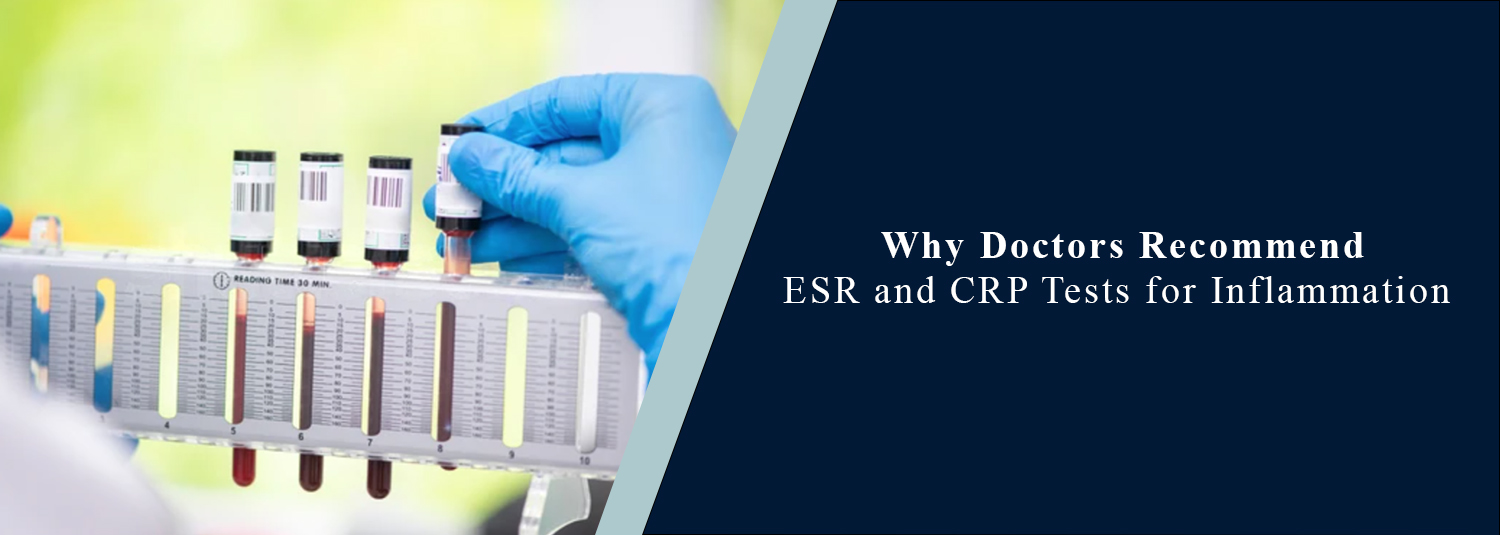
The body naturally responds to injury, infection, or harmful stimuli by means of inflammation. Although, as a preventative mechanism, chronic or excessive inflammation may point to underlying health issues like infections, autoimmune disorders, or even some types of cancer. Two types of significant blood tests, with the help of which inflammation is identified and tracked down, are often suggested by doctors: ESR (Erythrocyte Sedimentation Rate) and CRP (C-reactive Protein).
These tests do not diagnose a particular illness by themselves, but are good indicators of the existence and the degree of inflammation in the body.
What Is ESR?
ESR (Erythrocyte Sedimentation Rate) is a test of how rapidly the red blood cells sink to the base of a test tube in an hour. In the normal case, red blood cells slowly settled. But in the event of inflammation, some proteins lead to clumping and produce faster settlement of the cells.
An increase in the ESR value tends to suggest inflammation but fails to identify its origin.
What Is CRP?
CRP (C-Reactive Protein) is a liver-secreted protein that is a result of inflammation. Its concentrations rise quickly in case of an acute inflammation or infection in the body.
In comparison with ESR, CRP is more sensitive and reacts to the alterations in the inflammatory process faster, thus it is especially valuable in identifying cases of active inflammation.
Why Are ESR and CRP Tests Recommended?
Doctors utilize ESR and CRP tests on several grounds with respect to diagnosis, follow-up, and assessment of treatment.
Key Reasons Include:
To identify inflammation in the body.
To assist in the diagnosis of such diseases as infections or autoimmune diseases.
To follow up on chronic inflammatory diseases like arthritis.
To determine how serious an illness is.
To monitor the effectiveness of a treatment.
Conditions Where ESR and CRP Are Useful
These smallpox tests are usually prescribed in cases where there is some indication of inflammation, but the causative agent is not known.
They are regarded in assessing:
Rheumatoid arthritis and other autoimmune diseases.
Infections (bacterial or viral)
Inflammatory bowel disease (IBD).
Lupus
Vasculitis
Complications or post-surgical inflammation.
Difference Between ESR and CRP
The two tests are used to measure the inflammation, but both operate differently and give a minor difference in information.
Which Test Is Better?
ESR and CRP are neither superior to each other; rather, they tend to be combined in order to have a clearer image of the state of inflammation.
CRP is more applicable in uncovering sudden or acute inflammation, for example, infections. Instead, ESR comes in handy in tracking chronic inflammatory diseases.
Both tests could be ordered at the same time, as doctors want to be more accurate in their diagnosis and monitor the further evolution of the disease.
When Should You Get These Tests?
ESR and CRP tests may be suggested by doctors in case you have such symptoms:
Persistent fever
Unexplained fatigue
Pain or stiffness in the joints.
Swelling or redness
Chronic infections
Sudden weight loss
Such symptoms can present with an underlying inflammatory process to be investigated further.
Limitations of ESR and CRP Tests
While these tests are helpful, they have certain limitations. They are unable to diagnose the precise factor leading to inflammation, and need to be interpreted in combination with other clinical data and diagnostic tests.
As an illustration, age, pregnancy, or anemia can influence the ESR levels, whereas minor infections or injuries can increase the CRP levels.
Conclusion
ESR and CRP tests are so easy but effective, and they assist physicians in investigating and tracking inflammation within the body. They do not make a definite diagnosis, but they can provide a valuable insight into the existence and severity of inflammatory processes.
With the integration of such tests with other medical tests, the doctors are able to diagnose underlying conditions at the early stages, to track the success of treatment, and to direct the patient towards improved health results.
Frequently Asked Questions
In News
Get Our Mobile App
for Easy Access
Book tests, view reports, and manage your health records on the go. Experience convenient healthcare with Molecular Diagnostics and Therapy.
- ✔ Book tests & home collection
- ✔ View reports instantly
- ✔ Track health history
- ✔ Get notifications & reminders
- ✔ Easy appointment management