CT Scan Side Effects: Is It Safe for Everyone?
Talk to Health Expert

Dr. Nikunj Jain
Co-Founder and HOD - Nuclear Medicine ,MBBS, DRM, DNB, FEBNM, FANMB, Dip. CBNC
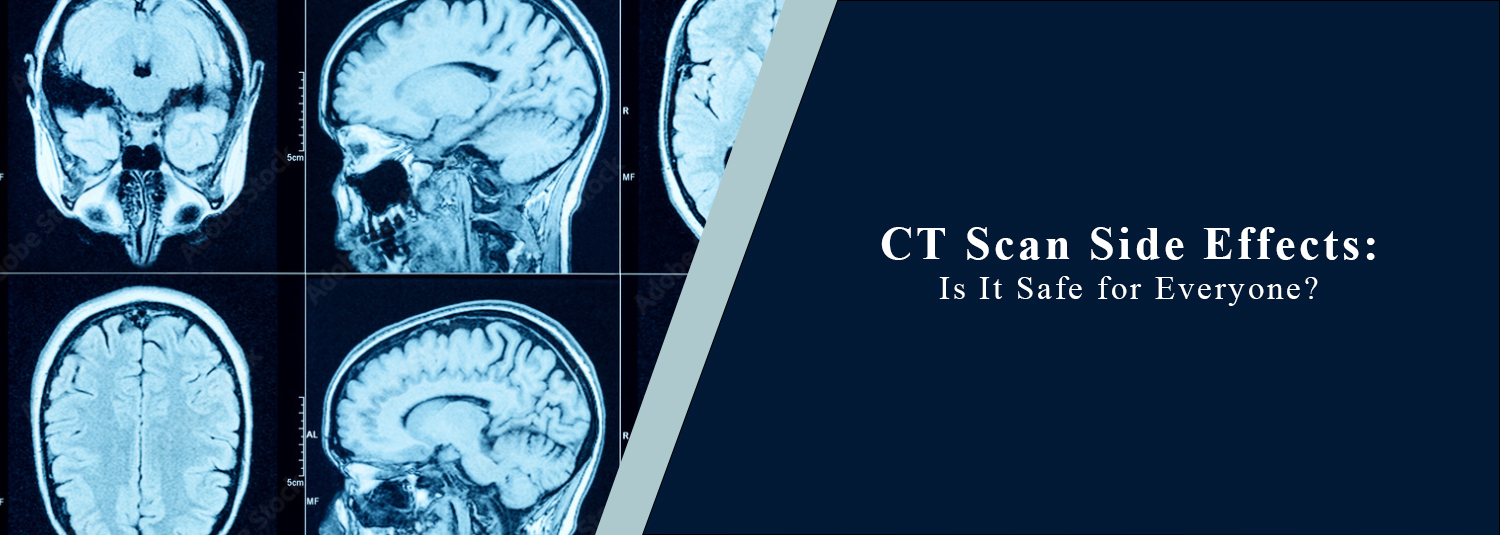
One of the most widely used imaging examinations in contemporary medicine is Computed Tomography (CT) scans. They offer high-resolution cross-sectional views of the body, which assist physicians in diagnosing a wide variety of conditions, including internal injuries and infections, tumors, and organ disorders. CT scans are especially useful in situations where time is of the essence and where making fast decisions is essential because of their speed and precision.
Most individuals fear the safety of CT scans despite their advantages. Concerns about radiation exposure, side effects, and long-term risks are rather common questions. Although CT scans are mostly safe, one should know how it works and their suitability for all people.
What Is a CT Scan?
A CT scan is a combination of computer technology and X-rays that are used to provide detailed images of the interior of the body. A CT scan can be compared to a regular X-ray except that the latter produces a single image, whereas the former gives multiple images at varying angles, which are then assembled to create a more detailed picture.
A contrasting dye is applied to make visibility better in certain instances. This dye assists in emphasizing the blood vessels, organs, and certain tissues, where doctors can easily detect abnormalities. Depending on the type of scan, the contrast material can be injected into a vein, orally, or in other forms.
Is a CT Scan Safe?
The CT scans are perceived to be safe in the hands of most individuals, provided they are carried out in accordance with medical advice. The intensity of the radiation in each scan is comparatively low and regulated. The doctors prescribe CT scans when the benefits of the diagnostic exercise outweigh the risks involved.
CT scans can be life-saving in most scenarios, particularly emergencies. They enable physicians to immediately identify internal bleeding, fractures, or severe illnesses that need urgent attention. Nonetheless, CT scans are not entirely safe, like any medical procedure.
Common Side Effects of CT Scans
A CT scan does not cause any side effects in most patients. The procedure is painless and non-invasive. But in the case of contrast dye, there will be mild and temporary effects.
Warm/flushing sensation upon injection.
Metallic taste in the mouth.
Light nausea or slight dizziness.
These effects tend to fade away in a couple of minutes and do not need any kind of treatment.
Potential Risks to Be Aware Of
Despite the fact that serious complications are not frequent, one should be aware of the potential risks of CT scans.
Radiation Exposure
CT scans are more radiative than normal X-rays. Although one scan has minimal risks, the impact of repeated exposure over time can lead to a slight possibility of getting cancer. That is why physicians do not do unnecessary scans because they are only prescribed when necessary.
Allergic Reactions to Contrast Dye
There are people who might have an allergy to the contrast material that will be used during the scan. Mild reactions can involve itching, rash, or swelling. There are a few instances where severe allergic reactions may take place, and this necessitates immediate medical care.
Kidney Function Concerns
Contrast dye may have an impact on kidney functioning, particularly in individuals with a prior diagnosis of kidney disease or diabetes. To eliminate this risk, doctors usually test the condition of the kidneys before using contrast.
Who Should Be More
Careful?
Although CT scans are not harmful to
the majority of individuals, some groups require additional measures. Pregnant
women are usually advised to avoid CT scanning unless it is necessary because
the radiation can be dangerous to the developing baby. In these instances,
other imaging procedures such as ultrasound or MRI are usually used.
Individuals who have a known kidney
issue are advised to notify their doctor before the scan, particularly where
contrast dye is used. Risks can be minimised with the help of proper hydration
and medical examination. Patients who have an allergy history, especially with
contrast material, are also supposed to inform their medical care provider.
Prevention, including medications or other imaging tests, can be taken into
account.
Benefits vs Risks
|
Benefits |
Risks |
|
Fast and accurate diagnosis |
Exposure to radiation |
|
Detects serious conditions early |
Possible allergic reactions |
|
Provides detailed internal images |
Kidney-related risks (with contrast) |
|
Useful in emergencies |
Not ideal for frequent repetition |
How to Reduce the Risks?
The CT scans are not very dangerous; however, a few precautions will reduce the possible risks as much as possible.
- It is important to always tell your doctor
your entire medical history.
- Do not forget to inform your doctor whether
you are pregnant or not, or if you suspect pregnancy.
- Keep yourself hydrated before and after the
scan.
- Repeat scans that are unnecessary should be avoided unless there is a medical necessity.
These are merely some of the steps that
should be followed in order to make the procedure safe and effective.
Conclusion
The CT scans have transformed diagnostic medicine, whereby a doctor is able to view the internal body with such detail and speed. They are particularly useful when identifying conditions that are life-threatening and making treatment decisions. To the majority of individuals, the process is risk-free, fast, and very valuable.
Although radiation and contrast dye are not without their dangers, they are, as a rule, insignificant and can be easily addressed by the medical staff. The trick is to take CT scans with responsibility and only when prescribed by a medical expert.
In case of any concerns regarding the side effects or safety, you can talk about it with your doctor and get the necessary reassurance and clarity. Learning makes you feel confident about the process and makes sure that you are getting maximum care.
Frequently Asked Questions
In News
Get Our Mobile App
for Easy Access
Book tests, view reports, and manage your health records on the go. Experience convenient healthcare with Molecular Diagnostics and Therapy.
- ✔ Book tests & home collection
- ✔ View reports instantly
- ✔ Track health history
- ✔ Get notifications & reminders
- ✔ Easy appointment management