MRI vs CT Scan: Which Test Is Better for Accurate Diagnosis?
Talk to Health Expert

Dr. Nikunj Jain
Co-Founder and HOD - Nuclear Medicine ,MBBS, DRM, DNB, FEBNM, FANMB, Dip. CBNC
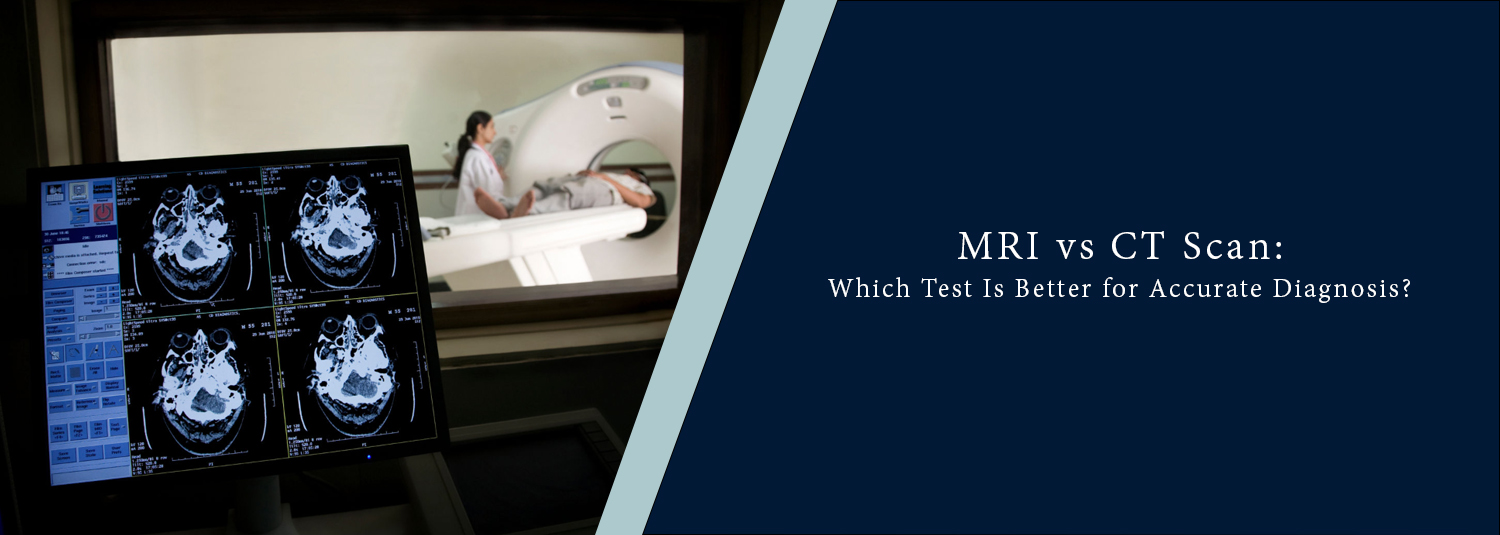
Radical imaging technologies are the core of modern healthcare as they enable the treatment device to work with high precision and speed, detecting diseases. The two most widespread types of diagnostic tools are MRI (Magnetic Resonance Imaging) and CT (Computed Tomography). Although both play an important role in medical diagnosis, there is a tendency for patients to be confused about which one is superior.
The fact is that MRI and CT scans are complementary and not substitutes. All of them possess their advantages, and the selection is determined by the nature of the condition under assessment, the urgency of the diagnosis, and the amount of information that should be offered. Being aware of these distinctions between the two can enable patients to be more confident and well-informed on their healthcare journey.
What is an MRI Scan?
MRI is a non-invasive imaging technique that involves very strong magnetic fields and radio waves, which give an extremely detailed image of the internal organs. Its greatest strengths are that it is not associated with radiation and therefore it is safer in most instances, particularly where an individual requires repetition of scans.
In imaging of soft tissue, MRI works especially well. It is very useful in studying the brain, spinal cord, muscles, ligaments, and inner organs, and offers great clarity. This renders it quite effective in the process of identifying neurological conditions, sporting injuries, and tumors. Due to its better contrast resolution, MRI is also able to detect even the smallest abnormalities that would otherwise not be apparent using other imaging methods.
Nevertheless, MRI scans require a longer time in comparison to CT scans, which can last between 30 and 60 minutes. The patients have to remain motionless inside an enclosed machine, which, in rare cases, may be an uncomfortable experience, particularly to people with claustrophobia.
What is a CT Scan?
A CT scan involves the use of X-rays and sophisticated computer processing techniques so as to produce cross-sectional body images. The CT scans are very versatile, as they show detailed images of bones, organs, and blood vessels.
Achieving high speed is one of the greatest benefits of CT scans. All this process takes a few minutes, hence they are very handy during emergencies. Indicatively, CT scans are used in instances of accidents, head injuries, or internal bleeding to assist the doctor in making quick and accurate decisions.
CT scans have become very popular in identifying fractures, lung complications, infections, cancer, and kidney stones. Modern CT technology does this even though it is associated with little radioactivity since the exposure levels are kept to a minimum without affecting image quality.
Key Differences Between MRI and CT Scan
To better understand their roles, here is a simple comparison:
When is MRI More Accurate?
MRI is regarded as a more accurate option to use in cases of detailed visualization of soft tissues. It is the option of choice when the situations include:
Mental illnesses and neurofibromatoses.
Spinal cord dentures and disc troubles.
Damage to ligaments and joints.
Soft tissue tumors
Abdominal and pelvic organs assessment.
It is perfect when it comes to diagnosing complex and non-emergency cases, as it is capable of giving high-resolution images, thus requiring high accuracy.
When is a CT Scan More Effective?
When there is emphasis on speedy performance and clarity of dense structures, then CT scans work best. They are usually prescribed in the following situations:
Skeletal injuries and bone fractures.
Intraprostatic hemorrhaging or injury.
Chest conditions and lung infections.
Kidney stones
Emergency diagnosis
When it comes to a critical situation, the CT scan may also be the option of the first available because of its fast results and reliability.
How Do Doctors Decide?
The choice of either an MRI or a CT scan depends on several factors. The doctors will look at the symptoms of the patient, health history, and the region that needs to be inspected. They also consider the urgency of the condition and the need to use detailed soft tissue imaging.
In general:
MRI is selected because it can be used to analyze the soft tissues and chronic diseases in greater detail.
Quick diagnosis, such as in an emergency, is better done using a CT scan.
It has been known that the patients should always do what the doctor says because the selection of the appropriate test is essential to proper diagnosis and a proper treatment plan.
Safety and Considerations
Both CT and MRI are safe when taken under valid medical guidance. Nonetheless, similar to the general points that have to be remembered, there are some crucial points. MRI is non-radiant and might be incompatible with patients who have some metal implants, pacemakers, and other medical devices. Also, the closed nature of the machine can prove uncomfortable to others. Scans through CT require a limited radioactive dose that is not normally very harmful. Noticeable repetitive exposure, however, is not taken unless necessary due to medical reasons.
Conclusion
Both MRI and CT are potent diagnostic methods that are indispensable elements of contemporary medicine. MRI has a reputation for providing an extensive view of non-radiative soft tissues, hence it is useful in complex and non-emergency conditions. CT scans, however, are quick, effective, and extremely useful in the detection of bone trauma and life-threatening ailments.
Rather than inquiring about which test is better, one would want to know what kind of test one needs in a certain circumstance. Correct diagnosis requires the appropriate choice of the imaging technique at the appropriate time.
We at Molecular Diagnostics and Therapy, where radiologists and highly developed technology in imaging combine to provide high-quality and timely results. Get an MRI or a CT scan. We are devoted to the idea of accuracy, safety, and comfort of the patient, helping you make the right choice towards a healthier existence.
Frequently Asked Questions
In News
Get Our Mobile App
for Easy Access
Book tests, view reports, and manage your health records on the go. Experience convenient healthcare with Molecular Diagnostics and Therapy.
- ✔ Book tests & home collection
- ✔ View reports instantly
- ✔ Track health history
- ✔ Get notifications & reminders
- ✔ Easy appointment management