
Ultrasound vs MRI: Key Differences You Should Know
Talk to Health Expert

Dr. Nikunj Jain
Co-Founder and HOD - Nuclear Medicine ,MBBS, DRM, DNB, FEBNM, FANMB, Dip. CBNC
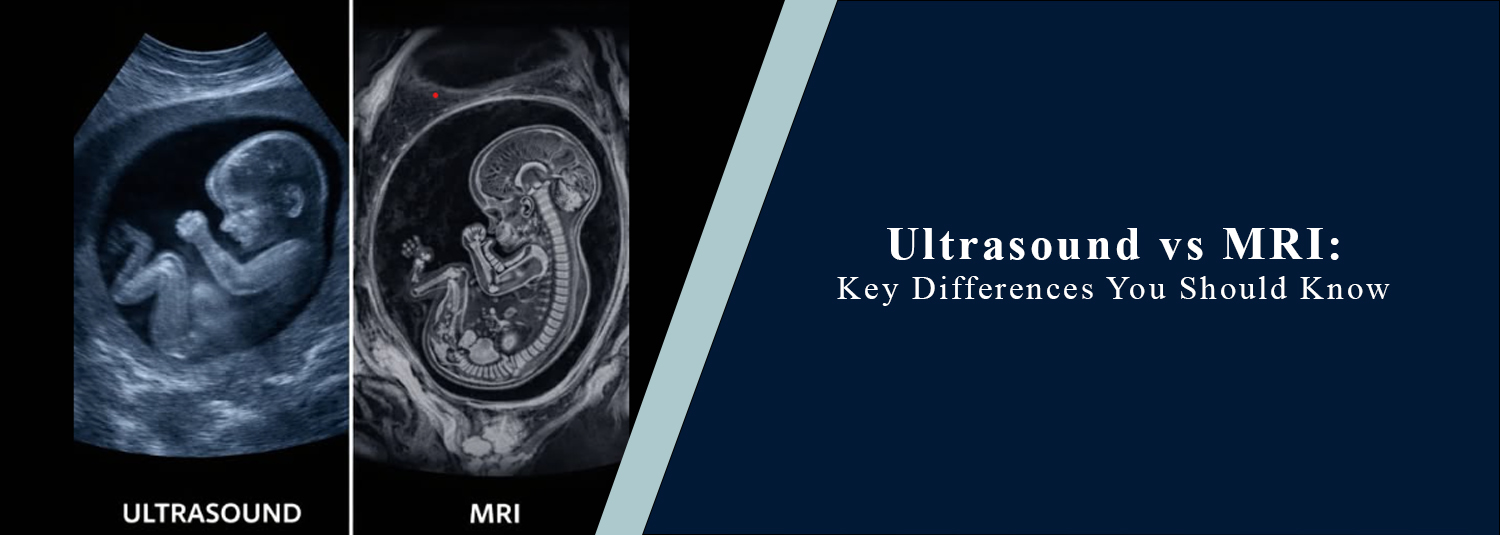
Medical imaging is an important diagnostic and monitoring tool that can be used to identify and treat a large variety of medical issues. The most popular methods in imaging include MRI and ultrasound. Although both are very effective, they have different purposes and are applied in various types of clinical situations.
Knowledge of the distinction between ultrasound and MRI can guide you in making the right decisions when your physician prescribes the diagnostic procedure.
What Is an Ultrasound?
Ultrasound is a method of diagnostic imaging which makes use of high-frequency sound waves to make images of body organs and structures. The fact that it is safe, fast, and not based on the concept of radiation makes it a commonly used one.
Commonly, this test is used to test the abdomen, pelvis, and blood vessels. It is also the choice in terms of pregnancy surveillance since it offers real-time images of the growing foetus.
Ultrasound finds application especially in the assessment of the soft tissues and fluid-filled structures, such as the liver, kidneys, gallbladder and uterus.
What Is an MRI?
MRI (Magnetic Resonance Imaging) is a high-grade procedure of imaging that involves the application of powerfully enhanced magnetic fields and radio waves to bring out extremely clear images of the inner body organs and tissue. It can particularly be used to investigate the brain, spine, joints and soft tissues.
MRI does not employ the use of radiation as compared to X- rays or CT scans. Rather, it gives high-resolution images which facilitate the identification of abnormalities that may otherwise not be detected using other forms of imaging.
MRI can be used to diagnose neurological diseases, tumours, lacerations of the ligament, and chronic diseases.
Key Differences Between Ultrasound and MRI
Even though both MRI and ultrasound are effective and safe, the two are vastly different in terms of the technology, usage, and detail. The following is an obvious analogy:
This comparison shows that, though ultrasound is efficient, fast, and cheap, MRI will give greater and more accurate imaging.
When Is an Ultrasound Recommended?
Simplicity and accessibility of ultrasound in most cases make it the most recommended imaging test. It is perfect during routine examinations and first-time diagnosis.
Usually, doctors recommend an ultrasound on:
Pregnancy monitoring
Abdominal pain or distension.
Stones in the kidney or in the gallbladder.
Pelvic examinations
Blood flow evaluation (Doppler ultrasound).
It is also used in patients who need a quick and non-invasive test.
When Is an MRI Recommended?
MRI is required in case of a more detailed and comprehensive view. It is frequently employed in cases of insufficient information in the ultrasound or other imaging tests.
MRI is usually recommended in conditions associated with:
Brain and nervous system disorders.
Spinal cord injuries
Damage to the joints and ligaments.
Tumours and cancers
Unidentified chronic pain.
MRI is usually applied in complex diagnosis and planning of treatments due to its high accuracy.
Advantages of Ultrasound
Ultrasound has a number of advantages that predispose it to be a popular diagnostic utility. It is fast, painless and does not entail a lot of preparation. It is thought to be very safe even in expectant women because it does not radiate.
The other benefit is that it has a real-time image showing capability, where doctors can see movement (blood flow or baby movements). It is also cheaper than complicated imaging procedures.
Advantages of MRI
The image quality and clarity of MRI cannot be compared to any other diagnostic technology, and thus, it is one of the most developed technologies in diagnostics. It is able to detect very minor abnormalities that cannot be noticed using alternative methods.
It is specifically effective in assessing soft tissues; thus, it is effective in determining neurological disorders, injuries of the joint, and tumours. Furthermore, MRI is able to provide images at various angles, such that they give an overall picture of the affected area. MRI is invaluable in complicated cases, although it is more costly and time-consuming.
Which One Should You Choose?
Ultrasound and MRI are two medical procedures that would depend on your medical condition, symptoms and what your doctor advises you to do. Ultrasound is performed in most instances as a screening instrument, and MRI is carried out as a more elaborate assessment instrument when necessary.
Self-decision about the type of test to be performed is not a good idea. The best imaging procedure will be recommended to you by a qualified medical practitioner, depending on the nature of your medical concerns.
Conclusion
Ultrasound and MRI are critical diagnostic methods that have a set of advantages and uses. Whereas the ultrasound is fast, safe, and affordable, MRI is informative with an in-depth and highly detailed image.
At Molecular Diagnostics and Therapy, we provide high-quality medical ultrasound and MRI services with professional service, hence correct diagnosis and quality results. In case an imaging test was suggested by your doctor, you should trust the process and select a diagnostic centre as reliable as possible. Diagnosis is the way to good health at an early phase.
Frequently Asked Questions
In News
Get Our Mobile App
for Easy Access
Book tests, view reports, and manage your health records on the go. Experience convenient healthcare with Molecular Diagnostics and Therapy.
- ✔ Book tests & home collection
- ✔ View reports instantly
- ✔ Track health history
- ✔ Get notifications & reminders
- ✔ Easy appointment management
