Why Some Diseases Don’t Show in MRI but Appear in Molecular Imaging?
Talk to Health Expert

Dr. Nikunj Jain
Co-Founder and HOD - Nuclear Medicine ,MBBS, DRM, DNB, FEBNM, FANMB, Dip. CBNC
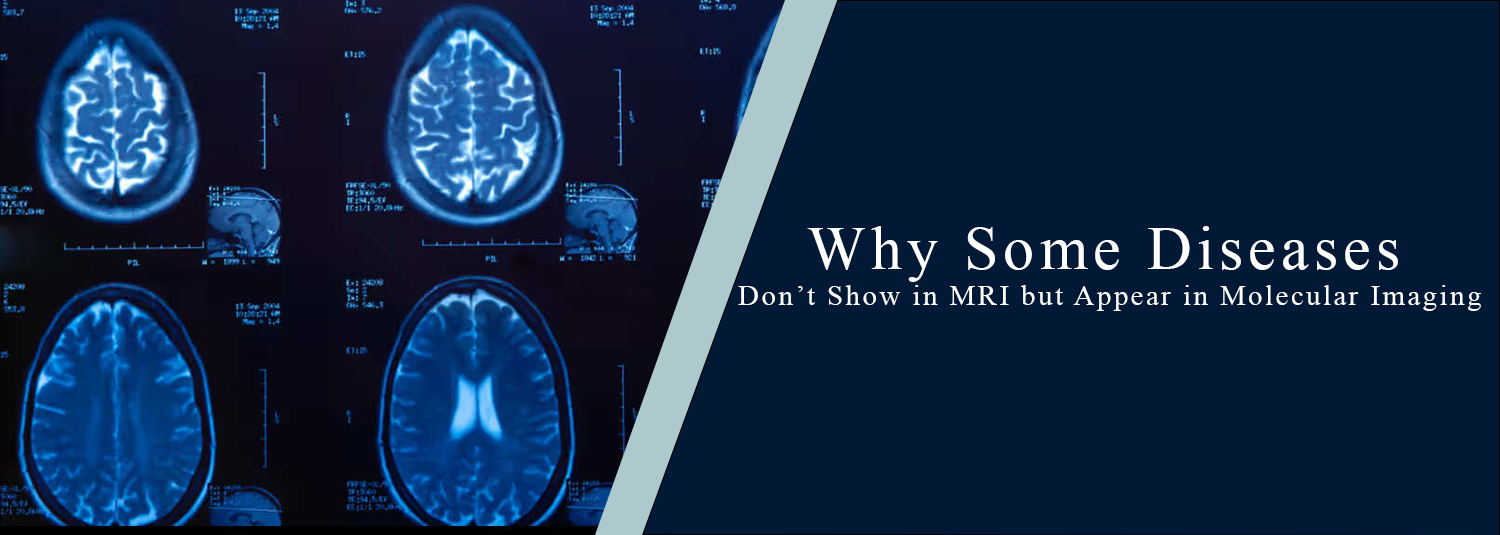
Diagnostic imaging has evolved, and modern diagnostic imaging simplifies the process through which physicians detect and diagnose diseases. MRI (Magnetic Resonance Imaging) is one of the most applied equipment. MRI has a reputation for producing pictures of organs and tissues in such detail. Although MRI is modern, it is limited. Some diseases may not be apparent on an MRI scan, but would instead be visible by using molecular imaging.
To know why that is the case, you should pay closer attention to the technologies and their functionality, and what they seek.
Understanding MRI: Structure Over Function
MRI does well in portraying the structure of the body. It has powerful magnets and radio waves that are used to make detailed images of organs, muscles, and bones. MRI is especially useful for:
Imaging of the Brain and Spinal Cord.
Joint and muscle injuries
Structural issues and encountering tumors.
MRI primarily demonstrates anatomy, the bodily form of tissues. It does not frequently show early disease at either cell or chemical level.
What Is Molecular Imaging?
Molecular imaging is concerned with the functional aspects of cells and tissues and not their morphologies. It involves small portions of radioactive material to emphasize biological activities within the body. Wide use tests of molecular imaging include:
Positron Emission Tomography (PET)
Single Photon Emission Tomography (SPECT)
Such scans are able to reveal how tissues are performing, including how they utilize sugar, blood flow, or receptors.
The Key Difference: Structure vs Function
The key factor that prevents these diseases from displaying in MRI and displaying in molecular imaging is that they involve functional alteration, followed by structural alteration.
MRI identifies physical abnormalities (ex, tumors, swelling, tears).
Molecular imaging identifies life activity (e.g., higher metabolic rate, anomalous cellular response).
Functional changes occur before structural changes in most diseases, and therefore, molecular imaging is able to detect the issue earlier.
Diseases That May Not Appear on MRI
1. Early-Stage Cancer
Initially, cancerous cells do not necessarily form a distinct mass. Even minor alterations are difficult to observe on MRI. The difference is that cancer cells are normally more active in terms of metabolism, and this is detected through a PET scan.
2. Neurological Disorders
Prior occurrence of the disease has no obvious structural alterations in early Alzheimer's disease. MRI may be benign, whereas molecular imaging may identify decreased brain activity or abnormal protein deposition.
3. Infection and Inflammation
Tissue shape may not yet have been changed by infections or inflammation. However, the abnormalities of tonic activity of cells referring to the immune response can be emphasized with the help of molecular imaging.
4. Cardiac Ischemia
Reduced blood supply to the heart could not lead to apparent damage at an early stage. The decreased flow may be demonstrated by molecular imaging and be diagnosed as at-risk heart tissue.
5. Cancer Recurrence
After treatment, scar tissue may look similar to active disease on MRI. Molecular imaging helps differentiate between inactive scar tissue and active cancer cells.
Why MRI Alone Is Sometimes Not Enough?
MRI is highly detailed, yet there are limitations:
It may miss lesions that are very small or early.
It is not always possible to know whether the tissue is active or not.
It lacks metabolic and chemical details.
This is where molecular imaging provides a crucial advantage.
The Power of Combining Both Techniques
MRI and molecular imaging are commonly used as one tool by doctors to see the complete picture. Example:
MRI and the positions and size of a spot are precise.
PET reveals either the presence or absence of aggressiveness at that spot.
The hybrid tests of PET-CT or PET-MRI combine structural and functional data and provide a more precise diagnosis and superior treatment regimen.
Real-World Example
The MRI of the suspected patient with a brain tumor may be normal in case the tumor is too small or structurally obscure. Even a PET scan would indicate unusual metabolism in a particular location, allowing the doctor to detect the disease earlier.
MRI does indicate a mass in the follow-up of cancer, but it is only through molecular imaging that it can be known whether this is active cancer or harmless scar tissue.
Why This Matters for Patients?
The reason this is important to patients is that it enables them to grasp the essence or nature of their personalities. The awareness regarding MRI and molecular imaging will enable patients to make informed decisions when it comes to diagnosis and care.
When the symptoms still persist despite having a normal MRI, the doctors can recommend more complex imaging. This does not imply that a single test was not carried out; it only implies that an alternative test is required to identify functional variations.
Conclusion
MRI is strong, yet it is not always sufficient. Certain diseases begin at a minute or functional level, many years before it becomes structurally apparent. Molecular imaging seals that gap, as it shows the working of the body on a cellular level. Collectively, the tools provide a picture of the whole health, leading to early diagnosis, correct diagnosis, and improved treatment.
However, in modern medicine, it is not about selecting one tool as opposed to the other, but about using the appropriate tool at the appropriate time, to discover what the body, for the moment, has not been able to present on the surface.
Frequently Asked Questions
In News
Get Our Mobile App
for Easy Access
Book tests, view reports, and manage your health records on the go. Experience convenient healthcare with Molecular Diagnostics and Therapy.
- ✔ Book tests & home collection
- ✔ View reports instantly
- ✔ Track health history
- ✔ Get notifications & reminders
- ✔ Easy appointment management