How Nuclear Medicine Detects Disease Before Symptoms Start?
Talk to Health Expert

Dr. Nikunj Jain
Co-Founder and HOD - Nuclear Medicine ,MBBS, DRM, DNB, FEBNM, FANMB, Dip. CBNC
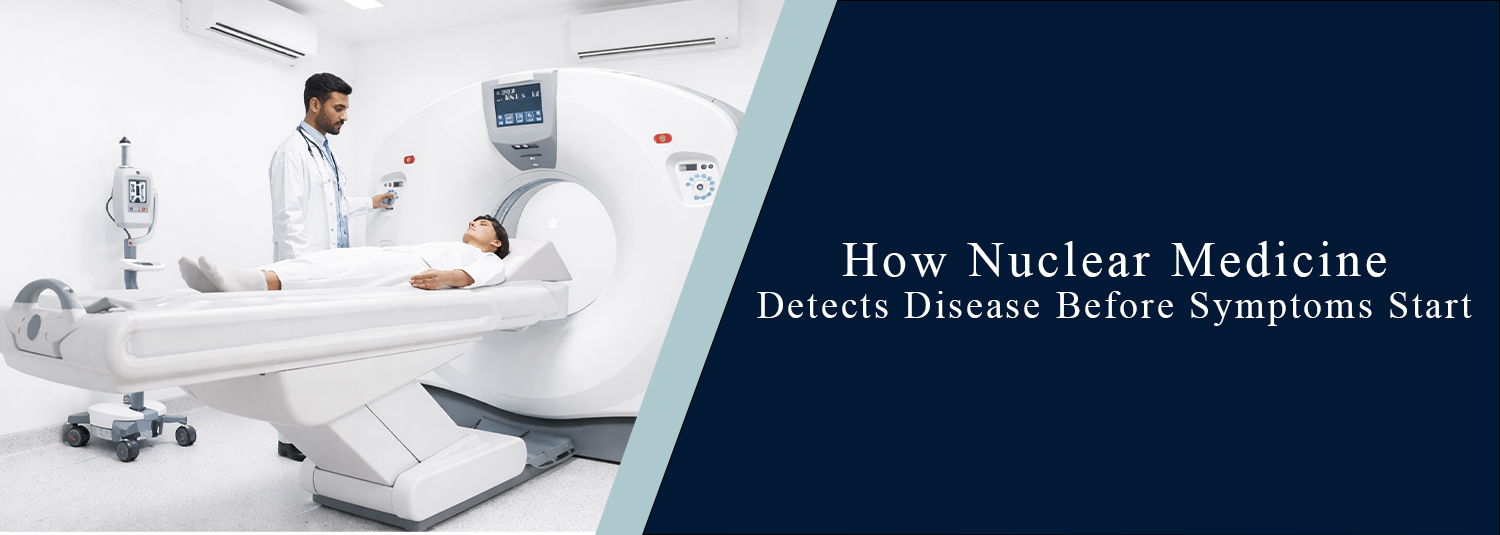
In healthcare today, earlier detection of a disease would be a simple treatment rather than a complex one. Numerous severe diseases like cancer, heart diseases, and disorders of the brain start unannounced. By the time symptoms manifest, the disease might be much more advanced. Nuclear medicine is able to detect disease earlier in comparison to the normal tests.
What Is Nuclear Medicine?
Nuclear medicine involves the use of minimal radioactive material, known as radiotracers, to visualize the functioning of the body parts. The normal X-rays, CTs, and MRIs examine the form of organs, while nuclear medicine examines cell and molecular behaviour.
These radiotracers are either injected into the bloodstream, inhaled, or swallowed, depending on the test. Once inside the body, they travel to specific organs or tissues. A special camera, such as a gamma camera or PET scanner, detects the radiation emitted and creates detailed images of the body’s internal activity.
Detecting Disease at the Molecular Level
Nuclear medicine is able to reveal minute alterations in the body when no damage is evident. These metabolisms occur on a chemical basis within the cells. As an example, cancerous cells can proliferate rapidly, or the heart muscle can receive reduced blood supply, and one will not experience any pain or fatigue.
This scan reveals the location of metabolic abnormalities, which enables the doctors to detect illness when the first signs are detected, in some cases, many years before the patient can sense anything.
Early Detection of Cancer
Nuclear medicine comes in use for the detection of cancer. PET scans detect cancer cells since they consume energy at a higher rate compared to normal cells. A standard tracer is FDG, which functions similarly to glucose. The cells with the cancer absorb more FDG, thus appearing bright on the scan. This allows physicians to identify tumors early, determine whether the cancer has metastasized or not, and monitor the effectiveness of treatment.
Early detection of cancer is better because it offers higher survival rates and option of treatment choices; therefore, the role of nuclear medicine is significant in the treatment of cancer.
Identifying Heart Disease Before It Becomes Critical
Heart disease accumulates over time, and one may not notice it until they have a heart attack. Nuclear medicine scans, such as a myocardial perfusion scan, determine the locations of the heart muscle that is receiving insufficient blood.
Through tracers that indicate the flow of blood, physicians identify early blocked blood vessels, hence provide preventive therapy or lifestyle modifications before it is life-threatening.
Understanding Brain Disorders Early
Early detection of brain issues like Alzheimer's, Parkinson's, and epilepsy can be easily achieved through the use of nuclear medicine. PET and SPECT scans demonstrate the functioning of the brain and the way blood is circulated.
To take an example, the brain of Alzheimer's patients slows down in some parts, even before memory impairment is evident. The disease can be managed and slowed down through early diagnosis.
Personalized and Targeted Diagnosis
Nuclear medicine is also used to personalize treatments for individuals. Due to the fact that it demonstrates how the body functions, a doctor obtains a lot of specific information and is able to develop a plan that would suit the patient.
In some cases, the tracer that identifies the disease can also be used as therapy. This concept is known as theranostics and is applicable in certain types of cancers in which the drug can only kill unhealthy cells and leave the healthy ones intact.
Safe and Minimally Invasive
Although Nuclear medicine involves the use of a radioactive material, it is generally harmless. The amount of the radiation is small and is monitored. The tracer has a tendency to leave the body promptly. The tests are not invasive and cause no pain, hence the patients are comfortable. Nuclear imaging, compared to surgery, in the diagnosis of diseases, reduces risk and recovery time.
The Future of Early Disease Detection
Technology continues to improve, which makes nuclear medicine more precise and simpler. To provide more realistic results, new tracers are designed to be used to address certain diseases. Robotic software and the use of AI assist in the rapid scan readout, and with greater accuracy by doctors. Such advancements lead to a future where diseases are diagnosed and cured very early before they arise to serious cases.
Conclusion
Nuclear medicine represents a major shift in how we approach disease detection. By focusing on the body’s function rather than just its structure, it allows healthcare providers to identify problems at their earliest stages, often before symptoms appear.
This early insight not only improves treatment outcomes but also empowers patients to take proactive steps toward better health. In a world where prevention is better than cure, nuclear medicine stands as a powerful tool in the fight against silent and life-threatening diseases.
Frequently Asked Questions
In News
Get Our Mobile App
for Easy Access
Book tests, view reports, and manage your health records on the go. Experience convenient healthcare with Molecular Diagnostics and Therapy.
- ✔ Book tests & home collection
- ✔ View reports instantly
- ✔ Track health history
- ✔ Get notifications & reminders
- ✔ Easy appointment management