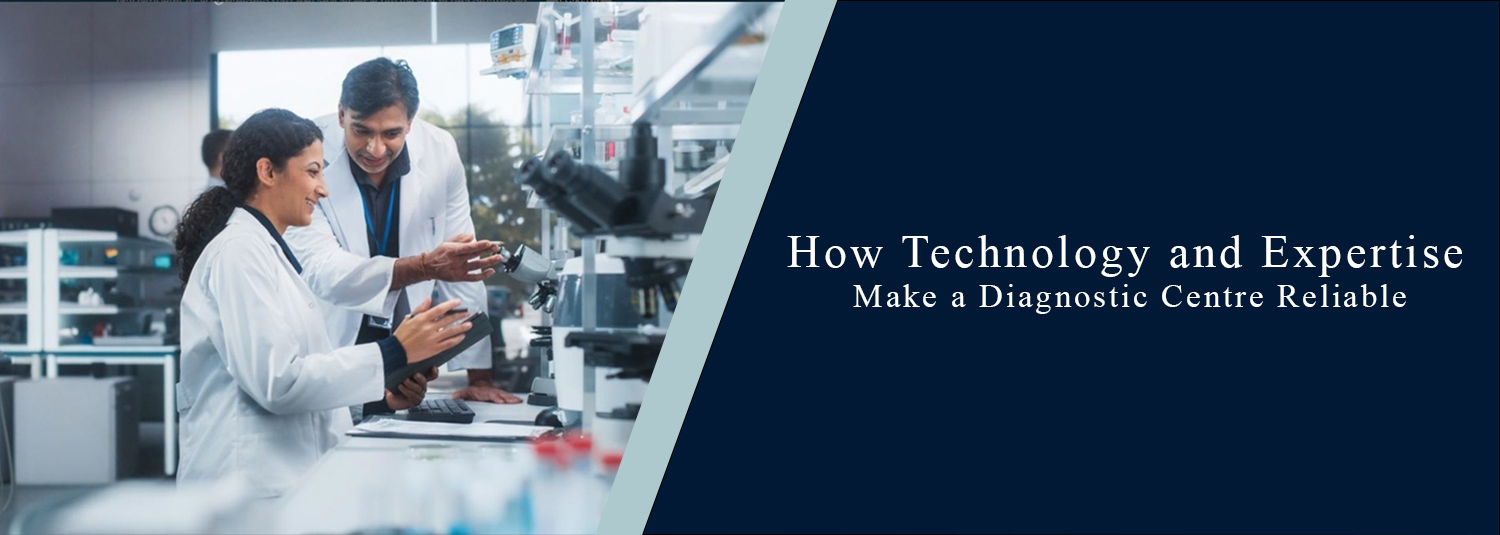
How Technology and Expertise Make a Diagnostic Centre Reliable?
Talk to Health Expert

Dr. Nikunj Jain
Co-Founder and HOD - Nuclear Medicine ,MBBS, DRM, DNB, FEBNM, FANMB, Dip. CBNC
Proper diagnosis is the most important aspect of good treatment in modern health care. Before the initiation of the treatment plan, doctors administer tests such as CT scans, MRI scans, PET scans, ultrasound, and laboratory tests to view what is inside the body. Because of this, choosing a reliable diagnostic centre has become extremely important for patients and healthcare providers alike.
Major technological advancements in medicine and qualified health care providers are the two key areas on which a good diagnostic centre is founded. Examinations conducted by good equipment and highly qualified specialists provide correct results, identify diseases on time, and result in better treatment of the patient.
The Role of Advanced Technology in Diagnostics
Medical technology has altered the way we discover illnesses in the past several decades. The machines that are available today enable physicians to identify illness earlier and with greater accuracy.
These are high-resolution MRI scanners, multi- slice CT scanners, PET-CT imaging and digital ultrasound diagnostic centres. These devices generate such detailed images of organs, tissues, and bones, which assist the doctors in identifying issues which might otherwise not be detectable during a regular examination.
Indicatively, PET-CT scans are widely used in the diagnosis and treatment planning of cancer since it demonstrates the way cells operate at a minute level. Similarly, state-of-the-art MRI devices enable physicians to view the state of the brain, spinal issues, and soft-tissue injuries with much clarity.
Modern technology increases the accuracy of the tests, decreases the possibility of errors, and assists the doctor with planning his treatment.
Faster and More Efficient Testing
The other significant advantage is faster testing. The new imaging systems have images that are of better quality and take a shorter time compared to the old ones, thereby taking less time in scanning, yet giving out quality results.
Fast tests are highly valued where critical decisions are to be made as is the case with suspected strokes, accidental injuries, or the early detection of cancer. Some of its best outcomes and the highest rates of survival are usually a result of early diagnosis.
Online digital systems also allow centres to store images and share them online. This will ensure that doctors are able to consult and read reports fast and consult specialists when necessary.
The Importance of Medical Expertise
Technology is necessary, but equally important are trained professionals with a proper understanding of how to interpret the results properly. A good centre will always have quality radiologists and specialists in nuclear medicine, as well as trained technicians to ensure that they do the tests safely and reliably.
The radiologists view pictures and prepare comprehensive reports, which are used by doctors to diagnose diseases. Their process is useful in identifying subtle issues that may not be detected. Molecular imaging and radionuclide scan readings are interpreted by nuclear medicine specialists to identify such complex ailments as cancer, heart disease and neurological disorders.
Technicians and technologists also play a key role in ensuring that diagnostic procedures are performed correctly. Their training helps maintain proper imaging techniques, patient positioning, and safety protocols during tests.
Quality Control and Safety Standards
The reliability also relies on the quality and safety regulations that are adhered to by a centre. In order to maintain machines, good centres have strict protocols that ensure machines are kept calibrated and well-maintained very often.
Quality checks ensure that the results of the tests remain consistent and true to the test. This is of particular significance to those devices that are sensitive to exact measurements (as in CT scanners and nuclear medicine).
The other important factor is patient safety. Centres adhere to radiation safety protocols in order to minimise superfluous exposure and provide high-quality imaging. Effective safety ensures the safety of patients as well as staff.
Patient Comfort and Experience
A reliable centre is also concerned with patient comfort and experience. Most patients become anxious when waiting to take imaging tests, particularly MRI or PET scans. The staff should be friendly and facilities updated to minimise stress and make the process of taking tests easy.
Well-furnished waiting area, effective communication with the staff and appointment systems pay off. Patients have confidence in the diagnostic process when they are supported and informed.
Why Technology and Expertise Must Work Together?
The use of technology alone cannot assure credible diagnostics. Even the most advanced machines require individuals who are skilled to operate the machines and interpret the results. Similarly, competent physicians must have quality instruments in order to make proper evaluations.
Centres that combine advanced technology and medical expertise result in much more accurate, timely and reliable information that assists doctors in making improved treatment decisions.
This collaboration is particularly critical in such aspects of human health as cancer imaging, heart diagnostics, and nuclear medicine, where accuracy is paramount in treating patients.
Conclusion
The ability to diagnose and be treated correctly is only possible when one chooses a reliable diagnostic centre. There are more detailed pictures given by modern technology and quicker outcomes, and the skilled specialists make sure that those outcomes are properly interpreted.
Technology and expertise together form a diagnostic environment that dwells on the issues of accuracy, safety and patient care.
Advanced imaging technologies are used at Molecular Diagnostics and Therapy. We have experienced nuclear medicine specialists and thus assemble reliable and precise diagnostic services. Through innovation, accuracy, and comfort of patients, we empower doctors and patients to achieve greater health outcomes by providing the highest quality solutions to both.
Frequently Asked Questions
In News
Get Our Mobile App
for Easy Access
Book tests, view reports, and manage your health records on the go. Experience convenient healthcare with Molecular Diagnostics and Therapy.
- ✔ Book tests & home collection
- ✔ View reports instantly
- ✔ Track health history
- ✔ Get notifications & reminders
- ✔ Easy appointment management