How Technology Is Making Diagnostics Faster and More Accurate?
Talk to Health Expert

Dr. Nikunj Jain
Co-Founder and HOD - Nuclear Medicine ,MBBS, DRM, DNB, FEBNM, FANMB, Dip. CBNC
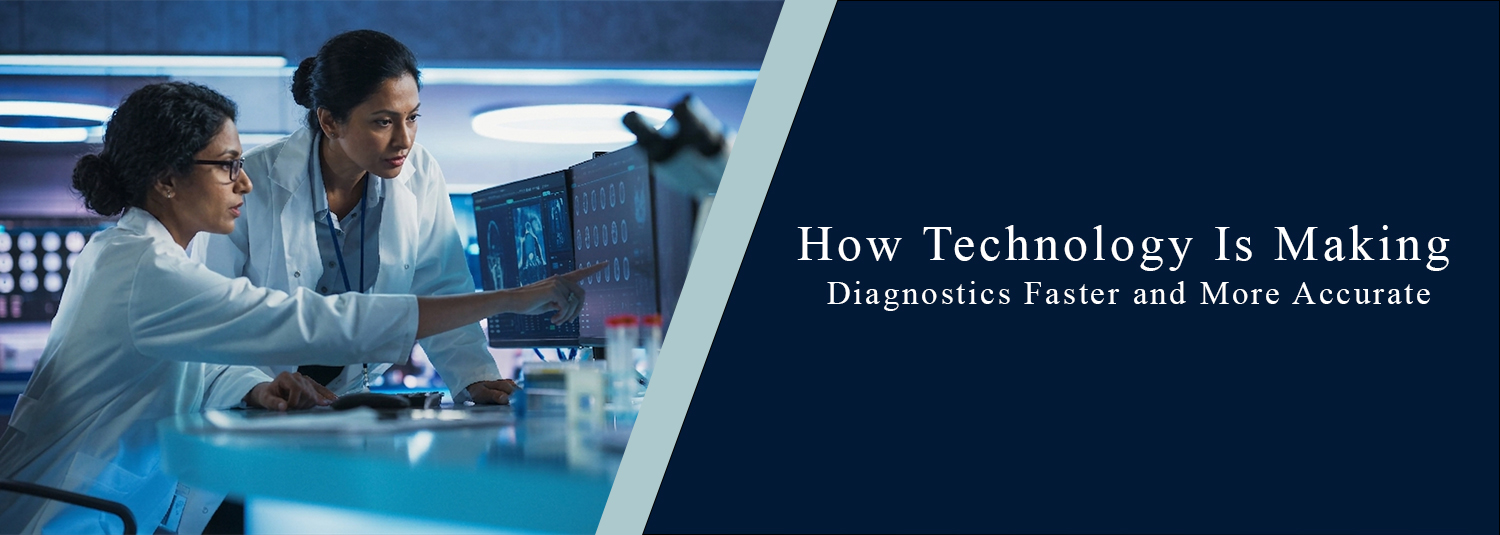
In the modern day health care, early detection and correct treatment of problems is a significant factor in good treatment. Technology: The rapid technological advancement has simplified the process of identification and management of diseases. Tests have become faster and more precise, and now, this keeps patients healthier and allows doctors to make better decisions.
Continuous and ever-advancing technology, through improved imaging tools up to smart computer software, is contributing to the fact that it is becoming easier, more accurate, and quicker to diagnose patients.
Evolution of Diagnostic Technology
In the past, physicians relied on checkups and simple laboratory test results as the predominant diagnosis methods. These helped, but they tended to lack timely detection of diseases.
New imaging technologies, such as CT, MRI, PET-CT, as well as ultrasound, can help physicians to see inside the body at extremely fine details. They have transformed how we seek diseases as well as illnesses like cancer.
These machines have improved and are more sophisticated, faster, and more precise.
High-Resolution Imaging for Better Accuracy
One giant leap is high-resolution imaging. Scanners today provide very clear images and allow doctors to identify minute problems.
For example:
The state-of-the-art MRI machines have higher soft tissue contrast.
Multi-slice CT scanners detect detailed cross-sectional images.
PET-CT-scans show the metabolic activity on the cellular level.
This detail assists in the early detection of diseases, which is important in treatable diseases.
Faster Scan Times and Quick Results
The time required for tests is reduced thanks to Tech. New machines complete scans in a short period of time, yet produce good images.
In brief scan periods have several advantages:
Fewer patients in pain.
Reduced possibilities of movement error.
Digital means also enhance the speed of analysis and reporting, and, therefore, doctors are able to initiate treatment immediately.
Role of Artificial Intelligence (AI)
The role of AI in imaging is increasing. Intelligent algorithms scan images, detect issues, and assist physicians in interpreting the images.
AI helps in:
Detecting unobtrusive alterations in images.
Reducing human error
Quickening of report production.
Normalising the diagnosis interpretation.
In cases where physicians are involved in collaboration with AI, diagnosis becomes quick and precise.
Automation in Laboratories
Labs have also improved with technology. Automatic machines can process numerous samples within a short time, and they are correct.
Automation reduces:
Manual errors
Turnaround time
Variability in results
This provides uniform and steady laboratory reports that are needed to make a proper diagnosis and treatment planning.
Digital Reporting and Integration
The transition of paper to digital has facilitated the speed of testing. Reporting has been turned computerised and can be easily shared with the doctors and patients.
Digital reporting has the following advantages:
Quick access to reports
Easy storage and retrieval
Better communication among health care providers.
Reduced paperwork
Improved Patient Safety
New machines are constructed in order to keep the patients safe and minimise risks in the course of the test.
Examples include:
Minimised radiation levels with low-dose CTs.
Less dangerous imaging contrast agents.
State-of-the-art technology in the course of testing.
Such advances are used to diagnose a patient with accuracy and minimal risks.
Enhanced Detection of Complex Diseases
Technology now allows for finding serious illnesses more narrowly. In the field of oncology, advanced imaging methods are useful in:
Early breast tumour detection.
Identifying metastasis
Check of response to treatment.
On the same note, in cardiology and neurology, medical diagnostic equipment today gives a comprehensive report on heart disease and brain conditions, and thus, intervention is timely.
Telemedicine and Remote Diagnostics
Technology also provides more access via telemedicine to people. The physicians are able to view imaging remotely and provide feedback. This is of particular use to:
Rural or remote patient.
Cases of emergency that need urgent consultation.
Second opinion on complicated diagnoses.
Remote diagnostics means that the patients can receive quality care, no matter how far they may be.
Continuous Innovation in Healthcare
New research continues to improve diagnostics. Future care is determined by new concepts, such as molecular imaging, AI predictions, and wearable devices.
These developments have the purpose of making diagnostics:
More personalized
More precise
More accessible
Further development will make the diagnosis even faster and more accurate.
Conclusion
Technology has introduced new changes in the diagnostic services to the extent of rendering them quicker, more vibrant, and more accessible. High-resolution imaging and the incorporation of AI are only a fraction of the progress of medical services, enhancing the quality of healthcare. Automated laboratories and reporting are another aspect.
Treatment is only effective through accurate diagnosis, and timely diagnosis is made possible by modern technology, which guarantees the patient the best possible treatment. Diagnostic centres such as Molecular Diagnostics and Therapy are embracing modern technologies to offer quality and accurate diagnostic services, which will contribute to the positive health outcomes of patients.
Frequently Asked Questions
In News
Get Our Mobile App
for Easy Access
Book tests, view reports, and manage your health records on the go. Experience convenient healthcare with Molecular Diagnostics and Therapy.
- ✔ Book tests & home collection
- ✔ View reports instantly
- ✔ Track health history
- ✔ Get notifications & reminders
- ✔ Easy appointment management