PET-CT vs MRI Scan: Differences, Uses, and Which Is Better for Cancer?
Talk to Health Expert

Dr. Nikunj Jain
Co-Founder and HOD - Nuclear Medicine ,MBBS, DRM, DNB, FEBNM, FANMB, Dip. CBNC
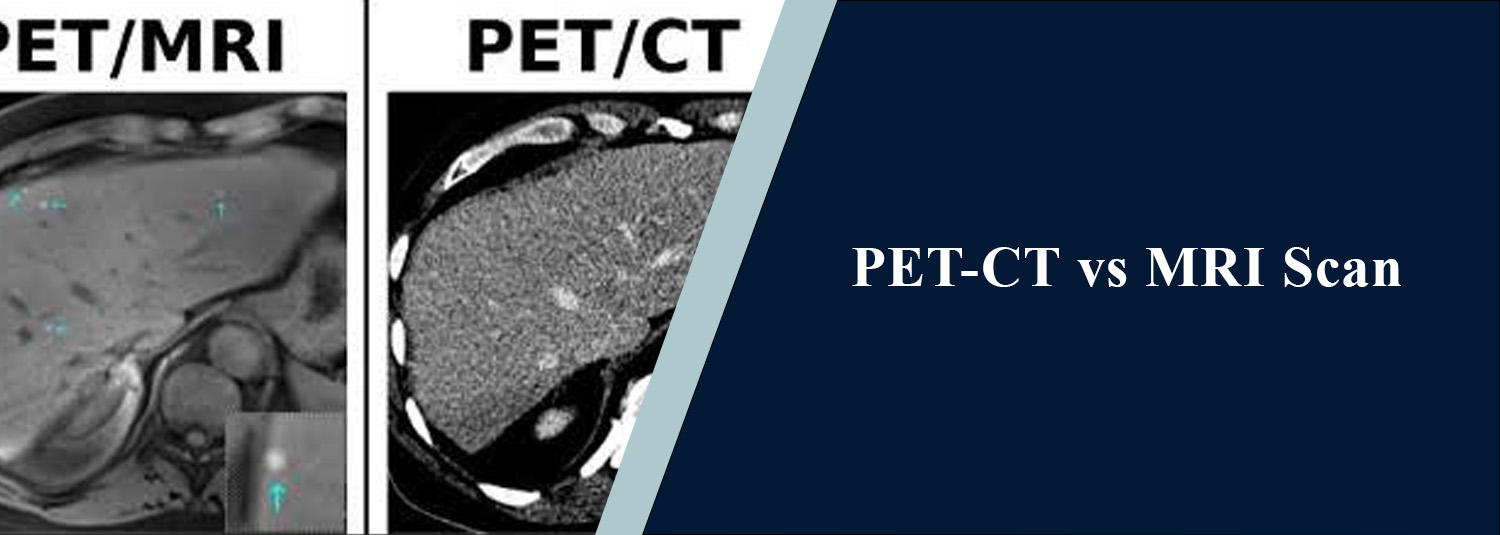
Medical imaging is critical for diagnosing various conditions,
ascertaining their severity, and guiding treatment. Two of the most common
procedures are PET-CT and MRI scans. Both are performed to aid in disease
detection, but they differ in their mechanisms and uses. To begin with, there
is no PET-CT vs MRI scan comparison that shows which procedure is better.
Instead, the two tests should be compared in terms of the suspected diagnosis
and the tissues involved, and the information needed by the physician. At
Molecular Diagnostics and Therapy, we offer advanced diagnostic imaging to help
the doctor evaluate the patient’s condition and determine the most suitable
course of treatment.
What Is a PET-CT Scan?
PET-CT stands for PET-Computed Tomography, a fusion of two
procedures. As the name implies, the combined test uses positron emission
tomography and computed tomography to simultaneously obtain metabolic and
anatomical images. Radioactive tracers are injected to highlight certain
tissues based on their metabolism.
The results can be read as a series of images that can be used to
detect abnormal tissues, examine physiological processes, or find out if cancer
has spread. A PET-CT scan is mainly used to find malignancies, follow cancerous
cells’ progress, recurrence, and response to therapy. In addition, it can be
used for some heart and neurological conditions. The tracer, type, and protocol
determine the results’ specificity.
What Is an MRI Scan?
MRI stands for Magnetic Resonance Imaging and is a diagnostic
procedure that uses powerful static magnets and radio waves to create images of
the body’s internal organs. The MRI scan is warranted when a detailed view of
the tissues is required, as opposed to CT, which is more sensitive to density
differences. Unlike PET-CT, MRI uses no ionising radiation but may require
contrast injection to enhance the quality of MRI images. MRI is used to
evaluate soft tissues, including the brain, spine, joints, and muscles, among
others.
PET-CT vs MRI: Key Differences
The fundamental difference between MRI and PET-CT scans is the
type of results they generate. MRI is adept at generating high-quality
anatomical images, while PET-CT provides metabolic data. In other words, the
two procedures differ in the type of information they present to the doctor.
PET-CT scans are performed by injecting a tracer and exposing the patient to
ionising radiation from the tracer and CT. MRI scans do not involve radiation,
but in some instances, an injection of a contrast dye may be necessary.
These differences determine PET-CT vs MRI scan appropriateness,
depending on the suspected condition. Duration, preparation, and cost also vary
depending on the area to be scanned, the type of tracer used, and whether a
contrast medium is needed. PET-CT is more likely to be recommended if a
whole-body scan is necessary, or the tissues to be examined are unclear.
PET-CT vs MRI for Cancer Diagnosis
Cancer diagnostics and treatment are the primary application for
both imaging systems. However, as mentioned earlier, PET-CT scans are useful
for detecting abnormal metabolic processes, while MRIs are anatomical scans.
For cancer patients, MRI helps to evaluate the size of the tumour, whether it
has spread, and the vital structures it has invaded. PET-CT scans, on the other
hand, can detect cancer’s extent and recurrence. It is also used to assess
treatment response in patients with selected cancers. However, not all cancers
can absorb the sugar in the tracer, and in some instances, inflammation,
infection, or other benign conditions can also be detected.
For example, an MRI scan would be more appropriate for a patient
with a brain tumour, as it allows the physician to get a detailed
cross-sectional view of the tissues. For example, in colorectal cancer, CT is
usually used to check for spread, MRI is used for local staging of rectal
cancer, and PET-CT is used in selected cases such as suspected recurrence.
Nevertheless, in certain circumstances, both tests may be required to obtain a
detailed evaluation report. It is worth noting that neither MRI nor PET-CT
scans alone can detect cancerous cells with absolute certainty in all cases. In
most cases, endoscopy or colonoscopy, as relevant.
When Is PET-CT Recommended?
The doctor may recommend a PET-CT scan to obtain information on
the level of activity within the body. In oncology, the test is used to stage
selected cancers, determine if cancer cells have spread, recurrence, and
treatment response. The choice of tracer also determines the test’s sensitivity
to cancer cells. The test is not perfect, as there are no tracers that target
all malignancies. The choice of the test and the tracer depends on the doctor’s
recommendation and the patient’s symptoms, diagnosis, and treatment history.
When Is an MRI Scan Recommended?
An MRI scan may be
recommended when there is a need to obtain a detailed view of the tissues. It
is typically used to evaluate brain and spinal cord tumours, as well as
injuries to the muscles and joints. In addition, the test is also useful for
detecting abnormalities in the liver, abdomen, and pelvis. In cancer
diagnostics, MRI is useful for determining tumour size and location and whether
it has invaded adjacent tissues. It can also be used to monitor recovery after
cancer therapy. Sometimes, an MRI scan may be necessary to determine the stage
of cancer, depending on the tumour’s proximity to vital structures.
MRI scans cannot be
performed on patients with specific implants without the doctor’s approval.
Therefore, before the procedure, it is critical to inform the technician of any
metal pieces in the body, previous surgeries, or any other condition that might
affect the test results.
Conclusion
At Molecular Diagnostics and Therapy, we offer advanced diagnostic imaging to help the physician interpret the results and develop an effective treatment plan. We can perform PET-CT and MRI scans, depending on the doctor’s recommendation. If you have been scheduled for any of the two scans, ensure that you bring all the previous test results with you. In addition, you should provide a list of all medications and supplements you are currently taking. To obtain accurate results, it is critical that you follow all the preparation instructions provided by the centre.
Frequently Asked Questions
In News
Get Our Mobile App
for Easy Access
Book tests, view reports, and manage your health records on the go. Experience convenient healthcare with Molecular Diagnostics and Therapy.
- ✔ Book tests & home collection
- ✔ View reports instantly
- ✔ Track health history
- ✔ Get notifications & reminders
- ✔ Easy appointment management