PET Scan in Alzheimer’s and Dementia – Early Signs on Imaging
Talk to Health Expert

Dr. Nikunj Jain
Co-Founder and HOD - Nuclear Medicine ,MBBS, DRM, DNB, FEBNM, FANMB, Dip. CBNC
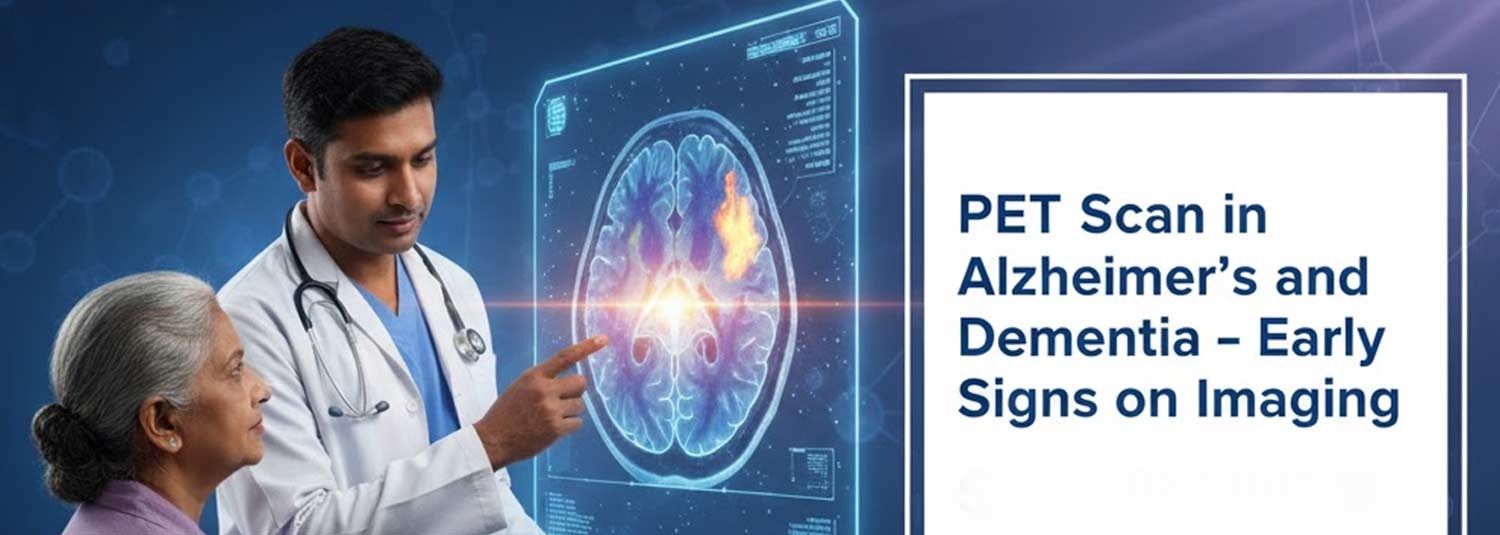
When memory lapses start interfering with daily life, it’s natural to wonder if it’s just age or something more serious like Alzheimer’s or dementia. Doctors today rely on advanced tools like PET scans (Positron Emission Tomography scans) to detect early signs of Alzheimer’s and dementia — sometimes even before noticeable symptoms appear.
In this blog, we’ll explain in simple language what a PET scan is, how it works in Alzheimer’s and dementia, what it shows on imaging, risks, cost, and why it’s becoming an important test for early diagnosis of memory-related conditions.
What Is a PET Scan?
A PET scan (Positron Emission Tomography) is a type of brain imaging test. Unlike an MRI or CT scan that shows structure, a PET scan shows how the brain is functioning.
- It uses a small amount of radioactive tracer injected into the body.
- This tracer attaches to brain molecules (like glucose or amyloid proteins).
- The PET scanner then creates a detailed image showing how brain cells are using energy or where abnormal protein deposits are present.
For Alzheimer’s and dementia, PET scans are often more accurate in spotting early brain changes than routine scans.
PET Scan in Alzheimer’s – What It Shows
In Alzheimer’s disease, PET scans can highlight:
- Reduced brain metabolism – parts of the brain stop using energy efficiently.
- Amyloid plaques – sticky protein clumps that build up in the brain.
- Tau tangles – abnormal protein changes linked to brain cell damage.
These changes may be visible on a PET scan even before major memory loss or cognitive decline begins.
PET Scan in Dementia – Differentiating Types
Not all dementia is the same. PET scans help doctors identify:
- Alzheimer’s dementia – presence of amyloid or tau proteins.
- Frontotemporal dementia (FTD) – abnormal patterns in the frontal or temporal lobes.
- Lewy body dementia – reduced dopamine activity (shown using a dopamine transporter PET).
- Vascular dementia – damage due to reduced blood flow (seen better with MRI but PET can complement findings).
This is important because treatment and management differ across types of dementia.
Early Signs on PET Imaging
PET scans are powerful because they can detect early signs of Alzheimer’s and dementia such as:
- Subtle memory decline not obvious in daily tasks.
- Decreased activity in hippocampus and temporal lobes (memory centers).
- Amyloid build-up years before symptoms appear.
- Brain metabolism differences between Alzheimer’s, Parkinson’s, and other dementias.
This makes PET scans especially valuable in patients with mild cognitive impairment (MCI), where it’s unclear if symptoms will progress to dementia.
PET Scan vs MRI in Alzheimer’s
Many people ask: What is the difference between PET scan and MRI in Alzheimer’s?
- MRI/CT scans – show brain structure, shrinkage, or damage.
- PET scans – show how brain cells are working, protein deposits, and metabolism.
Doctors often recommend both for a complete picture.
Is PET Scan Safe for Alzheimer’s Patients?
Yes, PET scans are generally safe. The radioactive tracer dose is very low and usually clears from the body within 24 hours.
Risks may include:
- Mild discomfort from injection.
- Rare allergic reactions.
- Not recommended for pregnant women unless necessary.
Cost of PET Scan for Alzheimer’s and Dementia
The cost of a PET scan depends on country and city. In India, it usually ranges from ₹15,000 – ₹35,000, depending on whether it is:
- FDG-PET (glucose metabolism)
- Amyloid PET (protein deposits)
- Tau PET (less commonly available)
While it may sound expensive, the benefit of early detection can save families from years of uncertainty.
Key Facts from Global Organizations
- Alzheimer’s Association (USA): PET scans can detect Alzheimer’s-related brain changes before symptoms show.
- World Health Organization (WHO): Dementia affects more than 55 million people worldwide, with Alzheimer’s being the most common cause.
- National Institute on Aging (NIA): PET imaging helps differentiate Alzheimer’s from other dementias, aiding early treatment and clinical trials.
FAQs
What does a PET scan show in Alzheimer’s?
It shows reduced brain activity, amyloid plaques, and tau tangles linked to Alzheimer’s disease.
Can PET scan detect Alzheimer’s early?
Yes, PET scans can detect amyloid and tau build-up years before memory loss begins.
Is PET scan painful?
No, it only involves a small injection and lying still during the scan.
How long does a PET brain scan take?
Usually 30–60 minutes, plus preparation time.
What is the difference between PET scan and MRI in Alzheimer’s?
MRI shows brain structure, PET shows brain function and protein changes.
How much does a PET scan for dementia cost in India?
It typically costs between ₹20,000–₹35,000 depending on the type of PET scan.
Can PET scan confirm Alzheimer’s disease?
It cannot confirm alone, but it provides strong evidence along with clinical evaluation.
Is PET scan safe for elderly patients?
Yes, it’s safe. The radioactive tracer dose is very small.
Can PET scan differentiate between Alzheimer’s and other dementias?
Yes, it helps distinguish Alzheimer’s, frontotemporal dementia, Lewy body dementia, and vascular dementia.
What to expect during a PET brain scan?
You’ll receive a tracer injection, rest quietly, and then lie in a scanner for imaging.
Final Thoughts
A PET scan for Alzheimer’s and dementia is more than just an imaging test — it’s a window into the brain’s early changes. By detecting amyloid plaques, tau tangles, and reduced brain activity, it helps doctors intervene earlier, plan treatment, and guide families with clarity.
Early detection means better management, more treatment options, and improved quality of life.
At Molecular Diagnostics, we offer advanced PET scan services for Alzheimer’s, dementia, and other brain disorders with the highest accuracy and care.
In News
Get Our Mobile App
for Easy Access
Book tests, view reports, and manage your health records on the go. Experience convenient healthcare with Molecular Diagnostics and Therapy.
- ✔ Book tests & home collection
- ✔ View reports instantly
- ✔ Track health history
- ✔ Get notifications & reminders
- ✔ Easy appointment management