Autism Spectrum Disorder (ASD): Causes, Symptoms, Types & Tests
Talk to Health Expert

Dr. Nikunj Jain
Co-Founder and HOD - Nuclear Medicine ,MBBS, DRM, DNB, FEBNM, FANMB, Dip. CBNC
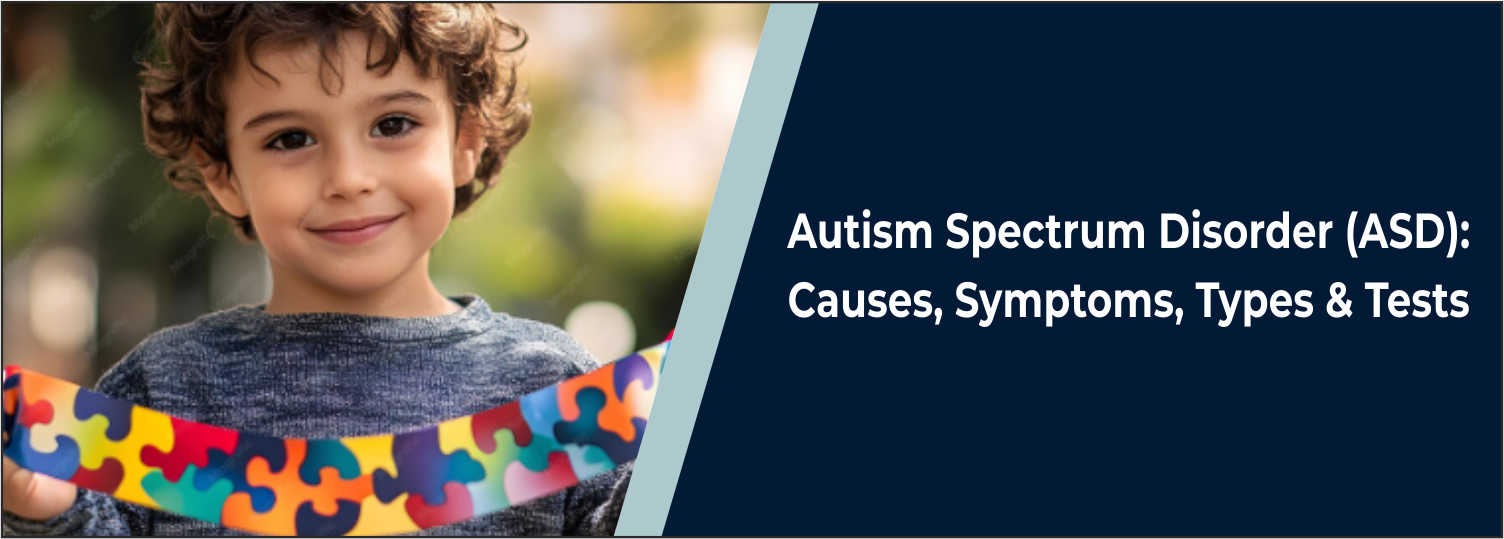
Autism Spectrum Disorder (ASD) represents a neurological and
developmental condition that impacts communication, interaction with other
people, learning, and behavior. Autism is referred to as a spectrum as
individuals can experience it differently and require degrees of support.
Differences in people's abilities may mean that some autistic individuals
require substantial ongoing support whilst others can be supported relatively
well and live independently.
The signs of autism typically appear early in childhood, but at
times symptoms may stand out as a child becomes older and more socially or
communicatively challenged. Identifying developmental differences early on can
help to inform families of a need for evaluation and support.
Diagnostic services are offered to support healthcare evaluation
at Molecular Diagnostics and Therapy when recommended by a medical
professional. Today, in this blog, we are going to discuss Autism Spectrum
Disorder, symptoms of autism, autism spectrum disorder causes, ASD types, autism
tests, and how autism is evaluated.
What Is Autism Spectrum Disorder?
ASD is a developmental disorder that impacts communication, social
interaction, behavior, and patterns of interests or activities. The Centers for
Disease Control and Prevention (CDC) identify social communication and
interaction differences and restricted and repetitive behaviour or interests as
characteristics of those with autism.
Autism affects people for a lifetime. In an individual's life,
however, how it impacts them may vary, and support (including education,
behaviour, communication, and others) may be appropriate to help this person
learn skills and engage in daily activities. There are no universal symptoms or
behaviors for autism. People with autism have a wide range of abilities,
challenges, interests, and needs for support.
Autism Spectrum Disorder Symptoms
The autism spectrum
disorder symptoms can vary considerably from one person to another. Some
children may show signs during infancy or toddler years, while others may be
identified later. Common characteristics may include:
- Difficulty with back-and-forth communication or social
interaction
- Difficulty
understanding or using gestures, facial expressions, or eye contact
- Delayed
or different language development
- Repeating
words or phrases
- Repetitive
movements such as hand flapping or rocking
- Strong
preference for routines or difficulty with unexpected changes
- Highly
focused interests
- Unusual
sensitivity or reduced sensitivity to sounds, lights, textures, smells, or
other sensory experiences
- Difficulty
developing or maintaining social relationships
Not everyone who has autism exhibits all these traits. Some may
excel in language development and struggle socially; others may have
considerable difficulty with communication. These characteristics can also
occur in people without ASD, so a comprehensive evaluation is needed.
Early Signs of Autism
Some early signs might be detected during the first few years.
They may respond limitedly to their name, use fewer gestures, have limited eye
contact, have difficulty sharing their interests with others, have delayed
speech, or have repetitive behaviours. Some children may even seem to forget
the skills they previously learned in language or social skills.
Development is different for every child, though, and children
with developmental differences may not be autistic. If parents/caregivers have
concerns about a child's communication, behaviour, learning, and/or social
development, it is important to discuss these concerns with a pediatrician or
qualified healthcare professional so that an evaluation can be determined if
additional support is required.
Autism Spectrum Disorder Causes
The causes of autism spectrum disorder are not completely known.
ASD has multiple contributing causes. Genetic factors play an important role,
while certain environmental or prenatal/perinatal factors may affect
likelihood. There are some changes in the genes and some genetic conditions
that are linked to a higher risk for autism. Factors that could have an effect
on early brain development are also being researched. Some prenatal and
perinatal risk factors are associated with a higher risk of ASD, but these factors
do not imply that a child has ASD. There isn't a single reason for autism, and
poor parenting doesn't cause autism.
Is Autism Genetic?
Autism has a strong genetic component, and genetic factors can be
inherited or arise through other genetic changes. However, ASD usually does not
follow a simple pattern of inheritance. Some autistic individuals are found to
have a specific, identifiable genetic condition, and for other individuals, no
one particular gene is known to be the cause. If a family member has autism,
this does not mean that all children are at risk. Genetic testing may sometimes
be part of a comprehensive medical investigation, especially if other
developmental, neurological, physical, or other tests are abnormal.
How Is Autism Diagnosed?
No one blood test, brain scan, or laboratory test can be used to
diagnose Autism Spectrum Disorder. The diagnosis relies primarily on a thorough
history with regard to development, behaviour, communication and social
interactions. Healthcare professionals can conduct parent/carer interviews,
observe the child, and utilize the child's developmental or autism-specific
assessments.
Depending on the needs and age of the person, a comprehensive
evaluation may include an assessment in many different areas by professionals
from each of those areas. They can be other qualified health care providers,
including occupational therapists, speech-language professionals,
psychologists, psychiatrists, pediatricians, and developmental specialists.
Autism Tests and Screening
There are screening tests and diagnostic tests for autism.
Screening is not a diagnosis. A screening tool determines if a child has some
characteristics that could be related to autism and might require more
examination. Not definitive of a child's ASD. The Modified Checklist for Autism
(M-CHAT) in Toddlers with follow-up (M-CHAT-R/F) is one commonly used screening
tool for toddlers. There may be other screening or assessment instruments
employed in other contexts and ages. A detailed developmental evaluation is
recommended if screening indicates additional testing is warranted.
Developmental Evaluation for Autism
A developmental
evaluation looks at different areas of a person's development and functioning.
The healthcare professional may assess:
- Communication and language
- Social
interaction
- Behaviour
- Learning
and cognitive abilities
- Play
skills
- Adaptive
or daily living skills
- Sensory
responses
- Motor
development
Information from
parents, caregivers, teachers, or other people who regularly interact with the
child can also be useful. The evaluation helps healthcare professionals
understand the individual's strengths and challenges rather than relying on a
single test result.
Is There a Blood Test for Autism?
None of the blood tests are currently recommended for the routine
screening of autism. Additional tests such as a blood test or genetic test may
sometimes be suggested to look for other conditions that could be causing the
developmental difference or to find out other genetic reasons for developmental
delays. These tests do not, however, provide diagnostic confirmation of, or
exclude, ASD. Much in the same way, magnetic resonance imaging (MRI) of the
brain is not routine for the diagnosis of autism. It may be suggested if a
health care professional identifies a person's symptoms as possibly being
caused by another neurological disorder, or because of certain clinical
indications.
Can Autism Be Diagnosed in Adults?
Yes. It is possible to diagnose autism in adults. Some children
may have the diagnosis before they are diagnosed as an adolescent or adult.
Adults who have longstanding challenges with social communication, sensory
experiences, routines or repetitive behaviours may request an assessment.
In general, adult autism assessment includes the comprehensive
inclusion of developmental history, as well as current features. Wherever
possible, information about childhood development is also useful. A late
diagnosis does not mean that autism has come up in recent times. Autism is a
developmental disorder, but the symptoms may be more apparent at different
ages.
Why Early Evaluation Matters?
Recognising
developmental differences at an early stage can support both the family to
understand their child's needs and to access support. This can involve the
provision of speech and language therapy, occupational therapy, educational
support and behavioural interventions, social skills support and other
individualised support. Support varies for each individual as a function of the
support needed to match the strengths, needs, and aspirations of the
individual. The aim of evaluations is not to restrict a person's abilities but
to make sense of how they are able to communicate, learn, interact, and 'be' in
the world.
Diagnostic Support at Molecular Diagnostics and
Therapy
Molecular Diagnostics and Therapy provides diagnostic services to
help assess various medical conditions in case a diagnosis is clinically
indicated. Diagnosis of Autism Spectrum Disorder is largely based on
developmental and behavioural assessment, and is not strictly based on a
laboratory or imaging test. Some other tests might be ordered, however, when
necessary, to help diagnose other health or genetic problems that the
individual may have when there is suspicion of other developmental issues of
concern. The selection of the appropriate assessment required to determine the
status and needs of the individual should always be made based on their
symptomatology, developmental history, and clinical requirements.
Conclusion
ASD is a developmental disorder that can impact communication,
social interaction, behaviour, sensory experiences, and patterns of interests.
Autism can appear very differently for every person, so autism is termed a
spectrum of symptoms. Despite there being no full consensus on the exact causes
of autism spectrum disorder, several studies have suggested the genetic and
developmental mechanisms are important. Autism is currently classified as a
single autism spectrum disorder rather than separate DSM-IV subtypes.
Autism evaluation may include developmental screening, detailed developmental history, clinical assessment, behavioural observation, and standardized diagnostic tools. As of yet, there is no single blood test or imaging scan that can be used to definitively diagnose autism. Some situations may suggest additional genetic or medical tests to explore other conditions of interest. In Molecular Diagnostics and Therapy, diagnostic services are provided for proper medical evaluation on the recommendation of a health care professional. If you are worried about a child or adult's behaviour, learning, or communication, having an evaluation can help determine their needs and can help direct or inform support.
Frequently Asked Questions
In News
Get Our Mobile App
for Easy Access
Book tests, view reports, and manage your health records on the go. Experience convenient healthcare with Molecular Diagnostics and Therapy.
- ✔ Book tests & home collection
- ✔ View reports instantly
- ✔ Track health history
- ✔ Get notifications & reminders
- ✔ Easy appointment management