Crohn's Disease: Causes, Symptoms, Types & Tests
Talk to Health Expert

Dr. Nikunj Jain
Co-Founder and HOD - Nuclear Medicine ,MBBS, DRM, DNB, FEBNM, FANMB, Dip. CBNC
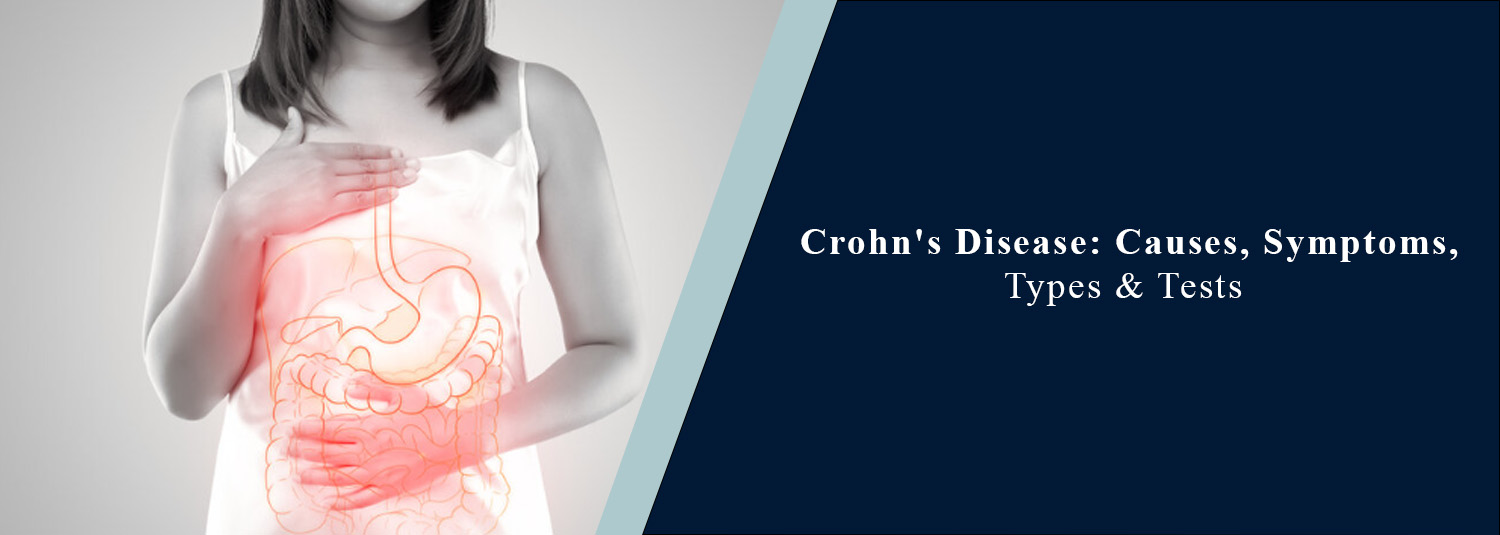
Inflammatory bowel disease, such as
Crohn's disease, is an ongoing inflammation of the digestive tract. It strikes
anywhere in the digestive tract from the mouth to the anus, but usually attacks
the small intestine or the beginning of the large intestine. The symptoms
differ from one person to another and increase in intensity during a period
known as a flare-up.
Knowing the signs, causes, types, and
when to get a medical evaluation for digestive issues that indicate Crohn's
could help a person recognise their symptoms and seek evaluation promptly.
There is no single test that helps diagnose Crohn's disease; doctors typically
use a combination of medical history and physical examination, laboratory
tests, endoscopy, and imaging tests, if needed.
What Is Crohn's
Disease?
Other diseases fall into the category
of inflammatory bowel disease characterized by the body's abnormal immune
response, which causes continuous inflammation in the digestive tract. Crohn's
disease affects different parts of the gastrointestinal tract, unlike diseases
that only affect one part of the gut. Sometimes the inflammation affects areas
of the intestine with healthy intestine between the areas of inflammation.
Inflammation also be located in different depths and parts of the body. This is
why the symptoms of Crohn's disease vary from person to person. It gradually
develops; it is mild or severe. Persistent inflammation occurs and can also
cause complications in other systems of the body or digest system; it is
important to be evaluated early.
What Causes Crohn's
Disease?
We don't yet know the cause of Crohn's
disease. Various factors may work together in causing the condition, studies
have shown. An abnormal immune response is one factor. For Crohn's patients,
the immune system overreacts to the normal gut microbes and causes
inflammation.
There could also be a genetic
component. Those who have a close relative with inflammatory bowel disease are
at a higher risk for developing Crohn's disease. The role of the gut microbiome
and the environment is also investigated. Another known risk factor is smoking,
and it makes you more likely to develop Crohn's disease. But just because
someone has a risk factor does not mean he or she will develop it.
What Are the Symptoms
of Crohn's Disease?
The symptoms of Crohn's disease vary
based on the location of the inflammation and its intensity. The most common
symptoms are chronic diarrhoea, abdominal pain/cramping, and unexplained weight
loss. Others may also feel tired, have a fever, sickness, loss of appetite,
vomit, or have anemia. The digestive disorders associated with Crohn's disease
also have other effects in the body, such as some skin changes, eye
inflammation, and joint pain. Symptoms may come and go. Sometimes, an
individual has times when the disease is actively present and other times when
it is not present (in remission). Persistent symptoms have to be taken as proof
of Crohn's disease but cannot be concluded so since symptoms are also present
in other digestive issues.
Types of Crohn's
Disease
Crohn's is broken down into the exact
part of the digestive tract involved. The disease affects the small and/or
large intestine, upper digestive tract, or around the anus. Some
classifications list Crohn's disease based on the way the disease behaves. The
underlying problem with inflammatory Crohn's disease is the inflammation. In
the stricturing form of the disease, the intestine narrows, and in the
penetrating form of the disease, abnormal connections are formed, called
fistulas. Crohn's disease affects different parts of the gut, and in some make
the disease more or less obvious and has a different risk of complications. The
4 levels of disease are judged by clinical evaluation and/or relevant
investigations.
How Is Crohn's
Disease Diagnosed?
No individual test is suitable for
confirming Crohn's disease in all patients. One of the first things your doctor
does is to speak with you about how you are feeling, your medical and family
history, what medicines you are taking, and other information. An examination
may also be done. The aim of diagnosing Crohn's disease is not just to assess
if there is Crohn's disease present, but also to establish the site of
inflammation, the extent of inflammation, and to exclude other diseases which
mimic the symptoms of Crohn's disease. As part of the diagnostic process,
doctors conduct blood tests, stool tests, endoscopy, and imaging tests.
Blood Tests for
Crohn's Disease
Laboratory tests are helpful to look
for signs of inflammation and potential problems. A blood count is performed
for the diagnosis of anaemia and any other abnormalities. Tests like C-reactive
protein help to give information related to the body's inflammation. Blood
tests, however, do not confirm a case of Crohn's disease, however. They are
usually used as part of other investigations to assist in a complete evaluation
of the patient.
Stool Tests for
Crohn's Disease
Stool samples are collected in a
doctor's office to look for signs of inflammation of the bowel and eliminate
the possibility of two other infections that have symptoms that are similar to
Crohn's disease. These tests are useful if a patient continues to have
diarrhoea or other digestive symptoms. There are particular stool markers or
microbiological tests recommended, depending on the clinical scenario. Blood
tests and the results are taken together with symptoms and imaging and
endoscopy findings to come up with a diagnosis.
Conclusion
Crohn's disease is an inflammatory
bowel disease (IBD) that causes inflammation anywhere along the digestive
tract. Diarrhoea, abdominal pain, cramping and weight loss are the most common
symptoms of Crohn's disease, and a small number of people may have other
symptoms, such as fatigue, fever, anaemia, nausea or symptoms elsewhere in the
body. It's not fully understood what causes Crohn's disease, although abnormal
immune reactions, genetics, environmental factors, changes in the gut
microbiome and smoking have been linked to the development of Crohn's disease.
Usually, more than one investigation is needed for the proper diagnosis of Crohn's. Differential tests may be suitable depending on the patient, such as blood tests, stool tests, colonoscopy and other endoscopic exams, CT, and MRI. If expected symptoms of digestion are recurring or persistent, it may be important to see a doctor at an early stage to help diagnose the cause of the problem and determine if further testing for Crohn's disease is necessary. Molecular Diagnostics and Therapy offers diagnostic imaging and laboratory services as tools for doctors to check a variety of health conditions in a patient's diagnosis.
Frequently Asked Questions
In News
Get Our Mobile App
for Easy Access
Book tests, view reports, and manage your health records on the go. Experience convenient healthcare with Molecular Diagnostics and Therapy.
- ✔ Book tests & home collection
- ✔ View reports instantly
- ✔ Track health history
- ✔ Get notifications & reminders
- ✔ Easy appointment management