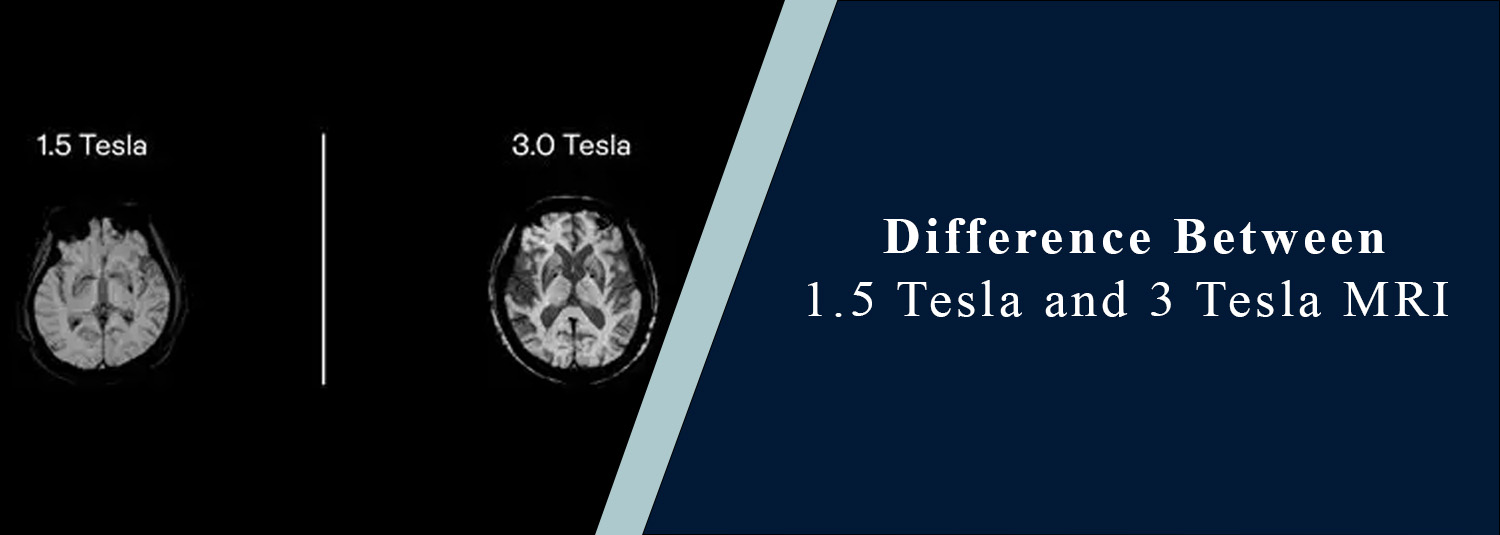
Difference Between 1.5 Tesla and 3 Tesla MRI
Talk to Health Expert

Dr. Nikunj Jain
Co-Founder and HOD - Nuclear Medicine ,MBBS, DRM, DNB, FEBNM, FANMB, Dip. CBNC
Magnetic Resonance Imaging, or MRI, is one of the most advanced diagnostic imaging techniques that is being employed in today's healthcare industry. It aids physicians in getting a detailed imaging of a patient's organs, soft tissue, joints, blood vessels, brain, & spine without the use of ionizing radiation when obtaining the images. MRI is also a valuable technique in diagnosing various diseases, in addition to planning the treatment of these diseases.
As people start to consider getting an MRI scan, they frequently encounter the phrases “1.5 Tesla MRI” and “3 Tesla MRI.” These are descriptions of the strength of the magnetic field applied by the MRI machine. The two types of MRI scanners are capable of producing images of high quality, but they have several distinct differences in terms of image resolution, speed of the scan, applications, and performance.
Healthcare professionals will be able to communicate with patients to let them understand the significance of 1.5T vs. 3T MRI machines and what one of these might be appropriate for them based on their health. The most recent advances in MRI technology in Molecular Diagnostics and Therapy allow for highly accurate diagnosis, yet comprehensive therapy is delivered to a patient in various clinical specialties.
What Does Tesla Mean in MRI?
The term "Tesla" is a unit used to measure magnetic field strength. The higher the power of the MRI field, the better the images that are created with the MR scanner. A powerful magnetic field is sent from the MRI machine, and the protons of the body will be realigned. Such atoms react with radio waves and emit signals that are interpreted as detailed images. Magnetic fields are stronger, the signals are stronger, and this can lead to better image clarity and diagnosis. The 1.5 Tesla MRI scanner has a magnetic field strength of 1.5 Tesla, whereas the 3 Tesla MRI scanner's magnetic field strength is 3 Tesla.
Understanding 1.5 Tesla MRI
The 1.5 Tesla MRI is one of the most popular MRIs in the world, and this type of system has been used for many years. It can produce a high-resolution image for a variety of tests, such as those that examine the brain, spinal cord, abdomen, joints, and soft tissues.
Many of the MRI protocol uses have been developed and optimized for 1.5 Tesla MRI use since it has been widely used for decades. Elaborate, and most daily medical analyses can be done with the precision of this scanner. A 1.5 Tesla MRI is enough for many patients to get all the information they need to diagnose and treat them properly.
Understanding 3 Tesla MRI
The magnetic field of a 3 Tesla MRI scanner is double that of a 1.5 Tesla MRI scanner. As a whole, this results in a greater magnetic field and thus produces a higher signal-to-noise ratio, which means increased information about the image detectable by the scanner.
If the signal is clear, then the image will be even better, and doctors will be able to see even smaller structures. This is especially important in cases where extremely precise anatomical details are critical, as is often the case with 3 Tesla MRI machines. In recent years, 3-Tesla MRI has been increasingly used, particularly in specialized areas, such as neurological imaging, vascular imaging, musculoskeletal imaging, and cancer imaging.
Difference in Image Quality
The primary difference between the two MRI's is in terms of image quality. The one difference between the 1.5 Tesla MRI and the 3 Tesla MRI is the quality of the images that each produces. The higher signal strength produced by the 3 Tesla scanner will allow the generation of more detailed and higher resolution pictures.
That greater clarity enables radiologists to pick up on subtle abnormalities that can be more elusive under a lower-level system. Some small blood vessels, nerve structures, and early tissue changes can be seen better at 3 Tesla imaging. It is crucial, however, to be aware that even a 1.5 Tesla MRI can yield good diagnostic images for the majority of medical conditions. Sometimes, the differences in image quality may not greatly impact diagnosis in routine exams.
Scan Speed and Efficiency
Most 3 Tesla MRIs possess a larger magnetic power, which may enable images to be taken faster. The scanner will likely not take as long to get a good image, especially since it gets a stronger signal from the body area.
The shorter the scan, the happier the patient will be, and the less opportunity for motion distortion. May be helpful when looking at children, elderly people, and those who will not stay still during an examination. But scanning time does vary for each body part scanned and by imaging protocol.
Brain and Neurological Imaging
One such advantage of a 3 Tesla MRI is brain imaging. The increased resolution provides doctors with greater detail in examining the small details of the brain structure.
Functional MRI is useful for conditions like multiple sclerosis, epilepsy, brain tumors, stroke, and neurodegenerative conditions that can benefit from the increased fidelity that 3 Tesla imaging gives. The higher magnetic field can also provide better visualization of blood vessels and very small abnormalities in the brain. 3 Tesla MRI is sometimes preferred for advanced studies and research applications involving the nervous system.
Spine and Musculoskeletal Imaging
All 3T and 1.5T MRI systems are suitable for a strong examination area, such as the spine, joints, muscles, ligaments, and tendons. Both scanners give valuable information to use for diagnosis when you're suffering from slipped discs, stenosis, sports injuries, cartilage damage, or nerve compression.
The increased resolution of 3 T MRI may, however, offer better visualization of subtle abnormalities in tissues and small to very small structures. The increased accuracy can occasionally help to diagnose more difficult orthopedic and sporting injuries.
Conclusion
A 1.5 T and 3 T MRI are powerful diagnostic devices that are crucial to medical practice today. Although 3 Tesla MRI technology yields improved images, higher strength signal, and may even scan more rapidly, 1.5 Tesla MRI is still recognized as superb at diagnosing a multitude of medical conditions.
Whether one or the other system will be used is decided depending on the part of the body being examined, clinical condition, and the intensity of examination appropriate for diagnosis. Patients may find it helpful to understand these differences so that they can understand the quality of the MRI and why it was recommended.
These advanced MRI capabilities, coupled with expert diagnostic support, ensure Molecular Diagnostics and Therapy continues to provide excellent imaging services to help accurately diagnose diseases, plan effective treatment, and deliver better patient outcomes.
Frequently Asked Questions
In News
Get Our Mobile App
for Easy Access
Book tests, view reports, and manage your health records on the go. Experience convenient healthcare with Molecular Diagnostics and Therapy.
- ✔ Book tests & home collection
- ✔ View reports instantly
- ✔ Track health history
- ✔ Get notifications & reminders
- ✔ Easy appointment management