MRCP Scan Non-Invasive Imaging for Bile Duct and Pancreatic Disorders
Talk to Health Expert

Dr. Nikunj Jain
Co-Founder and HOD - Nuclear Medicine ,MBBS, DRM, DNB, FEBNM, FANMB, Dip. CBNC
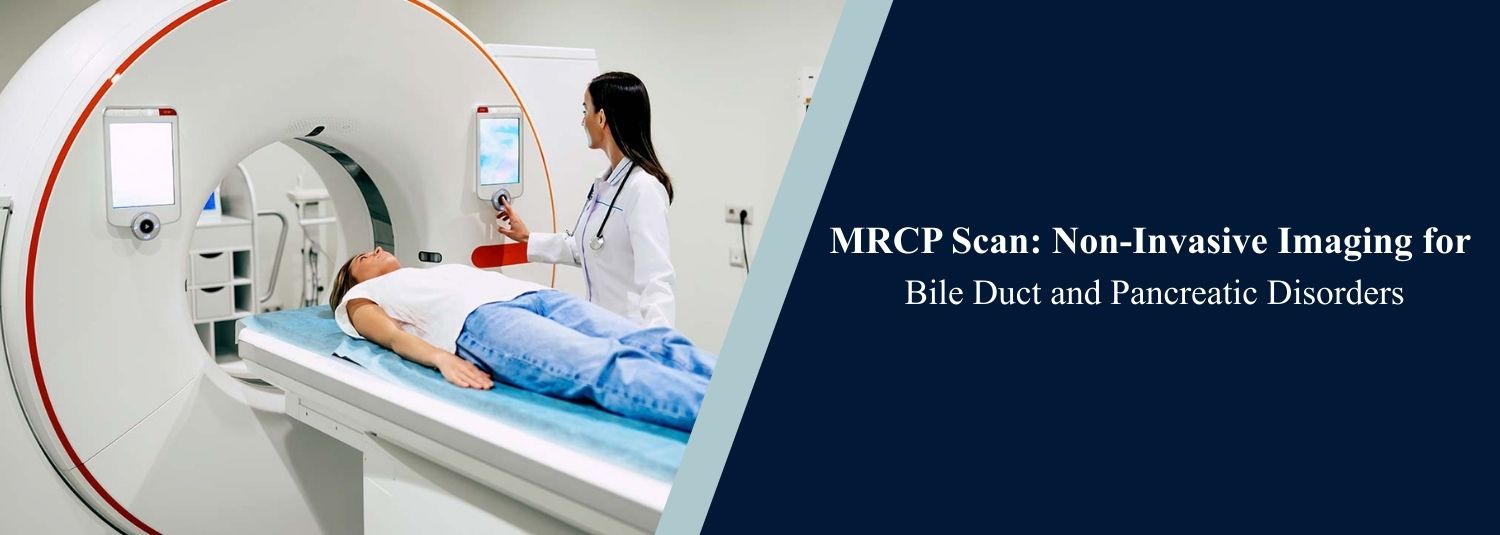
Do you experience severe digestive problems? These conditions can be difficult to diagnose because multiple abdominal organs are closely positioned. This is why physicians often recommend an MRCP scan (Magnetic Resonance Cholangiopancreatography). It provides a detailed view of the bile ducts and pancreatic duct without surgery or invasive tubes.
MRCP is a specialized imaging test used to examine the bile ducts and pancreas. It is safe, painless, and helps detect blockages, inflammation, stones, and tumors.
Understanding the Bile Ducts and Pancreas
The bile ducts are small channels that carry bile from the liver and gallbladder to the small intestine, where it helps digest fats. The pancreas produces digestive enzymes and hormones such as insulin.
If bile ducts become blocked, narrowed, or inflamed, serious issues may occur, including jaundice (yellowing of skin and eyes), abdominal pain, infection, or pancreatitis. Early and accurate imaging is important in such cases.
What Is an MRCP Scan?
MRCP is a specialized application of MRI (Magnetic Resonance Imaging). It uses strong magnetic fields and radio waves to create detailed images of the bile ducts, pancreatic duct, liver, gallbladder, and surrounding organs.
Unlike endoscopic procedures, MRCP does not require insertion of tubes into the digestive tract. It is completely non-invasive and reduces the risk of complications.
Why Do Doctors Recommend MRCP?
Doctors may recommend MRCP if a patient experiences:
- Chronic upper abdominal pain
- Jaundice (yellowing of skin and eyes)
- Abnormal liver function tests
- Inconclusive ultrasound results
MRCP helps confirm bile duct stones, narrowing of ducts, pancreatic tumors, and inflammation.
Conditions Diagnosed with MRCP
- Bile duct stones (choledocholithiasis)
- Biliary strictures (narrowed ducts)
- Pancreatitis
- Congenital duct abnormalities
- Cysts or tumors in pancreas or bile ducts
Since MRCP focuses on fluid-filled structures, it usually provides clear images without contrast in most cases.
How Is the Procedure Performed?
During the procedure, the patient lies on a table that moves into an MRI scanner. The machine produces rhythmic sounds; ear protection is provided.
The scan typically takes 20–40 minutes. Patients are required to remain still. Fasting for 4–6 hours may be advised for better visualization.
Advantages of MRCP
- No radiation exposure
- Completely non-invasive
- Low risk
- No hospital stay required
MRCP vs ERCP: Understanding the Difference
MRCP and ERCP both evaluate bile and pancreatic ducts, but their purposes differ. MRCP is purely diagnostic and non-invasive. ERCP is an invasive endoscopic procedure that allows both diagnosis and treatment.
Doctors often perform MRCP first. If treatment is needed, ERCP may be scheduled afterward.
Is MRCP Safe?
MRCP is very safe because it does not use radiation. However, patients with pacemakers, metal implants, or surgical clips must inform their doctor before the scan.
Pregnant women should consult their doctor. Those with claustrophobia may discuss sedation options.
Preparing for an MRCP Scan
Patients are usually advised to fast before the scan. Wear loose clothing and avoid jewelry, watches, or electronic devices.
Conclusion
MRCP is a safe, non-invasive imaging test used to diagnose bile duct and pancreatic disorders. It provides detailed images without radiation or surgery.
It helps doctors make accurate treatment decisions for patients experiencing abdominal pain, jaundice, or pancreatic disease.
Frequently Asked Questions
In News
Get Our Mobile App
for Easy Access
Book tests, view reports, and manage your health records on the go. Experience convenient healthcare with Molecular Diagnostics and Therapy.
- ✔ Book tests & home collection
- ✔ View reports instantly
- ✔ Track health history
- ✔ Get notifications & reminders
- ✔ Easy appointment management