Whole Body PET-CT Scan
Talk to Health Expert

Dr. Nikunj Jain
Co-Founder and HOD - Nuclear Medicine ,MBBS, DRM, DNB, FEBNM, FANMB, Dip. CBNC
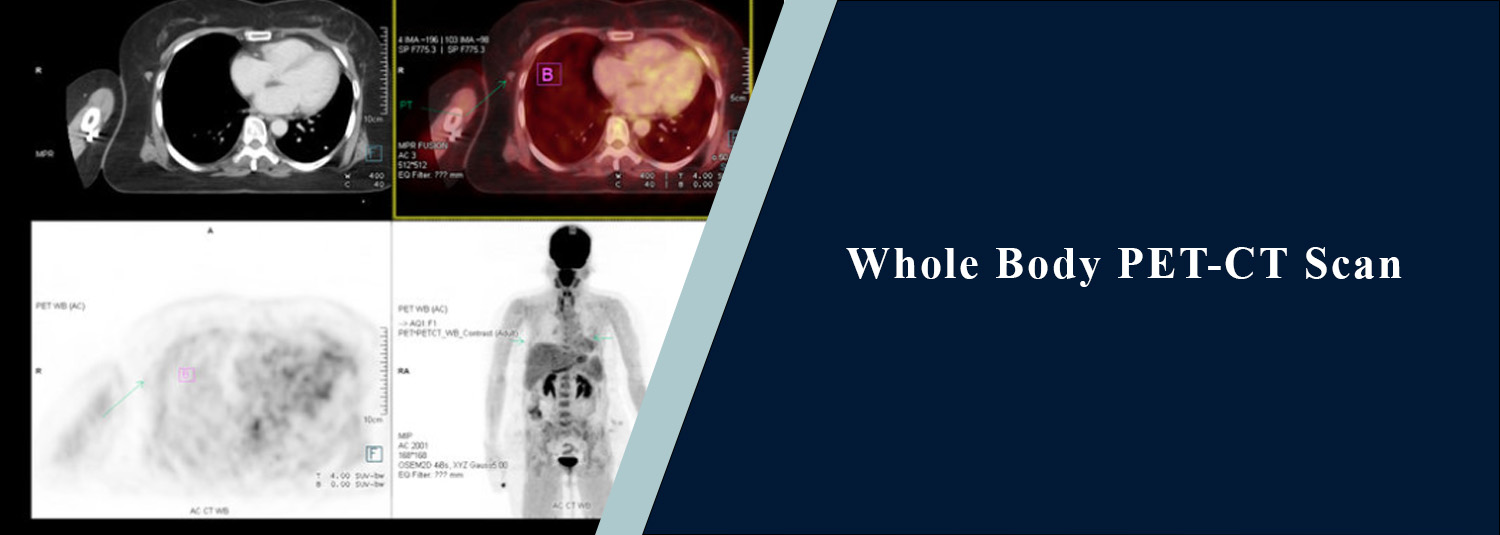
The Whole Body PET-CT scan is an
advanced nuclear medicine imaging test that combines the imaging capabilities
of Positron Emission Tomography (PET) and Computed Tomography (CT) scans. It
provides detail on the metabolic and/or anatomical activity of tissues from all
parts of the body.
PET-CT plays an important role in selected
situations in colon cancer, such as if a tumor is suspected to have spread, to
track how well treatment is working, or to look for signs of recurrence. Not a
regular alternative or tool to colonoscopy or other specific imaging studies,
but it offers additional information in certain situations.
What Is a Whole Body
PET-CT Scan?
Whole-body PET-CT is a combination of
PET and CT scans of the whole body. The PET (positron emission tomography)
component indicates areas of elevated metabolism using a radioactive tracer,
usually F-18 FDG. When areas with high FDG uptake occur, it is interpreted on
PET images as being more active than regions normally uptaking glucose. The CT
component offers detailed anatomic information which helps physicians determine
where and what an abnormal area represents. Using PET and CT together enables
the metabolic activity to be correlated to the anatomical structures seen in
the same examination.
Why Is Whole Body
PET-CT Used in Colon Cancer?
If the cancer spreads from the problem
area to the nearby lymph nodes or to places far away, like your liver or lungs,
it is known as colon cancer metastasis. Imaging assists doctors in deciding if
the disease has advanced or recurred and therefore directs the treatment plan
if advanced disease or recurrence is suspected.
When extra metabolic information is
required, a PET-CT scan is performed. It is useful in determining where there
is more glucose uptake, which suggests active cancer, and helps to understand
disease in other parts of the body. The selection of imaging is patient-specific,
though. In many situations, contrast-enhanced CT and/or MRI scanning are
preferred for the staging of colorectal cancer; in selected cases, FDG PET-CT
scanning is used.
Role of PET-CT in
Colon Cancer Staging
Staging is the process of deciding how
far the colon cancer has traveled and is a key component in making treatment
decisions. A whole-body PET-CT is used to evaluate the body for areas of
metabolically active disease. This is helpful if a physician is considering a
diagnosis of local versus distant spread of cancer, or if the physician wants
to confirm the results of other tests.
PET-CT gives information about the
lymph nodes and more distant areas of disease, such as whether an organ like
the liver and/or lungs is involved. The results of PET-CT imaging must be
evaluated in conjunction with other tests, however, and the patient's clinical
history.
PET-CT for Detecting
Colon Cancer Recurrence
Some colon cancers come back after
treatment. Recurrence can be local or distant, and diagnosis of recurrent
disease is crucial to determining the next step in therapy. In selected
patients, PET-CT testing is considered for patients when recurrence occurs. It
assist to determine where the increased metabolic activity is and whether any
other abnormal findings on imaging are due to the presence of disease. The
current PET-CT is compared with old examinations to detect any changes over
time. Therefore, the use of PET-CT is especially appropriate when the clinical
question is whether or not there is metabolically active recurrent or
metastatic disease.
PET-CT for Treatment
Response
PET-CT is also utilized to check
treatment response in selected colorectal cancer patients. In some cases,
however, rather than changes in size, changes in metabolic activity also inform
on treatment response. When FDG is not taken up, this is an indicator of
decreased metabolic activity, and if there is continued or increased uptake, it
warrants further evaluation. The results reported should not be linked to PET
without considering other factors. PET-CT results are taken into consideration
in conjunction with clinical findings, laboratory studies, prior imaging
studies, and the treatment options being administered at the time.
Can PET-CT Detect a
Tumor in the Colon?
PET-CT is not the primary tool for
viewing the inside of the colon but reveals areas of excess metabolism in the
colon. During a colonoscopy procedure, a physician then looks inside the colon
and takes tissue samples for a biopsy, if needed. Another imaging-based exam
that is used to assess the colon is called CT colonography. PET-CT is currently
recommended more often in the search for disease outside of the primary tumor
as a way of assessing metabolic activity, especially in specific patients with
confirmed or suspected advanced or recurrent colorectal cancer.
Whole Body PET-CT
Scan Test Details
The specifics of the PET-CT scan test
vary by tracer used and the indication for the test. On occasion, patients are
infused with a tiny dose of radioactive FDG during an FDG PET-CT. The patient
is then left to settle down as the tracer is circulated and absorbed by the
tissues. Once the uptake period is over, the patient lies down on a scanning
table where PET and CT images are taken. The full test enables doctors to assess
metabolism along with anatomical elements.
How to Prepare for a
Whole Body PET-CT Scan?
Preparation instructions vary depending on the PET-CT protocol. For an
FDG PET-CT, patients are commonly asked to fast for a specified period before
the examination. Blood glucose is checked before the tracer is administered
because glucose levels can influence FDG distribution. Patients are also
advised to avoid strenuous physical activity before the scan. People with
diabetes require specific preparation, so they should follow the instructions
provided by their doctor or imaging centre. It is important to inform the
medical team about diabetes, medications, pregnancy or possible pregnancy,
breastfeeding, and other relevant medical conditions before the examination.
Is Whole Body PET-CT
Safe?
PET-CT involves radiation from both the radioactive tracer and the CT
component. The examination is performed when the expected clinical benefit
justifies the radiation exposure. The radioactive tracer used for PET has a
relatively short physical half-life and is gradually eliminated from the body.
Patients may be advised to drink fluids and urinate regularly after the scan to
help eliminate the tracer. As with any medical examination, the scan should be
performed according to the recommendation of the treating doctor.
PET-CT vs Other Colon
Cancer Tests
Different tests provide different types of information in colorectal
cancer. Colonoscopy is important for examining the inside of the colon and
obtaining a biopsy when required. CT can provide anatomical information about
the abdomen, pelvis, chest, and other areas. MRI can be particularly important
for evaluating the local extent of rectal cancer. PET-CT provides additional
metabolic information and may be useful in selected colorectal cancer cases,
particularly when evaluating suspected metastatic or recurrent disease.
Therefore, these tests are complementary rather than interchangeable.
Whole Body PET-CT at
Molecular Diagnostics and Therapy
Molecular Diagnostics and Therapy provides advanced PET-CT and nuclear
medicine imaging services for oncology evaluation and treatment monitoring. For
patients with known or suspected colon cancer, the appropriate PET-CT protocol
can be selected according to the clinical question, previous investigations,
treatment history, and doctor's recommendation. A whole-body PET-CT scan may
provide valuable information about metabolically active disease throughout the
body when clinically indicated. The findings are interpreted together with
other diagnostic information to support further medical decision-making.
When May a Doctor
Recommend PET-CT for Colon Cancer?
A doctor may consider PET-CT when there is a specific clinical reason,
such as suspected metastatic disease, uncertain findings on conventional imaging,
suspected recurrence, or the need to assess disease activity in selected cases.
It is important to understand that PET-CT is not required for every person with
colon cancer. The appropriate imaging test depends on the stage of disease,
symptoms, previous treatment, and the specific information the treating team
needs.
Conclusion
Whole-body PET/CT scan is a combined
metabolic and anatomical imaging technique used for selected cancer patients
and offers significant information when evaluating these patients. It is
helpful in cases of suspected metastasis, in cases of recurrence, or as a
research tool to help evaluate treatment effectiveness in colon cancer patients
who still need more metabolic information.
But PET-CT is not an alternative to colonoscopy, biopsy, CT, or MRI in all cases. There is a specific role for each investigation, and the right combination relies on the clinical need and patient's circumstances. Molecular Diagnostics and Therapy offers high-quality PET-CT and nuclear medicine in order to help with the assessment and management of oncological disorders. If you were referred for a Whole Body PET-CT because you have colon cancer, then follow the imaging protocol and preparation as outlined by your doctor.
Frequently Asked Questions
In News
Get Our Mobile App
for Easy Access
Book tests, view reports, and manage your health records on the go. Experience convenient healthcare with Molecular Diagnostics and Therapy.
- ✔ Book tests & home collection
- ✔ View reports instantly
- ✔ Track health history
- ✔ Get notifications & reminders
- ✔ Easy appointment management