Why Analog PET-CT Scans Miss 30% of Small Tumors
Talk to Health Expert

Dr. Nikunj Jain
Co-Founder and HOD - Nuclear Medicine ,MBBS, DRM, DNB, FEBNM, FANMB, Dip. CBNC
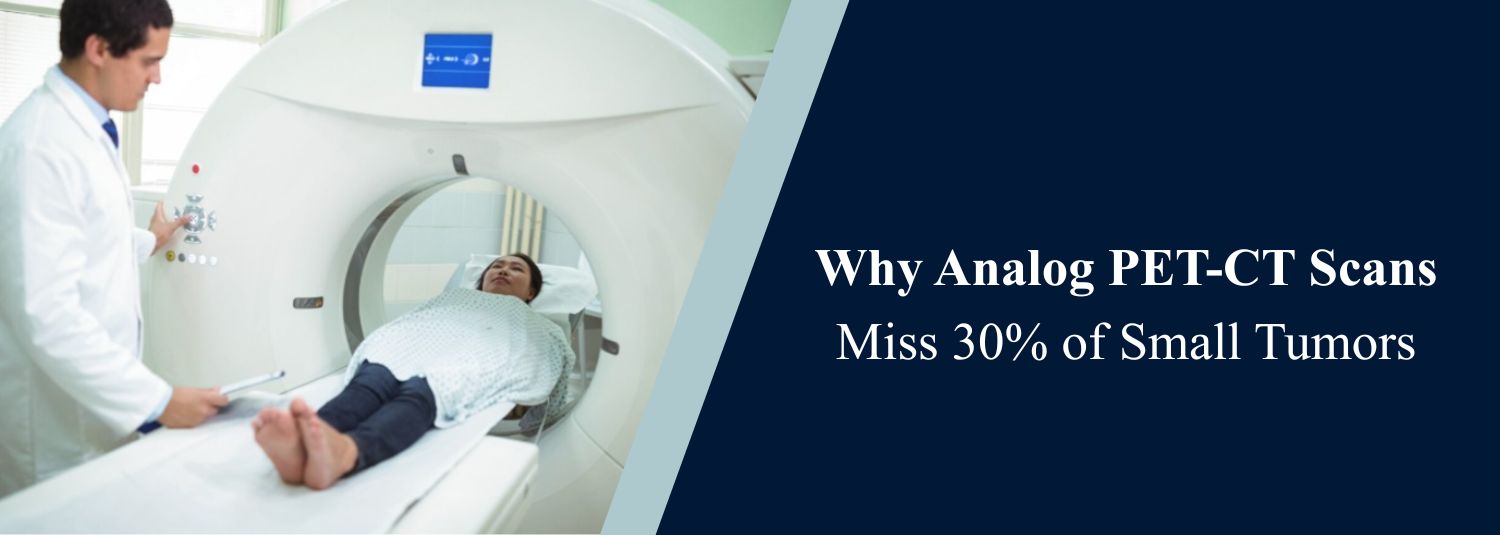
When doctors prescribe PET-CT scans as part of a diagnostic assessment, many patients go online to find out all the information. PET-CT scans are extensively used to assist in determining the functioning of organs and tissues, as well as in assisting in clinical decision-making. Not every PET-CT technology does it the same way, though. During the last few years, the issue has been asked as to why Analog PET-CT scans do not detect 30% of small tumors where one wants to accurately determine the state of the tumor. The knowledge of the functioning of the imaging technology can make patients feel better informed and ready to have a scan at the diagnostic centres like Molecular Diagnostics and Therapy.
What Is a PET-CT Scan?
A PET-CT scan is a diagnostic imaging examination that is a combination of two technologies:
PET (Positron Emission Tomography), which indicates metabolic activity within the body.
CT (Computed Tomography), which involves detailed structural images.
These images combined are useful to physicians to assess the functioning of tissues and organs. The diagnostic assessment with PET-CT scans can be performed in the oncology, cardiology, and neurology fields, according to the recommendations of the physicians. The scan also does not deliver a treatment or medical solution, but only creates imaging information to be evaluated.
Understanding Analog PET-CT Scans
Analog PET-CT scans use older detector technology to capture signals from the body. Although these types of systems have been in existence for many years, they might be limited in image resolution. This is among the major reasons why Analog PET-CT scans cannot notice 30% of the small tumors, and more so those that are very small or with low metabolism.
The signals in a continuous format are converted to analog systems, and these may lead to:
Lower sensitivity for tiny lesions
Reduced clarity in complex anatomical areas
Higher chances of subtle findings blending into background noise
These limitations are related to technology, not to patient factors or scan preparation.
When and Why PET-CT Scans Are Commonly Recommended
Physicians may recommend PET-CT scans for several diagnostic purposes, including:
General assessment of abnormal findings seen on other imaging tests
Monitoring changes in known conditions over time
Evaluating how certain organs are functioning
Supporting diagnostic planning
The choice between analog and newer systems depends on availability, referral patterns, and diagnostic requirements.
Step-by-Step PET-CT Scan Procedure
Before the Scan
Patients are usually given preparation instructions, which may include:
Fasting for a few hours before the scan
Avoiding strenuous physical activity
Informing staff about existing medical conditions
These steps help ensure proper image quality for diagnostic evaluation.
During the Scan
A small amount of radiotracer is administered
The patient rests while the tracer distributes in the body
The scan itself is painless and usually takes 20–30 minutes
After the Scan
Patients can generally resume normal activities
Images are processed and reviewed by qualified imaging specialists
Reports are shared with the referring physician
Safety, Accuracy, and Imaging Technology
PET-CT scans are designed to follow established radiation safety standards. Analog systems are considered safe for diagnostic use, but accuracy can vary depending on technology. This is where the concern arises that Analog PET-CT scans miss 30% of small tumors, as smaller abnormalities may not be clearly distinguished from normal tissue.
Analog vs Newer PET-CT Technology
This difference highlights how technology impacts image quality, not diagnostic intent.
Understanding PET-CT Reports
PET-CT reports describe observed patterns of tracer uptake and anatomical findings. These reports:
Use standardized imaging terminology
Do not confirm diagnosis or treatment outcomes
Are intended for physician interpretation
Patients are encouraged to discuss reports with their referring doctor, who can explain the findings in a clinical context.
Conclusion
Knowing about the imaging technology, the patient will be able to make sense of diagnostic processes without confusion or fear. Although technical constraints mean that Analog PET-CT scans cannot see small tumors (30%), this has not replaced diagnostic imaging. Other facilities, such as Molecular Diagnostics and Therapy, only focus on offering accurate imaging services based on laid-out protocols, which assist physicians with accurate diagnostic information. To get queries or scan information about the appointment, patients can call the centre on 92172 44110.
Frequently Asked Questions
In News
Get Our Mobile App
for Easy Access
Book tests, view reports, and manage your health records on the go. Experience convenient healthcare with Molecular Diagnostics and Therapy.
- ✔ Book tests & home collection
- ✔ View reports instantly
- ✔ Track health history
- ✔ Get notifications & reminders
- ✔ Easy appointment management