PET Scan vs CT Scan – Key Differences Patients Should Know
Talk to Health Expert

Dr. Nikunj Jain
Co-Founder and HOD - Nuclear Medicine ,MBBS, DRM, DNB, FEBNM, FANMB, Dip. CBNC
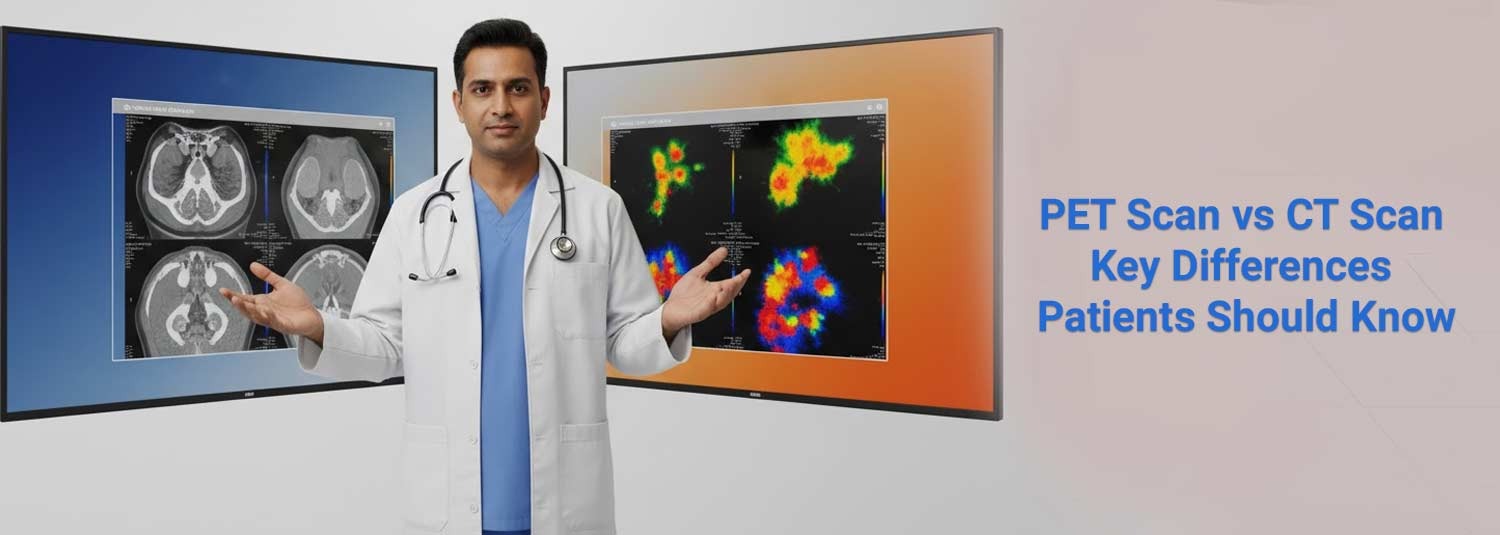
If your doctor has recommended a PET scan or a CT scan, you may be wondering: What’s the difference? Which one is better? Do I really need both? These are common questions, and the answers can help you feel more comfortable before your test.
Both PET (Positron Emission Tomography) and CT (Computed Tomography) scans are powerful medical imaging tools. While they sometimes get confused, they serve very different purposes: CT scans show structure, while PET scans show function. Let’s break it down in simple terms.
What Is a CT Scan?
A CT scan uses a series of X-rays to create detailed cross-sectional images of the body. Think of it as slicing a loaf of bread into thin pieces—you can see each slice clearly.
Common Uses of CT Scans:
- Detecting broken bones or fractures
- Diagnosing internal bleeding or injuries after accidents
- Spotting tumors, infections, or blood clots
- Examining organs like the lungs, liver, and kidneys
- Guiding biopsies or certain treatments
CT scans are quick, widely available, and excellent for seeing the structure of bones and organs.
What Is a PET Scan?
A PET scan (Positron Emission Tomography) works differently. It involves injecting a radioactive tracer (a small, safe amount of radioactive sugar) into your body. Since cancer cells and diseased tissues often use more energy, they absorb more of this tracer. The PET scanner then creates images showing areas of metabolic activity.
Common Uses of PET Scans:
- Cancer detection and checking if it has spread
- Monitoring cancer treatment progress
- Detecting heart problems, like reduced blood flow
- Evaluating brain disorders, including Alzheimer’s disease and epilepsy
- Finding hidden infections or inflammation
In short, PET scans are excellent for showing how tissues and organs are functioning, not just how they look.
PET Scan vs CT Scan: Key Differences
Here’s a side-by-side look at how they compare:
|
Feature |
CT Scan |
PET Scan |
|
Technology |
X-rays |
Radioactive tracer + scanner |
|
Shows |
Structure (bones, organs, tissues) |
Function (metabolism, activity) |
|
Best For |
Injuries, bone fractures, organ structure |
Cancer detection, brain/heart function |
|
Time Taken |
5–15 minutes |
30–60 minutes |
|
Radiation |
Low-to-moderate (X-rays) |
Low (radioactive tracer) |
|
Contrast/Tracer |
Sometimes contrast dye |
Radioactive sugar tracer |
PET-CT Scan: The Best of Both Worlds
In many hospitals, doctors combine the two into a PET-CT scan. This powerful test overlays both images—CT shows structure, PET shows function—giving doctors the most complete picture possible. For example, they can see exactly where a tumor is located and whether it’s active or growing.
Risks and Safety Considerations
Both scans are generally safe, but here are a few things to know:
- Radiation exposure: Both PET and CT use small amounts of radiation, but the benefits often outweigh the risks.
- Allergic reactions: Some people react to CT contrast dye, though it’s rare. PET tracers usually don’t cause allergic reactions.
- Pregnancy: Doctors avoid these scans during pregnancy unless absolutely necessary.
- Kidney health: Contrast dye in CT may not be safe for people with kidney problems.
Key Facts About PET and CT Scans
- PET was introduced in the 1950s; CT scanning became common in the 1970s.
- More than 80 million CT scans are performed every year worldwide.
- PET scans are highly accurate in detecting cancer spread and monitoring treatment.
- The World Health Organization (WHO) and National Cancer Institute (NCI) highlight PET-CT as a vital cancer diagnostic tool.
- The American College of Radiology (ACR) provides guidelines for both PET and CT scan safety.
- In many cases, PET-CT scans reduce the need for unnecessary surgeries.
FAQs About PET vs CT Scans
Which is better: PET scan or CT scan?
It depends—CT is better for bones and structure, PET is better for detecting active disease like cancer.
Do PET scans use radiation?
Yes, but the dose is low and generally considered safe.
How long does a PET scan take compared to a CT scan?
A PET scan takes 30–60 minutes, while a CT scan usually takes just 5–15 minutes.
Can PET and CT scans be done together?
Yes, many hospitals use PET-CT scans to combine both results.
Do PET scans hurt?
The only discomfort may be from the tracer injection; otherwise, it’s painless.
Why would a doctor order a PET scan instead of a CT scan?
If they need to see how a tumor, heart, or brain is functioning rather than just its structure.
Which scan is better for detecting cancer?
PET scans are more accurate for detecting active cancer cells, while CT shows the size and location.
Do I need to fast before a PET scan?
Yes, usually 4–6 hours before, since sugar can affect tracer results.
Are CT scans safe for kids?
Doctors try to limit CT scans in children, but they are safe when absolutely necessary.
How soon do you get PET or CT scan results?
A radiologist usually reviews the images and sends results to your doctor within 1–2 days.
Why These Scans Matter
Both PET and CT scans are cornerstones of modern medicine. They help detect disease earlier, guide treatment decisions, and improve survival rates—especially for cancer patients. Doctors often use them together to provide the most accurate diagnosis possible.
The Next Step: Pairing Imaging With Molecular Diagnostics
While imaging tests like PET and CT scans show where and how disease is happening, molecular diagnostic testing can reveal why it’s happening. By analyzing genes, proteins, and molecules, these tests can:
- Identify cancer types more precisely
- Personalize treatment plans
- Detect disease earlier at the molecular level
In News
Get Our Mobile App
for Easy Access
Book tests, view reports, and manage your health records on the go. Experience convenient healthcare with Molecular Diagnostics and Therapy.
- ✔ Book tests & home collection
- ✔ View reports instantly
- ✔ Track health history
- ✔ Get notifications & reminders
- ✔ Easy appointment management