CEMRI vs MRI Scan Understanding Contrast, Cost, Safety, and Report Accuracy
Talk to Health Expert

Dr. Nikunj Jain
Co-Founder and HOD - Nuclear Medicine ,MBBS, DRM, DNB, FEBNM, FANMB, Dip. CBNC
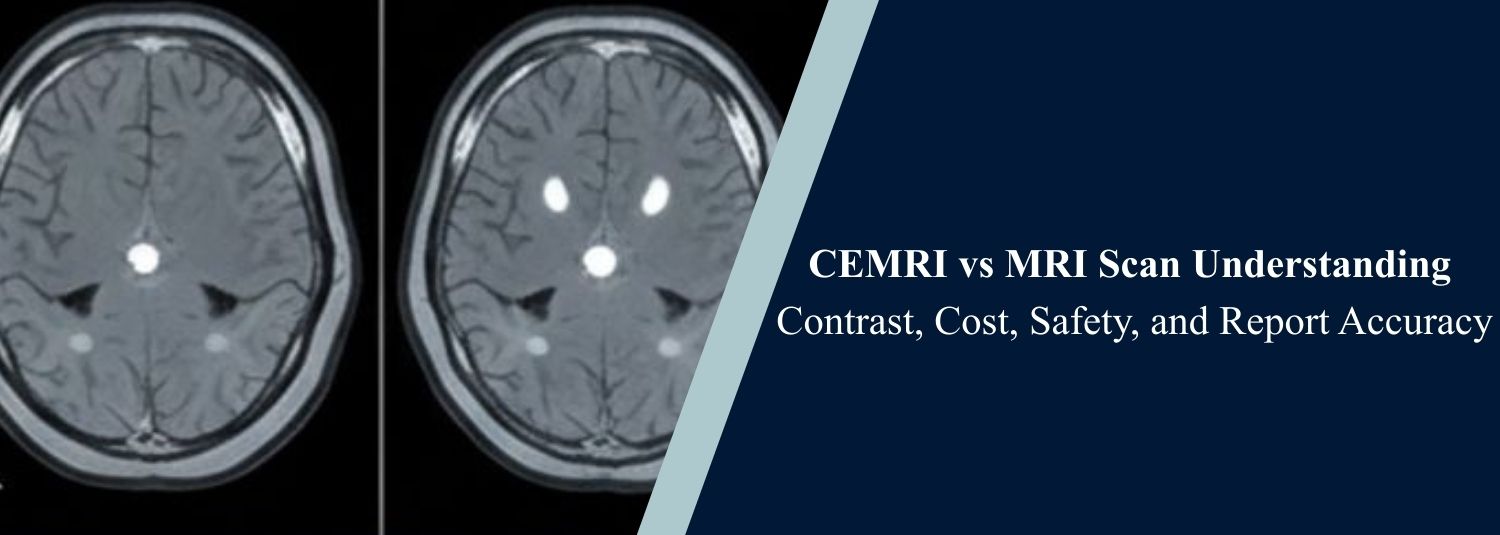
Patients usually come across two similar terms that have different meanings when advised by physicians to undergo advanced imaging, which include MRI scan and CEMRI. The question of which scan is superior, the safety of the contrast, and the accuracy of the reports are some of the questions that many people are confused by. This can be achieved by understanding the difference between CEMRI and MRI scans to ensure that patients are more relaxed and informed about the test before taking it. Molecular Diagnostics and Therapy also provides MRI and CEMRI scans, which are performed using advanced imaging systems with a strong focus on accuracy, safety, and patient comfort.
This blog is designed to help you understand CEMRI and MRI scans in a very easy and comfortable manner, so that you can know why a certain scan is recommended and what you expect from it.
What Is an MRI Scan?
The Magnetic Resonance Imaging scan, also known as an MRI scan, involves the application of radio waves and high magnetic fields to produce images of body organs, tissues, and bones in detail. It has no X-rays or radiations and thus it is an imaging modality of choice in a variety of conditions.
The brain, spine, joints, muscles, and internal organs are some of the areas that are commonly scanned with an MRI. They give precise structural information and assist physicians in identifying irregularities like swelling, tears, degeneration, or growths.
MRI scans are commonly advised for:
Brain and spine disorders
Joint and muscle injuries
Back pain and nerve compression
Soft tissue evaluation
Follow-up of known conditions
What Is a CEMRI Scan?
CEMRI stands for Contrast-Enhanced Magnetic Resonance Imaging. It is a magnetic resonance scan that is done with the help of a contrast agent, which is normally injected into a vein. The difference in colour makes the blood vessels and abnormal tissues prominent, and some conditions can be identified more easily.
CEMRI is particularly useful in situations where physicians require further clarity or more intricate analysis that cannot be rendered by a simple MRI. The contrast is used in order to distinguish between normal tissue and abnormal findings more precisely.
CEMRI is often recommended for:
Detection and evaluation of tumors
Brain lesions and infections
Breast imaging and cancer evaluation
Liver, kidney, and pelvic organ assessment
Post-surgical or treatment follow-up
Key Differences Between MRI and CEMRI
Both scans are useful, but it would be a matter of which medical question your doctor requires to be answered.
Contrast Use: Is It Really Necessary?
Not all MRIs need contrast. The diagnosis of the condition can be achieved in most cases by a simple MRI. But in cases where physicians require an evaluation of blood circulation, inflammation, tumor activity, or the effect of treatment, contrast is necessary.
Contrast agents used in CEMRI are generally safe and are eliminated from the body through urine. At Molecular Diagnostics and Therapy, contrast administration is done under strict protocols, with patient history and kidney function taken into consideration.
Cost Difference Between MRI and CEMRI
CEMRI scans are usually more expensive than normal MRI scans as they include contrast material, additional monitoring, and more detailed images. However, the increased price can usually lead to increased diagnostic clarity, thereby limiting the number of repeat scans or extra tests.
Doctors choose the scan that offers the best answer, but not necessarily the cost.
Safety Considerations for MRI and CEMRI
MRI and CEMRI scans are considered safe in most patients. MRI does not use radiation, and therefore makes it suitable for repeated use if required.
CEMRI can also be safe in case of proper screening. The diagnostic team should be notified in advance by patients who have kidney disease, are known to have contrast allergies, or have some implants. In Molecular Diagnostics and Therapy, patient safety checks are done before the scan.
Safety highlights include:
No radiation exposure
Careful screening before contrast use
Expert supervision during the procedure
Immediate assistance if needed
Accuracy of Reports: Why Expertise Matters
The accuracy of reports of MRI or CEMRI not only depends on the machine but also on the knowledge of the radiologist who interprets the images. Effective results require proper protocols, appropriate timing of contrast, and clinical correlation.
In the case of Molecular Diagnostics and Therapy, scans are read and interpreted by qualified radiology experts so that doctors are presented with clear, clinically helpful reports that they can use to make decisions.
How Doctors Decide Between MRI and CEMRI
Doctors consider several factors before recommending either MRI or CEMRI.
The decision is usually based on:
Nature of symptoms
Area of the body being examined
Need for detailed tissue evaluation
Previous scan findings
Medical history of the patient
If contrast is required for clarity, CEMRI becomes the preferred choice.
Why Choose Molecular Diagnostics and Therapy?
When it comes to the selection of a diagnostic centre, the selection of a scan is just as important as choosing a diagnostic centre. Molecular Diagnostics and Therapy provides high-quality MRI and CEMRI diagnostic imaging, procedures friendly to the patients, and good reporting.
Conclusion: Choosing the Right Scan for Accurate Diagnosis
MRI as well as CEMRI scans are significant in modern diagnosis. An MRI scan gives the best structural data, whereas a CEMRI scan gives better clarity to complex conditions. The right scan is that which will provide the answer to your doctor clearly. Molecular Diagnostics and Therapy guarantees high-quality MRI and CEMRI services that the patients can count on with advanced imaging, expert reporting, and patient-centered care. You can make a reservation and take a confident step towards the correct diagnosis and good health by calling 92172 44110 now.
Frequently Asked Questions
In News
Get Our Mobile App
for Easy Access
Book tests, view reports, and manage your health records on the go. Experience convenient healthcare with Molecular Diagnostics and Therapy.
- ✔ Book tests & home collection
- ✔ View reports instantly
- ✔ Track health history
- ✔ Get notifications & reminders
- ✔ Easy appointment management