PET Scan When Doctors Recommend It and How It Changes Treatment Decisions?
Talk to Health Expert

Dr. Nikunj Jain
Co-Founder and HOD - Nuclear Medicine ,MBBS, DRM, DNB, FEBNM, FANMB, Dip. CBNC
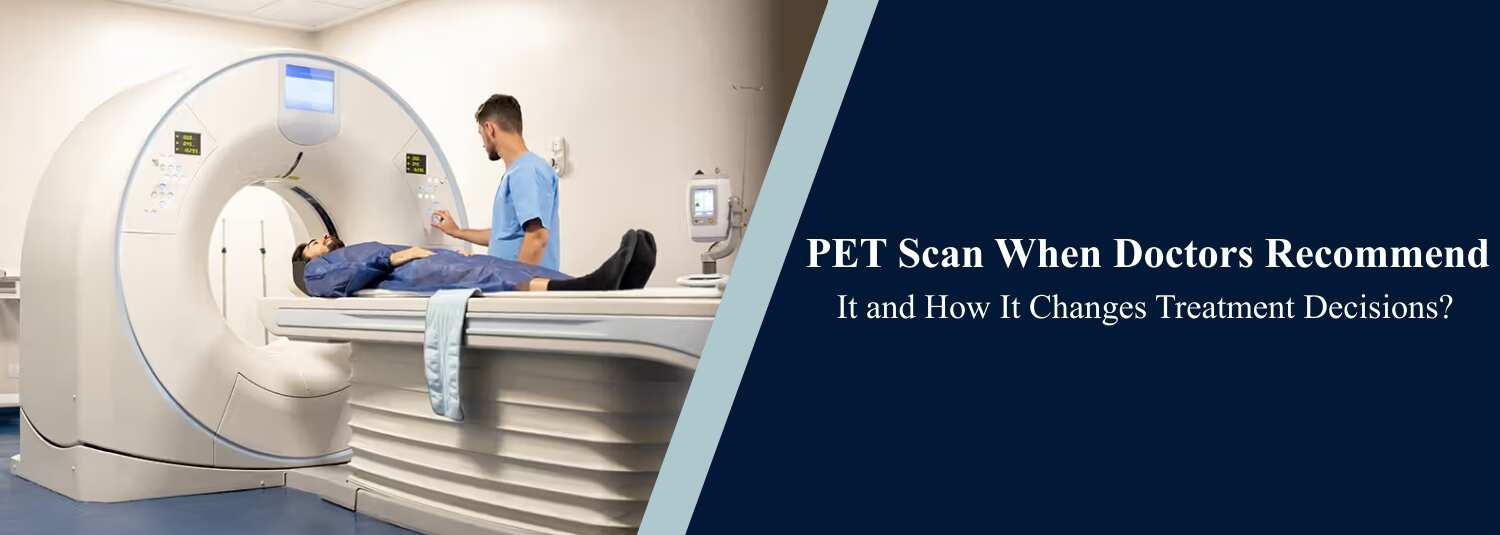
One of the most powerful tools of imaging nowadays is a PET scan. It enables the doctors to observe the functioning of organs and tissues within the body. The scans that are regularly done on a patient show primarily shape; however, the scans made via PET show the metabolic activity. This assists in the detection of disease at an earlier stage and in the process of decision-making regarding treatment.
At advanced centers like Molecular Diagnostics and Therapy, PET-CT technology is used to provide clear, accurate, and whole-body imaging for better diagnosis and care.
What Is a PET Scan?
PET stands for Positron Emission Tomography. It is a nuclear medicine imaging test, which involves a small amount of radioactive substance, typically FDG (Fluorodeoxyglucose). Most illnesses, particularly cancer, demand higher levels of glucose than normal tissues; they appear as bright dots on the scan.
A PET scan is often combined with CT (PET-CT). While CT shows the structure of organs, PET shows how active the cells are. Together, they provide both anatomical and functional information.
When Do Doctors Recommend a PET Scan?
Physicians recommend a PET scan in cases where they require detailed information that cannot be acquired by the use of ultrasound, CT, or MRI. There are some common scenarios which include:
1. Cancer Diagnosis
A PET scan is effective in detecting cancer and the activity of the tumor. They are widely applied to lung, breast, colon, and lymphoma, among other cancers.
2. Cancer Staging
Staging involves the determination of whether the cancer has spread or not to the lymph nodes or other body organs. Even metastases that are small are detected on a PET scan, which helps doctors make the appropriate decision on their choice of treatment.
3. Monitoring Treatment Response
PET scans show if there is a reduction of tumor activity after the removal of the tumor (chemo, radiation, or surgery). In case the scan reveals no active disease, it is an indication that the treatment is effective.
4. Detecting Recurrence
In case the symptoms of the cancer recur, a PET scan can be used to test whether the disease has reoccurred.
5. Heart and Brain Disorders
In other cases, PET scans are a scan that considers the functionality of the heart muscle and blood flow. They are also applicable in some brain diseases in the research of brain metabolism.
How do PET Scans Change Treatment Decisions?
One of the major benefits of PET imaging lies in the fact that it has a direct influence on the way treatment is planned.
More Accurate Staging
Sometimes CT scans show a tumor only in one location. However, a PET scan may reveal spread to distant organs. Other times, a CT scan may only reveal a tumor in one location. However, a PET scan can show spread to other distant organs. In such cases, surgery alone may not be enough, and doctors may recommend chemotherapy or targeted therapy instead.
Avoiding Unnecessary Procedures
In case a suspicious mass appears inactive on a PET scan, doctors can eliminate unnecessary surgery or biopsy.
Personalizing Therapy
The use of PET scans assists physicians in selecting the optimal treatment depending on how active the tumor in the human body is. As an example, a more intense treatment can be required in case a tumor demonstrates a great level of metabolism.
Early Change in Treatment Plan
In case of non-response of the tumor, the treatment plan can be reduced within a shorter duration of time since the doctor can view the scan via PET. This prevents the delays and enhances results.
PET Scan vs Other Imaging Tests
This comparison explains why PET scanning is especially valuable in oncology and complex diseases.
What to Expect During the Procedure?
A PET scan is not complicated and most of the time painless. Tracer is injected into a vein in minute amounts. Once the tracer gets distributed throughout your body, it will take 45 to 60 minutes. After this, you will be on a scanning table, and the machine will capture pictures of you. The entire duration of the process is approximately 2-3 hours. The majority of individuals can resume normal activity on the same day.
Is a PET Scan Safe?
Yes, PET scans are safe. Radiation dose is regulated and within the medical safety limit. Side effects are rare. However, first-time mothers who are pregnant or lactating should inform their physician. The doctor prescribes the use of a PET scan at the point where the advantages surpass the dangers.
Key Benefits of PET Scan
PET imaging offers several important advantages:
Early disease detection
Accurate staging of cancer
Whole-body imaging in one session
Better treatment planning
Quick evaluation of therapy effectiveness
Because it studies cellular metabolism, PET scans often detect disease before structural damage becomes visible.
Conclusion
A PET scan is not merely a test, but it also helps the doctors in making treatment decisions. It allows the doctors to select the most appropriate treatment by demonstrating the intensity of the disease and its transmission status. PET imaging is a significant component of present-day medicine, as it helps detect cancer at an early stage and determine whether the treatment is effective or not.
At Molecular Diagnostics and Therapy, new PET-CT technology provides excellent diagnosis and enables patients to receive personalised care based on their requirements and on time.
Frequently Asked Questions
In News
Get Our Mobile App
for Easy Access
Book tests, view reports, and manage your health records on the go. Experience convenient healthcare with Molecular Diagnostics and Therapy.
- ✔ Book tests & home collection
- ✔ View reports instantly
- ✔ Track health history
- ✔ Get notifications & reminders
- ✔ Easy appointment management