When Is CEMRI Recommended Over MRI? Doctor-Guided Explanation
Talk to Health Expert

Dr. Nikunj Jain
Co-Founder and HOD - Nuclear Medicine ,MBBS, DRM, DNB, FEBNM, FANMB, Dip. CBNC
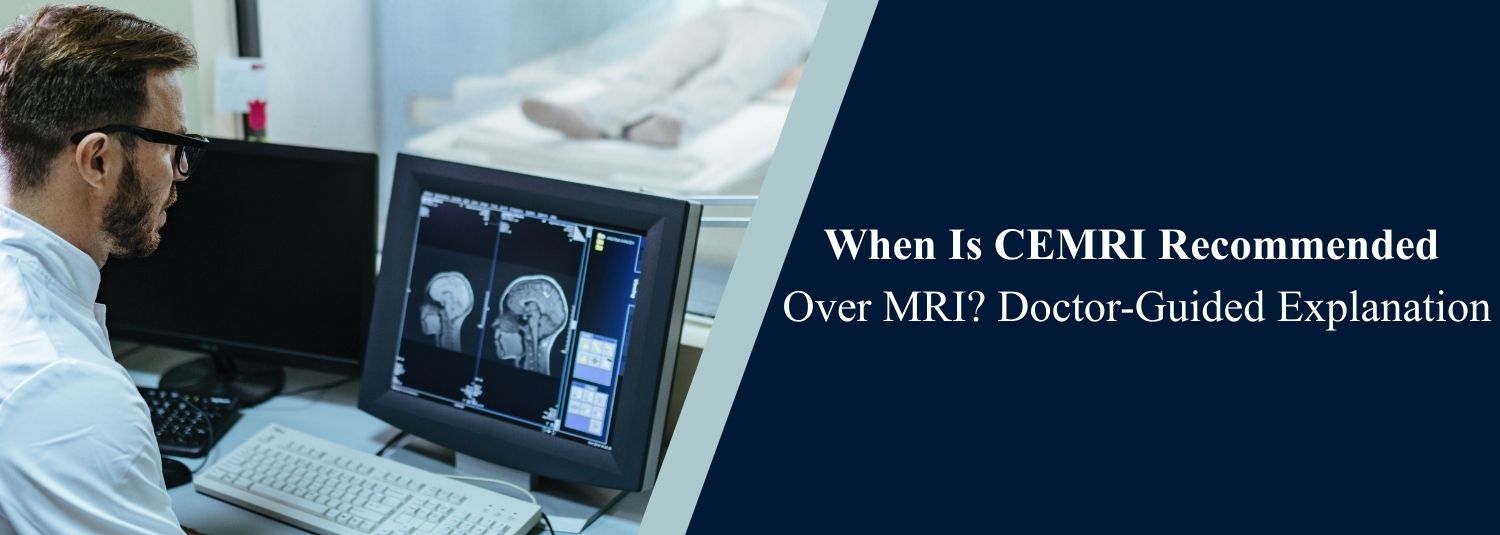
Magnetic Resonance Imaging, commonly known as an MRI scan, is one of the most advanced diagnostic tools in the world of modern medicine. It is used to assess soft tissues, organs, and internal structures of the body in a patient. But in some specific situations, doctors may recommend that you get a CEMRI test done, which is known as Contrast-Enhanced MRI instead of a regular MRI to get more detailed and accurate results.
As a patient, you should understand when CEMRI is recommended over a regular MRI because it can help you to feel confident and know what’s the reason for your doctor’s such decision. Molecular Diagnostics and Therapy provides both MRI and CEMRI using modern imaging technologies in an effort to help doctors to make accurate diagnoses and ensure patient safety.
What Is the Difference Between MRI and CEMRI?
A normal MRI involves the use of magnetic fields and radio waves to provide clear images of the internal body parts. It offers a lot of detail about the anatomy and can be used in regular check-ups, such as testing joint injuries, spine, or brain problems
Before or during the CEMRI, a contrast agent, typically gadolinium, is injected into the body through a vein. The contrast highlights tissues, blood vessels, and any abnormal conditions in the images. Simply put, MRI displays structure, whereas CEMRI displays issues in a more prominent way.
When Do Doctors Prefer CEMRI?
Not all people are recommended to get a CEMRI scan. When the ordinary MRI lacks clarity, or the doctor requires finer details of the tissues, it is normally recommended to be done. In the following cases, doctors can prefer CEMRI:
1. Cancer Detection and Staging
CEMRI helps in the identification of tumors more clearly, as it provides their precise size and examines the possibility of spreading to the surrounding tissues or blood vessels. It plays a role in diagnosing and treatment planning of cancer.
2. Brain and Spinal Disorders
In the case of a brain tumor, infection, inflammation, or multiple sclerosis, CEMRI provides superior visibility that cannot be seen in a simple MRI.
3. Post-Surgical Evaluation
Contrast is used to differentiate scar tissue and recurring disease, particularly in cancer follow-ups post-surgery.
4. Vascular and Blood Flow Assessment
CEMRI has the ability to highlight blood vessels and identify issues such as aneurysms, malformations, or blocked vessels.
5. Liver and Abdominal Lesions
Contrast is used to differentiate between benign cysts and cancerous tumors in the liver and other body organs.
When Is a Plain MRI Sufficient?
A large number of routine cases require a regular MRI only. These include:
Simple back pain or disc issues
Routine joint injuries
Muscle tears
Basic headache evaluation
Stable follow-up scans
Physicians do not want to use additional contrast on a patient unless it can be of diagnostic benefit.
How is the CEMRI Procedure Performed?
It is likewise the CEMRI process, which is similar to a normal MRI, along with a minor injection of contrast dye into a vein in your arm. The test is:
Painless
Non-invasive
Radiation-free
Usually completed within 30–60 minutes
Most patients tolerate the contrast injection well, and side effects are rare.
Is CEMRI Safe?
CEMRI is generally safe when performed under medical supervision. Modern contrast agents are designed to be well-tolerated. However, patients with severe kidney disease, known contrast allergies, or pregnancy should inform their doctor before undergoing the test.
At Molecular Diagnostics and Therapy, careful screening is conducted before administering contrast to ensure patient safety.
Advantages of CEMRI Over MRI
Under particular circumstances, CEMRI has the following advantages to present:
Improved detection of small tumors
Better differentiation between benign and malignant lesions
Enhanced evaluation of inflammation and infection
More accurate surgical planning
Reduced need for repeat imaging
These advantages make doctors use CEMRI when they need to have precise diagnostic information.
Final Thoughts
The most common conditions can be evaluated using a standard MRI; however, CEMRI is needed in case more precise images are required to make a reliable diagnosis and develop a treatment plan. Clinical needs and medical history of the patient are used to determine the decision of MRI or CEMRI.
Molecular Diagnostics and Therapy has trained radiologists who specialize in taking care of each case and advise on the appropriate method of imaging, proper diagnosis, safety of the patient, and their care outcomes.
Frequently Asked Questions
In News
Get Our Mobile App
for Easy Access
Book tests, view reports, and manage your health records on the go. Experience convenient healthcare with Molecular Diagnostics and Therapy.
- ✔ Book tests & home collection
- ✔ View reports instantly
- ✔ Track health history
- ✔ Get notifications & reminders
- ✔ Easy appointment management