
Brain Tumor: Causes, Symptoms, Types & Tests
Talk to Health Expert

Dr. Nikunj Jain
Co-Founder and HOD - Nuclear Medicine ,MBBS, DRM, DNB, FEBNM, FANMB, Dip. CBNC
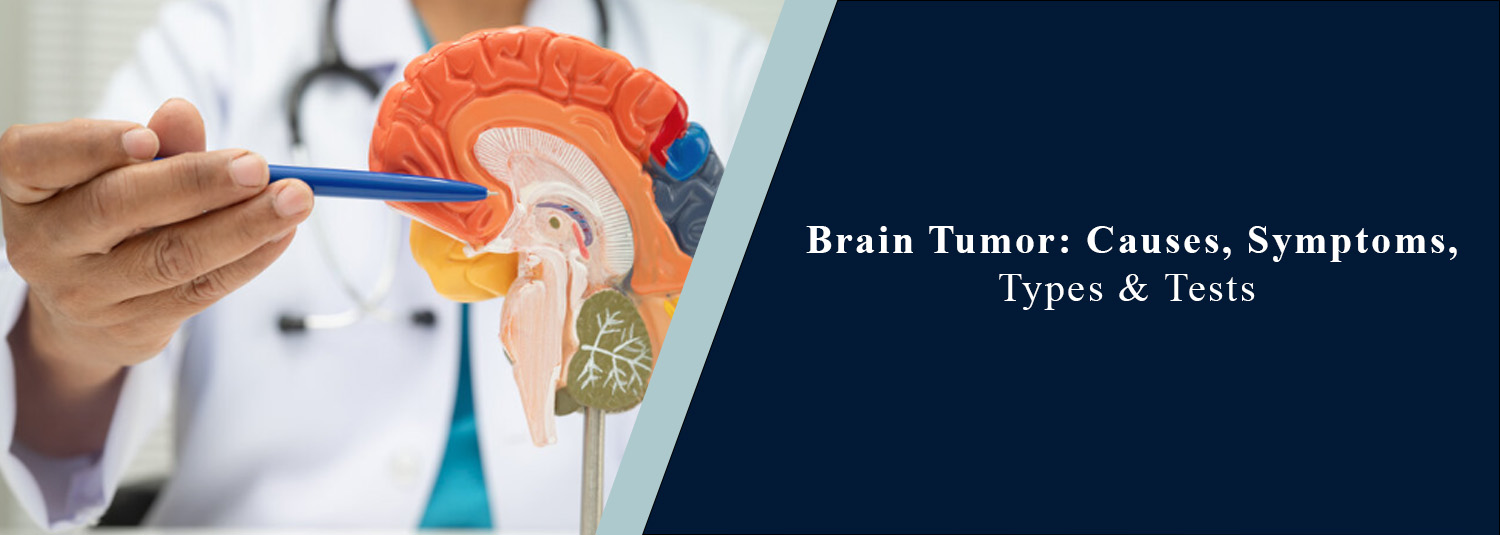
A brain tumor is abnormal cell growth
in and around the brain. Brain tumors are non-cancerous (benign) or cancerous
(malignant). Unfortunately, they also begin in the brain (primary) or occur
because cancer has spread to the brain from another location
(secondary/metastatic). Brain tumor symptoms and side effects also differ
depending on the brain tumor location, size, and type. Other health conditions
also cause some of these symptoms, so although someone has a headache or
another neurological symptom, it does not mean that they have a brain tumour.
It is important to evaluate the patient medically, especially if symptoms
persist, are unusual, or are worsening.
What Is a Brain
Tumor?
A brain tumour consists of an abnormal
mass of tissue that develops in or on the brain. A tumour invades healthy brain
tissue adjacent to the tumour, swells, or exerts pressure within the skull.
Brain tumors are tumours are either benign or malignant. Although benign tumors
do not have cancer cells in them, when they press on an important brain area,
they cause problems. Malignant tumors may grow faster and invade neighbouring
tissues. Brain tumors are also classified based on the position in which they
are located and the cells and/or tissue in which they originate. Some tumors
start out in the brain, and others in other parts of the body migrate to the
brain.
Brain Tumor Causes
Although we know much more about the
causes of most brain tumors, we do not yet know the exact cause. Some tumours
appear to be caused by genetic and environmental factors. A few genetic
disorders passed down in families make it more likely that brain and central
nervous system tumors form. Radiation therapy, especially during childhood, and
other chemotherapy treatments also have been associated with a small number of
brain tumors.
Most people with a brain tumor,
however, have no specific cause. Also keep in mind that most symptoms, such as
headaches that occur in the day-to-day life of a healthy child, are not related
to a brain tumor. Additional tests are recommended by a doctor if there are
signs or symptoms that an imaging test or other evaluation is required.
Brain Tumor Symptoms
The signs and symptoms of brain tumors
vary from one person to another. This is due in part to the fact that there are
distinct parts of the brain that control distinct functions. The symptoms thus
vary depending on the size and location of a tumor. Typical symptoms of a brain
tumour include headaches that don't go away or are unusual, nausea, vomiting,
seizures, changing vision or hearing, problems with memory and changes in
personality or behaviour.
Other symptoms include difficulty with
concentration, balance, walking, speech or movement. If a person has just a
headache, that doesn't necessarily indicate a brain tumor. If headaches are
new, occurring more often, or becoming worse, however, seeking medical advice
is recommended if the headaches are accompanied by other symptoms such as
seizures, weakness, vision changes, confusion, or problems with balance.
Types of Brain Tumors
There are many different brain tumor
types. They are categorized by the cells or tissues that they form from; by
where they grow and whether they are benign (harmless) or malignant (cancer).
Gliomas, meningiomas, and pituitary tumors are among the most frequently
mentioned types of brain tumors. Others include schwannomas and ependymal
tumors. There are several types (subtypes) of gliomas, including astrocytic
tumors and oligodendroglial tumors.
Brain tumors are also said to be
primary or metastatic. Primary brain tumors are those that develop in brain
tissue or the tissues surrounding the brain, while metastatic brain tumors
develop when cancer that started in other parts of the body moves to the brain.
Some tumours are given a grade that is based on the rate at which their cells
grow and on microscopic and molecular features. This helps physicians to better
understand the tumor and provide proper treatment.
Brain Tumor Tests
If a brain tumor is suspected, a
physical examination, a neurological examination, and a medical history start
the examination. Neurological tests evaluate functions like coordination,
movement, reflexes, balance, hearing, and vision. Imaging plays an important
role in the evaluation of brain tumors. The physician suggests an MRI or CT
scan, depending on the clinical findings and symptoms.
Brain MRI for Tumor
Detection
A brain MRI uses a strong magnetic
field, radio waves, and a computer to produce detailed images of the brain. MRI
is an important test for suspected brain tumors because it does not involve
ionizing radiation and gives detailed images of all soft tissues. Brain MRI is
carried out with or without contrast, depending on what the doctor wants to
assess. Imaging also shows extra details of an abnormality and its
surrounding structures. MRI also tracks a brain tumor over time to measure
changes in the tumor when being treated and to determine the outcome of
treatment.
Conclusion
Brain tumors are not always malignant
and occur in various locations of the brain. Symptoms are dependent on the
size, location, and type of tumor. Symptoms vary from person to person:
headaches, seizures, nausea, vomiting, vision changes, hearing impairment,
memory loss, and behaviour irregularities. If a brain tumor is suspected,
further tests are ordered, including neurological exams, an MRI, and a CT scan
(possibly other tests, depending on the individual).
Sometimes further tests or a biopsy are
required to identify what an abnormality is in some cases.
In case of any neurotypical symptoms, whether they are persistent or not, please don't make your own diagnosis, but consult someone else whom you know and trust to answer your questions. Support such as evaluation and imaging are used to uncover the underlying cause, if the cause is to be determined, and to plan the next steps.
Frequently Asked Questions
In News
Get Our Mobile App
for Easy Access
Book tests, view reports, and manage your health records on the go. Experience convenient healthcare with Molecular Diagnostics and Therapy.
- ✔ Book tests & home collection
- ✔ View reports instantly
- ✔ Track health history
- ✔ Get notifications & reminders
- ✔ Easy appointment management
