DOTA Test: Definition, Procedure, Uses, and Benefits
Talk to Health Expert

Dr. Nikunj Jain
Co-Founder and HOD - Nuclear Medicine ,MBBS, DRM, DNB, FEBNM, FANMB, Dip. CBNC
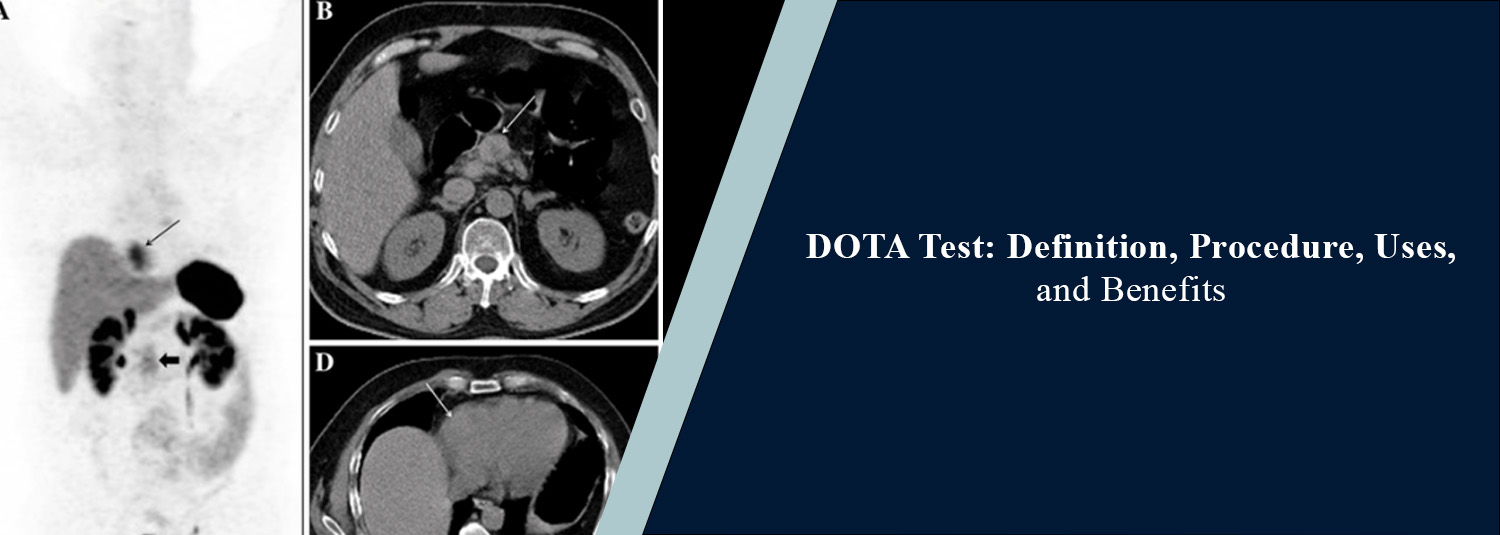
In most cases, the DOTA test is a
PET/CT scan in which the imaging component is a DOTA-based somatostatin
receptor scan (most often Ga-68 DOTATATE PET/CT). It can be especially useful
in assessing certain neuroendocrine tumors because some of these tumors have
somatostatin receptors that can be bound by the radiotracer. The scan can point
to the location of tumors, their spread, and whether specific receptor-targeted
therapies might apply to the treatment. Molecular Diagnostics and Therapy
provides skilled diagnostic evaluation and treatment with the appropriate
laboratory and diagnostic service options which complement imaging-based
evaluation.
What Is a DOTA Test?
A nuclear medicine imaging examination
that uses a radioactive tracer (such as Ga-68 DOTATATE) to detect cells that
express somatostatin receptors. Gallium-68 DOTATATE (Ga-68 DOTATATE) is one
tracer that is often used. Once given, the tracer locks onto somatostatin
receptors on specific cells. The tracer is then picked up by a PET scanner that
generates detailed images of the regions where the tracer has been deposited.
The type of tracer and imaging procedures may differ from one medical
indication to another and depending on availability.
Why Is a DOTA Scan
Performed?
DOTA-based PET/CT imaging is commonly
used to evaluate neuroendocrine tumors (NETs). It can aid the medical
professional in identifying the site of a tumor as well as in confirming its
expansion to other parts of the body.
- Locating
a suspected neuroendocrine tumor
- Assessing the extent or spread of a known
tumor
- Looking for recurrent or metastatic disease
- Evaluating somatostatin receptor expression
- Supporting treatment planning in selected
patients
The scan is not appropriate for every type of cancer, and its usefulness
depends on the biological characteristics of the suspected or known tumor.
How Is the DOTA
Procedure Performed?
The health care team will give
instructions on how to prepare for the scan. The following directions may be
different according to the tracer and the protocol of the facility.
The radiotracer is given, typically by
injection into a vein, during the procedure. A waiting period is allowed for
the tracer to be distributed throughout the body and to the relevant receptors.
PET is also performed, usually in
combination with an examination of the CT image, on the patient. The
radiotracer is detected by the PET component, while anatomical information is
provided by the CT component. The images can be used jointly to help health
professionals determine the location and distribution of areas of tracer
uptake. The entire appointment can take a few hours, depending on whether there
is any preparation before the tracer is administered, how long after the tracer
is taken to set up the scan, how long it takes to take the scan, and what scans
would occur after, such as waiting.
What Can a DOTA Scan
Detect?
Increased somatostatin receptor
expression can be found with a DOTA-based PET/CT scan. This is especially
helpful for many well-differentiated neuroendocrine tumors. Sometimes the scan
can be used to help determine whether there is any disease elsewhere in the
body, in the bones, liver or lymph nodes, or in the primary tumour. Not all
tumours, however, have equally abundant somatostatin receptors, and a negative
or low uptake does not rule out all neuroendocrine tumours. Always look at the
results in conjunction with the clinical examination and pathological results
and other investigations.
Benefits of DOTA
PET/CT
A major advantage of DOTA imaging is
data obtained regarding the entire body of somatostatin receptor-active
disease. This can help medical professionals to have a clearer idea about how a
tumor spreads. It might also give information that could be useful for
treatment planning. A somatostatin receptor-tracer with high uptake, in
selected patients, can be used to assess the potential for receptor-specific
radionuclide therapy. The other benefit is that PET/CT brings functional data
obtained from PET, with anatomical data from CT, so that findings can be better
localized.
Is the DOTA Test
Safe?
Exposing the patient to a relatively
low amount of radiation from the radiotracer, and if a CT is performed, from
the CT component as well, DOTA PET/CT exposes the patient to a small amount of
radiation. Weighing the pros and cons, the healthcare team decides to recommend
the examination for the patient. Patients should let their healthcare team know
about any pregnancy or if they might be pregnant, as well as if they are
breastfeeding. The imaging center should give specific instructions regarding
medications, hydration, and any other instructions to follow for preparation.
What Happens After
the Scan?
For the majority of patients, once the
scanning has been done, they may be able to resume their normal daily
activities unless they are advised otherwise by their medical staff. Over time,
this radiotracer is naturally excreted from the body, mostly in the urine. The
interpreting specialist looks at pictures and writes a report to give to the
health-care professional. These findings are then correlated with the symptoms,
pathology, laboratory findings, and other imaging tests.
DOTA Scan and Other
Diagnostic Tests
A DOTA scan is a part of a
comprehensive evaluation. Further tests may be done based on the suspected
disease, and they could include blood tests, pathology, conventional imaging,
molecular testing, and others. For instance, tissue pathology can assist in
establishing the tumor type, and molecular investigations can be performed to
yield information on specific biological features where clinically applicable.
Conclusion
The DOTA test can be very important in helping diagnose many neuroendocrine tumors (NETs), and DOTA imaging (such as Ga-68 DOTATATE imaging) can be used as part of a PET scan. It may be useful for identifying somatostatin-receptor-positive disease, determining the distribution of the disease in selected patients, monitoring these patients, and may have a role in planning the approach to treatment. Several factors such as diagnosis, symptoms, tumor properties, and clinical needs determine the need for a DOTA scan. Interpretation of the results must be made by qualified health care professionals in the context of a comprehensive diagnostic work-up. To implement this comprehensive approach, Molecular Diagnostics and Therapy provides suitable laboratory or molecular diagnostics services.
Frequently Asked Questions
In News
Get Our Mobile App
for Easy Access
Book tests, view reports, and manage your health records on the go. Experience convenient healthcare with Molecular Diagnostics and Therapy.
- ✔ Book tests & home collection
- ✔ View reports instantly
- ✔ Track health history
- ✔ Get notifications & reminders
- ✔ Easy appointment management