MRI and CT Scan: Overview, Uses, & Difference
Talk to Health Expert

Dr. Nikunj Jain
Co-Founder and HOD - Nuclear Medicine ,MBBS, DRM, DNB, FEBNM, FANMB, Dip. CBNC
MRI scans and CT scans are two of the
most frequently used exams doctors use to take an inside look at the body and
assess a variety of health-related issues. Both produce detailed images of the
body's interior, but they work differently and are used for different medical
applications. Being informed about MRI vs. CT can assist patients in
understanding their reason for being advised to have a certain scan.
In Molecular Diagnostics and Therapy,
the advanced diagnostic imaging services enable doctors to assess various
conditions and monitor them over a period of time. In some situations, MRI can
be used instead of CT, and in others CT is the better choice. Your doctor will
decide which is right for you.
What Is an MRI Scan?
MRI is Magnetic resonance imaging. It
relies on a powerful magnetic field, radio waves, and a computer to create
detailed images of organs, tissues, and other structures within the body. MRIs
do not involve any ionizing radiation. MRI is especially good at showing soft
tissues. MRI can offer information on the brain, spine, joints, bones, muscles,
ligaments, organs, blood vessels, and soft-tissue parts in detail.
What Is a CT Scan?
CT = Computed Tomography. A CT scan
involves taking a lot of pictures of the body using X-rays and a computer to
form cross-sectional pictures. These images can also be used to generate
various planes and 3-D images. CT can give detailed information about bones,
organs, blood vessels, soft tissues, and other internal structures. Also, it's
known for its quickness, especially helpful when physicians need information
quickly, in an emergency, for instance.
How Does MRI Work?
In an MRI, the patient's body sits on a
table that can move inside the scanner. The magnetic field and radio waves
cause hydrogen atoms in body tissue to give off signals, which a computer turns
into images. MRI exams are often more time-consuming than CT scans, and the
patient must almost always be still during the exam. This scanner might tap or
knock noisily; hearing protection is generally given.
How Does a CT Scan
Work?
A computed tomography (CT) scan is
performed by lying a patient on a table that passes through a ring-shaped
scanner. An X-ray tube spins around the patient, capturing X-rays from various
sides. These images are then fed into a computer to provide fine, detailed
cross-sectional images. One of the biggest advantages of CT scanners is their
ability to obtain images in a very short amount of time.
MRI Scan Uses
MRI may be recommended when detailed information about soft tissues is
needed. Common uses include evaluation of:
- Brain
and spinal conditions
- Joint and muscle problems
- Ligament and tendon injuries
- Certain tumors
- Abdominal and pelvic conditions
- Liver and other organ abnormalities
- Blood vessels and certain heart conditions
MRI can also be useful for monitoring some conditions and assessing
changes over time.
CT Scan Uses
CT can be useful for a wide range of conditions, including:
- Bone
injuries and fractures
- Head injuries
- Internal bleeding
- Lung and chest conditions
- Abdominal problems
- Certain cancers
- Blood vessel conditions
- Evaluation of injuries after accidents
Because CT is fast, it is often valuable in emergency settings,
especially when doctors need to quickly assess injuries or internal bleeding.
MRI vs CT Scan: What
Is the Difference?
The main differences are the technology
used (magnets vs X-rays), radiation exposure, scan time, and which tissues each
shows best. MRI employs magnets to create images, and CT uses radiation. MRI
uses a magnetic field and radio waves, and CT uses X-rays. MRI uses no ionizing
radiation, while CT uses a small dose of X-ray radiation. MRI will not expose
you to radiation, while CT will. When detailed soft-tissue information is
important, MRI is often recommended. In cases that require an immediate
assessment of injuries or bone detail, CT is often the imaging test of choice.
Neither test is better in every case. The right scan depends on what your
doctor needs to see. Depending on the doctor's question, the type of scan is
the most appropriate.
MRI vs CT Scan for
the Brain
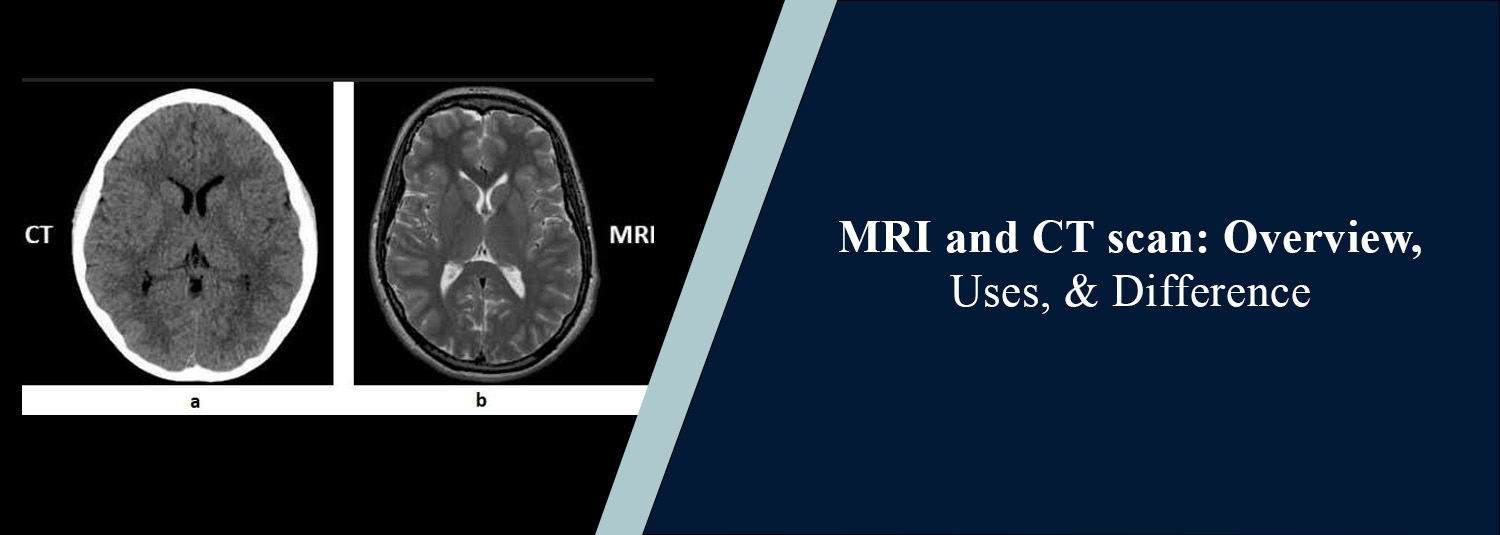
The brain can be scanned using either
MRI or CT, with each scan type offering a unique kind of information. CT is
often useful if a speedy assessment is required, for example, if there is a
suspected head injury or bleeding. MRI can give more detailed pictures of brain
tissues, and might be helpful for examining several diseases of the brain and
nerves. It will depend upon the doctor's diagnosis, the urgency of the situation,
and the symptoms.
MRI vs CT Scan Safety
Although MRI does not involve any
X-rays or any other types of radiation, the powerful magnetic field restricts
use for Patients with pacemakers, cochlear implants, certain metal implants, or
metal fragments may not be able to have an MRI or may need special precautions.
Tell your technician about any implants. CT uses X-rays, so it involves
radiation exposure. It varies according to the type of CT and the body part to
be scanned. Because CT involves radiation, it should be used when the benefit
outweighs the risk. Contrast dye is sometimes needed for some MRI or CT scans.
Contrast is usually not used unless needed for the particular exam and
situation.
MRI vs CT Scan Cost
Many of these factors can affect the
cost of an MRI or CT scan, such as which area of the body is the focus of the
scan, the presence or absence of contrast, and the type of scan performed, as
well as the diagnostic centre. So, a single set price for MRI vs. CT scan is
not possible. Patients have to find out the cost of the particular test that
their physician suggests.
Conclusion
MRI and CT are two important forms of
diagnostic imaging that are different in nature, and their information differs
as well. MRI relies on magnetic fields and radio waves, involves no radiation,
and plays an important role in numerous soft tissue studies. CT (computed
tomography) is a technique that uses X-rays and is particularly useful in cases
where there is a need for rapid imaging, bone detail, and/or emergency assessment.
The appropriate selection relies upon the patient's factors and clinical queries being addressed. Molecular Diagnostics and Therapy provides cutting-edge imaging diagnostics for a timely assessment and surveillance of different disease states.
Frequently Asked Questions
In News
Get Our Mobile App
for Easy Access
Book tests, view reports, and manage your health records on the go. Experience convenient healthcare with Molecular Diagnostics and Therapy.
- ✔ Book tests & home collection
- ✔ View reports instantly
- ✔ Track health history
- ✔ Get notifications & reminders
- ✔ Easy appointment management